[no title] Scripting News(cached at July 27, 2025, 10:33 pm)

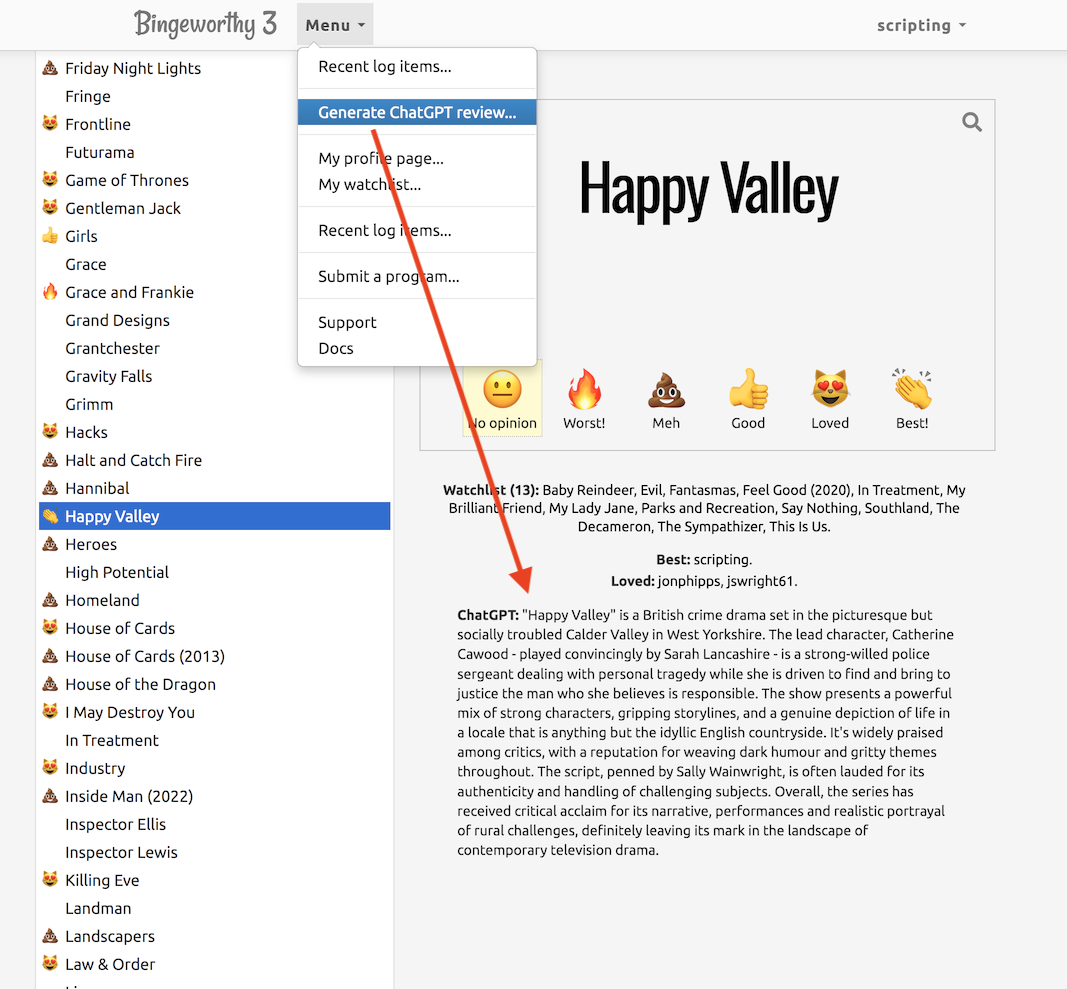
One of my favorite features in the newest version of Bingeworthy is that it can generate a ChatGPT review of a program. Screen shot. I wouldn't have opened this up before because of that would let in the weirdness of the internets. This way we can find out what people thought, as sanitized by ChatGPT.
VPN Downloads Surge in UK as New Age-Verification Rules Take Effect Slashdotby EditorDavid on uk at January 1, 1970, 1:00 am (cached at July 27, 2025, 10:05 pm)

Proton VPN reported a 1,400 percent hourly increase in signups over its baseline Friday — the day the UK's age verification law went into effect. For UK users, "apps with explicit content must now verify visitors' ages via methods such as facial recognition and banking info," notes Mashable: Proton VPN previously documented a 1,000 percent surge in new subscribers in June after Pornhub left France, its second-biggest market, amid the enactment of an age verification law there... A Proton VPN spokesperson told Mashable that it saw an increase in new subscribers right away at midnight Friday, then again at 9 a.m. BST. The company anticipates further surges over the weekend, they added. "This clearly shows that adults are concerned about the impact universal age verification laws will have on their privacy," the spokesperson said... Search interest for the term "Proton VPN" also saw a seven-day spike in the UK around 2 a.m. BST Friday, according to a Google Trends chart. The Financial Times notes that VPN apps "made up half of the top 10 most popular free apps on the UK's App Store for iOS this weekend, according to Apple's rankings." Proton VPN leapfrogged ChatGPT to become the top free app in the UK, according to Apple's daily App Store charts, with similar services from developers Super Unlimited and Nord Security also rising over the weekend... Data from Google Trends also shows a significant increase in search queries for VPNs in the UK this weekend, with up to 10 times more people looking for VPNs at peak times... "This is what happens when people who haven't got a clue about technology pass legislation," Anthony Rose, a UK-based tech entrepreneur who helped to create BBC iPlayer, the corporation's streaming service, said in a social media post. Rose said it took "less than five minutes to install a VPN" and that British people had become familiar with using them to access the iPlayer outside the UK. "That's the beauty of VPNs. You can be anywhere you like, and anytime a government comes up with stupid legislation like this, you just turn on your VPN and outwit them," he added... Online platforms found in breach of the new UK rules face penalties of up to £18mn or 10 per ent of global turnover, whichever is greater... However, opposition to the new rules has grown in recent days. A petition submitted through the UK parliament website demanding that the Online Safety Act be repealed has attracted more than 270,000 signatures, with the vast majority submitted in the past week. Ministers must respond to a petition, and parliament has to consider its topic for a debate, if signatures surpass 100,000. X, Reddit and TikTok have also "introduced new 'age assurance' systems and controls for UK users," according to the article. But Mashable summarizes the situation succinctly. "Initial research shows that VPNs make age verification laws in the U.S. and abroad tricky to enforce in practice."

Read more of this story at Slashdot.

Is ChatGPT Making You Stupid? Slashdotby EditorDavid on ai at January 1, 1970, 1:00 am (cached at July 27, 2025, 9:05 pm)

"Search engines still require users to use critical thinking to interpret and contextualize the results," argues Aaron French, an assistant professor of information systems. But with the rise of generative AI tools like ChatGPT, "internet users aren't just outsourcing memory — they may be outsourcing thinking itself." Generative AI tools don't just retrieve information; they can create, analyze and summarize it. This represents a fundamental shift: Arguably, generative AI is the first technology that could replace human thinking and creativity. That raises a critical question: Is ChatGPT making us stupid...? [A]s many people increasingly delegate cognitive tasks to AI, I think it's worth considering what exactly we're gaining and what we are at risk of losing. "For many, it's replacing the need to sift through sources, compare viewpoints and wrestle with ambiguity," the article argues, positing that this "may be weakening their ability to think critically, solve complex problems and engage deeply with information." But in a section titled "AI and the Dunning-Kruger effect," he suggests "what matters isn't whether a person uses generative AI, but how. If used uncritically, ChatGPT can lead to intellectual complacency." His larger point seems to be that when used as an aid, AI "can become a powerful tool for stimulating curiosity, generating ideas, clarifying complex topics and provoking intellectual dialogue.... to augment human intelligence, not replace it. That means using ChatGPT to support inquiry, not to shortcut it. It means treating AI responses as the beginning of thought, not the end." He believes mass adoption of generative AI has "left internet users at a crossroads. One path leads to intellectual decline: a world where we let AI do the thinking for us. The other offers an opportunity: to expand our brainpower by working in tandem with AI, leveraging its power to enhance our own." So his article ends with a question — how will we use AI to make us smarter? Share your own thoughts and experiences in the comments. Do you think your AI use is making you smarter?

Read more of this story at Slashdot.
'It's DOOM, but You Can Cut, Copy and Paste Opponents' Slashdotby EditorDavid on fps at January 1, 1970, 1:00 am (cached at July 27, 2025, 8:05 pm)

From the Adafruit blog: Greg Technology (aka Greg Sadetsky) on YouTube demonstrates a version of Chocolate Doom where opponent characters can be cut, copied, and pasted at will to add a bit more fun to the game. Obviously this means you can paste in your attackers multiple times. ("They're kind of not really happy if you do that..." Greg says at one point in the video. "But then, you can also cut them... like, vaccuum them out.") In response to a comment on YouTube, Sadetsky explained that "It stores a reference to the kind of monster (every monster has a unique type number). "So yeah, you could paste them across games!"

Read more of this story at Slashdot.

Creator of 1995 Phishing Tool 'AOHell' On Piracy, Script Kiddies, and What He Thinks Slashdotby EditorDavid on piracy at January 1, 1970, 1:00 am (cached at July 27, 2025, 7:06 pm)

In 1995's online world, AOL existed mostly beside the internet as a "walled, manicured garden," remembers Fast Company. Then along came AOHell "the first of what would become thousands of programs designed by young hackers to turn the system upside down" — built by a high school dropout calling himself "Da Chronic" who says he used "a computer that I couldn't even afford" using "a pirated copy of Microsoft Visual Basic." [D]istributed throughout the teen chatrooms, the program combined a pile of tricks and pranks into a slick little control panel that sat above AOL's windows and gave even newbies an arsenal of teenage superpowers. There was a punter to kick people out of chatrooms, scrollers to flood chats with ASCII art, a chat impersonator, an email and instant message bomber, a mass mailer for sharing warez (and later mp3s), and even an "Artificial Intelligence Bot" [which performed automated if-then responses]. Crucially, AOHell could also help users gain "free" access to AOL. The program came with a program for generating fake credit card numbers (which could fool AOL's sign up process), and, by January 1995, a feature for stealing other users' passwords or credit cards. With messages masquerading as alerts from AOL customer service reps, the tool could convince unsuspecting users to hand over their secrets... Of course, Da Chronic — actually a 17-year-old high school dropout from North Carolina named Koceilah Rekouche — had other reasons, too. Rekouche wanted to hack AOL because he loved being online with his friends, who were a refuge from a difficult life at home, and he couldn't afford the hourly fee. Plus, it was a thrill to cause havoc and break AOL's weak systems and use them exactly how they weren't meant to be, and he didn't want to keep that to himself. Other hackers "hated the fact that I was distributing this thing, putting it into the team chat room, and bringing in all these noobs and lamers and destroying the community," Rekouche told me recently by phone... Rekouche also couldn't have imagined what else his program would mean: a free, freewheeling creative outlet for thousands of lonely, disaffected kids like him, and an inspiration for a generation of programmers and technologists. By the time he left AOL in late 1995, his program had spawned a whole cottage industry of teenage script kiddies and hackers, and fueled a subculture where legions of young programmers and artists got their start breaking and making things, using pirated software that otherwise would have been out of reach... In 2014, [AOL CEO Steve] Case himself acknowledged on Reddit that "the hacking of AOL was a real challenge for us," but that "some of the hackers have gone on to do more productive things." When he first met Mark Zuckerberg, he said, the Facebook founder confessed to Case that "he learned how to program by hacking [AOL]." "I can't imagine somebody doing that on Facebook today," Da Chronic says in a new interview with Fast Company. "They'll kick you off if you create a Google extension that helps you in the slightest bit on Facebook, or an extension that keeps your privacy or does a little cool thing here and there. That's totally not allowed." AOHell's creators had called their password-stealing techniques "phishing" — and the name stuck. (AOL was working with federal law enforcement to find him, according to a leaked internal email, but "I didn't even see that until years later.") Enrolled in college, he decided to write a technical academic paper about his program. "I do believe it caught the attention of Homeland Security, but I think they realized pretty quickly that I was not a threat." He's got an interesting perspective today, noting with today's AI tool's it's theoretically possible to "craft dynamic phishing emails... when I see these AI coding tools I think, this might be like today's Visual Basic. They take out a lot of the grunt work." What's the moral of the story? "I didn't have any qualifications or anything like that," Da Chronic says. "So you don't know who your adversary is going to be, who's going to understand psychology in some nuanced way, who's going to understand how to put some technological pieces together, using AI, and build some really wild shit."

Read more of this story at Slashdot.

To Fight Climate Change, Norway Wants to Become Europe's Carbon Dump Slashdotby EditorDavid on eu at January 1, 1970, 1:00 am (cached at July 27, 2025, 7:06 pm)

Liquefied CO2 will be transported by ship to "the world's first carbon shipping port," reports the Washington Post — an island in the North Sea where it will be "buried in a layer of spongy rock a mile and a half beneath the seabed." Norway's government is covering 80% of the $1 billion first phase, with another $714 million from three fossil fuel companies toward an ongoing expansion (with an additional $150 million E.U. subsidy). As Europe's top oil and gas producer, Norway is using its fossil fuel income to see if they can make "carbon dumping" work. The world's first carbon shipment arrived this summer, carrying 7,500 metric tons of liquefied CO2 from a Norwegian cement factory that otherwise would have gone into the atmosphere... If all goes as planned, the project's backers — Shell, Equinor and TotalEnergies, along with Norway — say their facility could pump 5 million metric tons of carbon dioxide underground each year, or about a tenth of Norway's annual emissions... [At the Heidelberg Materials cement factory in Brevik, Norway], when hot CO2-laden air comes rushing out of the cement kilns, the plant uses seawater from the neighboring fjord to cool it down. The cool air goes into a chamber where it gets sprayed with amine, a chemical that latches onto CO2 at low temperatures. The amine mist settles to the bottom, dragging carbon dioxide down with it. The rest of the air floats out of the smokestack with about 85 percent less CO2 in it, according to project manager Anders Pettersen. Later, Heidelberg Materials uses waste heat from the kilns to break the chemical bonds, so that the amine releases the carbon dioxide. The pure CO2 then goes into a compressor that resembles a giant steel heart, where it gets denser and colder until it finally becomes liquid. That liquid CO2 remains in storage tanks until a ship comes to carry it away. At best, operators expect this system to capture half the plant's CO2 emissions: 400,000 metric tons per year, or the equivalent of about 93,000 cars on the road... [T]hree other companies are lined up to follow: Ørsted, which will send CO2 from two bioenergy plants in Denmark; Yara, which will send carbon from a Dutch fertilizer factory; and Stockholm Exergi, which will capture carbon from a Swedish bioenergy plant that burns wood waste. All of these projects have gotten significant subsidies from national governments and the European Union — essentially de-risking the experiment for the companies. Experts say the costs and headaches of installing and running carbon-capture equipment may start to make more financial sense as European carbon rules get stricter and the cost of emitting a ton of carbon dioxide goes up. Still, they say, it's hard to imagine many companies deciding to invest in carbon capture without serious subsidies... The first shipments are being transported by Northern Pioneer, the world's biggest carbon dioxide tanker ship, built specifically for this project. The 430-foot ship can hold 7,500 metric tons of CO2 in tanks below deck. Those tanks keep it in a liquid state by cooling it to minus-15 degrees Fahrenheit and squeezing it with the same pressure the outside of a submarine would feel 500 feet below the waves. While that may sound extreme, consider that the liquid natural gas the ship uses for fuel has to be stored at minus-260 degrees. "CO2 isn't difficult to make it into a liquid," said Sally Benson, professor of energy science and engineering at Stanford University. Northern Pioneer is designed to emit about a third less carbon dioxide than a regular ship — key for a project that aims to eliminate carbon emissions. The ship burns natural gas, which emits less CO2 than marine diesel produces (though gas extraction is associated with methane leaks). The vessel uses a rotor sail to capture wind power. And it blows a constant stream of air bubbles to reduce friction as the hull cuts through the water, allowing it to burn less fuel. For every 100 tons of CO2 that Northern Lights pumps underground, it expects to emit three tons of CO2 into the atmosphere, mainly by burning fuel for shipping. Eventually the carbon flows into a pipeline "that plunges through the North Sea and into the rocky layers below it — an engineering feat that's a bit like drilling for oil in reverse..." according to the article. "Over the centuries, it should chemically react with the rock, eventually being locked away in minerals."

Read more of this story at Slashdot.

'Fantastic Four' Tops 'Superman' Opening, Second-Largest of the Year Slashdotby EditorDavid on movies at January 1, 1970, 1:00 am (cached at July 27, 2025, 7:06 pm)

Marvel's Fantastic Four: First Steps "raked in about $57 million at the domestic box office for its opening day, according to multiple outlets," reports Forbes. That haul makes it "the year's second-largest opening day so far and a win for Marvel and Disney about a year after they announced a reduction in film and TV show quantity to focus on quality." The roughly $57 million "Fantastic Four: First Steps" generated at the domestic box office Friday fell narrowly short of the opening day for "A Minecraft Movie" ($57.11 million) and just topped opening day for DC Comics rival "Superman" ($56.1 million), according to Variety. The film has netted about $106 million globally after securing $49.2 million overseas, setting itself up for an opening weekend of around $125 million, the same figure achieved by "Superman" earlier this month. Fantastic Four: First Steps is receiving praise from critics and fans alike, boasting an 88% on Rotten Tomatoes and a 7.6/10 on IMDb... With its opening weekend alone, "Fantastic Four: First Steps" out-earned the entire domestic run of "Fantastic Four" (2015), an adaptation of the heroes that flopped hard at the domestic box office ($56.1 million) and received poor ratings... Marvel's next movie is slated to release almost a full year from now, with Spider-Man: Brand New Day hitting theaters next summer before Avengers: Doomsday in December.

Read more of this story at Slashdot.

A Bingeworthy Sunday Scripting News(cached at July 27, 2025, 6:03 pm)

I wasn't planning on this, but there was a report that there was a problem with BingeWorthy, and I looked into it and was able to fix it. When I added a feature that lets you ask ChatGPT to review the program you're looking at, I broke the ability to add a new program to the database. It took about 15 minutes to trace down and verify and fix, another hour or so -- and now that very important function works again.

As long as I was in there working around, I updated the Bingeworthy RSS feed to only report program additions. The other events it was reporting just weren't as interesting.

I also added that feed to my blogroll.

I'd say it works a lot better now.

I'm trying to think but nothing happens!

'Chuck E. Cheese' Handcuffed and Arrested in Florida, Charged with Using a Stolen Cr Slashdotby EditorDavid on usa at January 1, 1970, 1:00 am (cached at July 27, 2025, 2:06 pm)

NBC News reports: Customers watched in disbelief as Florida police arrested a Chuck E. Cheese employee — in costume portraying the pizza-hawking rodent — and accused him of using a stolen credit card, officials said Thursday.... "I grabbed his right arm while giving the verbal instruction, 'Chuck E, come with me Chuck E,'" Tallahassee police officer Jarrett Cruz wrote in the report. After a child's birthday party in June at Chuck E. Cheese, the child's mother had "spotted fraudulent charges at stores she doesn't frequent," according to the article — and she recognized a Chuck E. Cheese employee when reviewing a store's security footage. But when a police officer interviewed the employee — and then briefly left the restaurant — they returned to discover that their suspect "was gone but a Chuck E. Cheese mascot was now in the restaurant." Police officer Cruz "told the mascot not to make a scene before the officer and his partner 'exerted minor physical effort' to handcuff him, police said... " The officers read the mouse his Miranda warnings before he insisted he never stole anyone's credit, police said.... Officers found the victim's Visa card in [the costume-wearing employee's] left pocket and a receipt from a smoke shop where one of the fraudulent purchases was made, police said. He was booked on charges of "suspicion of larceny, possession of another person's ID without consent and fraudulent use of a credit card two or more times," according to the article. He was released after posting a $6,500 bond. Thanks to long-time Slashdot reader destinyland for sharing the news.

Read more of this story at Slashdot.

'Serious Delays' Hit Satellite Mega-Constellations of China's Starlink Rivals Slashdotby EditorDavid on china at January 1, 1970, 1:00 am (cached at July 27, 2025, 10:05 am)

"A Chinese mega-constellation of communications satellites is facing serious delays," reports the South China Morning Post, "that could jeopardise its ambitions to compete with SpaceX's Starlink for valuable orbital resources." Only 90 satellites have been launched into low Earth orbit for the Qianfan broadband network — also known as the Thousand Sails Constellation or G60 Starlink — well short of the project's goal of 648 by the end of this year... Shanghai Yuanxin Satellite Technology, the company leading the project, plans to deploy more than 15,000 satellites by 2030 to deliver direct-to-phone internet services worldwide. To stay on track, Yuanxin — which is backed by the Shanghai municipal government — would have to launch more than 30 satellites a month to achieve its milestones of 648 by the end of 2025 for regional coverage and 1,296 two years later for global connectivity. The New York Times reports that "the other megaconstellation, Guowang, is even farther behind. Despite plans to launch about 13,000 satellites within the next decade, it has 34 in orbit." A constellation has to launch half of its satellites within five years of successfully applying for its frequencies, and complete the full deployment within seven years, according to rules set by the International Telecommunication Union, a United Nations agency that allocates frequencies. The Chinese megaconstellations are behind on these goals. Companies that fail to hit their targets could be required to reduce the size of their megaconstellations. Meanwhile SpaceX "has about 8,000 Starlink satellites in orbit and is expanding its lead every month," the Times writes, citing data from the U.S. Space Force and the nonprofit space-data group CelesTrak. (The Times has even created an animation showing Starlink's 8,000 satellites in orbit.) Researchers for the People's Liberation Army predict that the network will become "deeply embedded in the U.S. military combat system." They envision a time when Starlink satellites connect U.S. military bases and serve as an early missile-warning and interception network.... One of the major reasons for China's delay is the lack of a reliable, reusable launcher. Chinese companies still launch satellites using single-use rockets. After the satellites are deployed, rocket parts tumble back to Earth or become space debris... Six years after [SpaceX's] Falcon 9 began launching Starlink satellites, Chinese firms still have no answer to it... The government has tested nearly 20 rocket launchers in the "Long March" series.

Read more of this story at Slashdot.

Did a Vendor's Leak Help Attackers Exploit Microsoft's SharePoint Servers? Slashdotby EditorDavid on microsoft at January 1, 1970, 1:00 am (cached at July 27, 2025, 7:05 am)

The vulnerability-watching "Zero Day Initiative" was started in 2005 as a division of 3Com, then acquired in 2015 by cybersecurity company Trend Micro, according to Wikipedia. But the Register reports today that the initiative's head of threat awareness is now concerned about the source for that exploit of Microsoft's Sharepoint servers: How did the attackers, who include Chinese government spies, data thieves, and ransomware operators, know how to exploit the SharePoint CVEs in such a way that would bypass the security fixes Microsoft released the following day? "A leak happened here somewhere," Dustin Childs, head of threat awareness at Trend Micro's Zero Day Initiative, told The Register. "And now you've got a zero-day exploit in the wild, and worse than that, you've got a zero-day exploit in the wild that bypasses the patch, which came out the next day...." Patch Tuesday happens the second Tuesday of every month — in July, that was the 8th. But two weeks before then, Microsoft provides early access to some security vendors via the Microsoft Active Protections Program (MAPP). These vendors are required to sign a non-disclosure agreement about the soon-to-be-disclosed bugs, and Microsoft gives them early access to the vulnerability information so that they can provide updated protections to customers faster.... One researcher suggests a leak may not have been the only pathway to exploit. "Soroush Dalili was able to use Google's Gemini to help reproduce the exploit chain, so it's possible the threat actors did their own due diligence, or did something similar to Dalili, working with one of the frontier large language models like Google Gemini, o3 from OpenAI, or Claude Opus, or some other LLM, to help identify routes of exploitation," Tenable Research Special Operations team senior engineer Satnam Narang told The Register. "It's difficult to say what domino had to fall in order for these threat actors to be able to leverage these flaws in the wild," Narang added. Nonetheless, Microsoft did not release any MAPP guidance for the two most recent vulnerabilities, CVE-2025-53770 and CVE-2025-53771, which are related to the previously disclosed CVE-2025-49704 and CVE-2025-49706. "It could mean that they no longer consider MAPP to be a trusted resource, so they're not providing any information whatsoever," Childs speculated. [He adds later that "If I thought a leak came from this channel, I would not be telling that channel anything."] "It also could mean that they're scrambling so much to work on the fixes they don't have time to notify their partners of these other details.

Read more of this story at Slashdot.

Comic-Con Peeks at New 'Alien' and 'Avatar' Series, Plus 'Predator' and 'Coyote vs. Slashdotby EditorDavid on movies at January 1, 1970, 1:00 am (cached at July 27, 2025, 4:06 am)

At this weekend's Comic-Con, "Excitement has been high over the sneak peeks at Tron: Ares and Predator: Badlands," reports CNET. (Nine Inch Nails has even recorded a new song for Tron: Ares .) A few highlights from CNET's coverage: The Coyote vs. Acme movie will hit theaters next year "after being rescued from the pile of scrapped ashes left by Warner Bros. Discovery," with footage screened during a Comic-Con panel. The first episode of Alien: Earth was screened before its premiere August 12th on FX. A panel reunited creators of the animated Avatar: The Last Airbender for its 20th anniversary — and discussed the upcoming sequel series Avatar: Seven Havens. A trailer dropped for the new Star Trek: Starfleet Academy series on Paramount+ To capture some of the ambience, the Guardian has a collection of cosplayer photos. CNET notes there's even booths for Lego and Hot Wheels (which released toys commemorating the 40th anniversary of Back to the Future and the 50th anniversary of Jaws). But while many buildings are "wrapped" with slick advertisements, SFGate notes the ads are technically illegal, "with penalties for each infraction running up to $1,000 per day," (according to the San Diego Union-Tribune). "Last year's total ended up at $22,500." The Union-Tribune notes that "The fines are small enough that advertisers clearly think it is worth it, with about 30 buildings in the process of being wrapped Monday morning."

Read more of this story at Slashdot.

[no title] Scripting News(cached at July 27, 2025, 2:33 am)

If you had asked a mathematician for advice on the Supreme Court ruling that money is speech, it was a totally foreseeable outcome that money would overwhelm speech, that the only speech would be money. We're right there now.
Astronomer Hires Coldplay Lead Singer's Ex-Wife as 'Temporary' Spokesperson: Gwynet Slashdotby EditorDavid on privacy at January 1, 1970, 1:00 am (cached at July 27, 2025, 1:05 am)

The "Chief People Officer" of dataops company Astronomer resigned this week from her position after apparently being caught on that "Kiss Cam" at a Coldplay concert with the company's CEO, reports the BBC. That CEO has also resigned, with Astronomer appointing their original co-founder and chief product officer as the new interim CEO. UPDATE (7/26): In an unexpected twist, Astronomer put out a new video Friday night starring... Gwyneth Paltrow. Actress/businesswoman Paltrow "was married to Coldplay's frontman Chris Martin for 13 years," reports CBS News. In the video posted Friday, Paltrow says she was hired by Astronomer as a "very temporary" spokesperson. "Astronomer has gotten a lot of questions over the last few days," Paltrow begins, "and they wanted me to answer the most common ones..." As the question "OMG! What the actual f" begins appearing on the screen, Paltrow responds "Yes, Astronomer is the best place to run Apache Airflow, unifying the experience of running data, ML, and AI pipelines at scale. We've been thrilled so many people have a newfound interest in data workflow automation." (Paltrow also mentions the company's upcoming Beyond Analytics dataops conference in September.) Astronomer is still grappling with unintended fame after the "Kiss Cam" incident. ("Either they're having an affair or they're just very shy," Coldplay's lead singer had said during the viral video, in which the startled couple hurries to hide off-camera). The incident raised privacy concerns, as it turns out both people in the video were in fact married to someone else, though the singer did earlier warn the crowd "we're going to use our cameras and put some of you on the big screen," according to CNN. The New York Post notes the woman's now-deleted LinkedIn account showed that she has also served as an "advisory board member" at her husband's company since September of 2020. The Post cites a source close to the situation who says the woman's husband "was in Asia for a few weeks," returning to America right as the video went viral. Kristin and Andrew Cabot married sometime after her previous divorce was finalized in 2022. The source said there had been little indication of any trouble in paradise before the Coldplay concert video went viral. "The family is now saying they have been having marriage troubles for several months and were discussing separating..." The video had racked up 127 million videos by yesterday, notes Newsweek, adding that the U.K. tabloid the Daily Mail apparently took photos outside the woman's house, reporting that she does not appear to be wearing a wedding ring.

Read more of this story at Slashdot.