Cable Broadband Growth Is Sputtering in the US, and No One's Sure Why Slashdotby EditorDavid on internet at January 1, 1970, 1:00 am (cached at October 30, 2021, 11:35 pm)

Something is slowing internet subscriber growth at Comcast and Charter, reports Bloomberg, "raising concerns about an end to what has been a huge growth business." But why? Explanations ranging from a slowdown in consumer spending to competition from phone giants. Slashdot reader JoeyRox shared this report from Bloomberg: Charter on Friday reported 25% fewer new broadband subscribers than analysts estimated and said the overall number of new customers would fall back to 2018 levels. Comcast, which had earlier cut its subscriber forecast, reported 300,000 new internet customers Thursday, less than half the number added a year ago. Analysts were expecting some slowdown in demand coming off 2020, a year when broadband sign-ups spiked as the pandemic shifted people to working and schooling from home. Still, with Charter echoing Comcast's gloomy picture from Thursday, suddenly there's a chill on the cable broadband front, which became the most prized segment of the business as consumers cut traditional TV service. Charter's shortfall raises "questions about whether this is the beginning of the end of the cable broadband story," said Geetha Ranganathan, an industry analyst at Bloomberg Intelligence... Both Charter and Comcast blamed a slower new home market for some of the slack in demand, leaving the companies to try and squeeze more business out of their saturated markets. Other factors could include a dropoff in lower-paying customers as government assisted broadband funds dry up... New competition from phone companies certainly doesn't help. AT&T Inc. is expanding its network and added 289,000 new fiber internet customers last quarter. Meanwhile, T-Mobile US Inc. and Verizon Communications Inc. are very excited about new wireless home broadband offers that aim directly at cable and outlying areas where cable could potentially expand. Changes in TV viewing may also be a factor. For decades, cable companies sold TV and internet in discounted bundles. With rise of streaming video "the cable promos aren't as appealing for broadband only," Lopez said. Even as Comcast and Charter deploy new faster network technology to attract more lucrative customers, cable's share of the market is starting to shrink, according to Tammy Parker, a senior analyst with GlobalData.

Read more of this story at Slashdot.

Google Pays Fines to Russia for Failing to Delete Banned Content Slashdotby EditorDavid on google at January 1, 1970, 1:00 am (cached at October 30, 2021, 10:35 pm)

"U.S. tech giant Google has paid Russia more than 32 million roubles ($455,079) in fines," reports Reuters, "for failing to delete content Moscow deems illegal, the company and a Russian lawmaker said after talks on Monday." Russia last week said it would seek to fine the U.S. tech giant a percentage of its annual Russian turnover later this month for repeatedly failing to delete banned content on its search engine and YouTube, in Moscow's strongest move yet to rein in foreign tech firms... Russia's state communications regulator, Roskomnadzor, on Monday said it has the technical capability to slow down the speed of YouTube, Interfax reported, but that administrative measures are currently sufficient. In 2020, Google's compliance with requests to delete content was 96.2%, Pancini said, and in the first half of this year, it removed over 489,000 videos, but Russia said too much banned content still remained available.

Read more of this story at Slashdot.
You Can Now Remotely Access Your Tesla's Camera - and Talk to People Slashdotby EditorDavid on security at January 1, 1970, 1:00 am (cached at October 30, 2021, 9:35 pm)

The Tesla Oracle blog reports on a newly-released security feature "that enables Tesla owners to remotely view what's happening around their vehicles in real-time using their mobile phones..." "While you have opened the live camera view of your parked Tesla car, you can talk back to the people in the vehicle's surroundings." The Tesla vehicle will change your voice, amplify and output it via an external speaker installed under the car. Teslas built since January 2019 have this speaker installed as part of the pedestrian warning system, a requirement by the NHTSA. In the last year's holiday software update package, Tesla introduced the Boombox feature using this external speak. Boombox lets Tesla owners add custom horn and pedestrian warning sounds to the vehicle. Tesla owners will now be able to warn potential vandals more explicitly by giving them verbal warnings from a remote location... In a tweet Wednesday, Elon Musk joked the feature was also "great for practical jokes."

Read more of this story at Slashdot.

The US Is Installing New Power- and Accuracy-Increasing Sensors on Its Nuclear Weapo Slashdotby EditorDavid on military at January 1, 1970, 1:00 am (cached at October 30, 2021, 8:35 pm)

new nukes "A sophisticated electronic sensor buried in hardened metal shells at the tip of a growing number of America's ballistic missiles reflects a significant achievement in weapons engineering that experts say could help pave the way for reductions in the size of the country's nuclear arsenal," reports the Washington Post, "but also might create new security perils." The wires, sensors, batteries and computing gear now being installed on hundreds of the most powerful U.S. warheads give them an enhanced ability to detonate with what the military considers exquisite timing over some of the world's most challenging targets, substantially increasing the probability that in the event of a major conflict, those targets would be destroyed in a radioactive rain of fire, heat and unearthly explosive pressures. The new components — which determine and set the best height for a nuclear blast — are now being paired with other engineering enhancements that collectively increase what military planners refer to as the individual nuclear warheads' "hard-target kill capability." This gives them an improved ability to destroy Russian and Chinese nuclear-tipped missiles and command posts in hardened silos or mountain sanctuaries, or to obliterate military command and storage bunkers in North Korea, also considered a potential U.S. nuclear target. The increased destructiveness of the warheads means that in some cases fewer weapons could be needed to ensure that all the objectives in the nation's nuclear targeting plans are fully met, opening a path to future shrinkage of the overall arsenal, current and former U.S. officials said in a number of interviews, in which some spoke on the condition of anonymity to discuss sensitive technology. Production of the first of many high-yield nuclear warheads containing the gear, developed over the past decade at a cost of billions of dollars, was completed in July for installation on missiles aboard Navy submarines, the National Nuclear Security Administration announced. The Post notes that the U.S. has now installed the technology on hundreds of submarine-based warheads, doubling their destructive power (according to estimates by a Georgetown professor). The acting administrator of America's National Nuclear Security Administration called it "the culmination of over a decade of work."

Read more of this story at Slashdot.

Linux Distros Beat Windows 11 in Phoronix Performance Testing Slashdotby EditorDavid on windows at January 1, 1970, 1:00 am (cached at October 30, 2021, 7:35 pm)

Phoronix ran some fun performance tests this week. "Now that Windows 11 has been out as stable and the initial round of updates coming out, I've been running fresh Windows 11 vs. Linux benchmarks for seeing how Microsoft's latest operating system release compares to the fresh batch of Linux distributions." First up is the fresh look at the Windows 11 vs. Linux performance on an Intel Core i9 11900K Rocket Lake system... The Windows 11 performance was being compared to all of the latest prominent Linux distributions, including: - Ubuntu 20.04.3 LTS - Ubuntu 21.10 - Arch Linux (latest rolling) - Fedora Workstation 35 - Clear Linux 35150 [...] Each operating system was cleanly installed and then run at its OS default settings for seeing how the out-of-the-box OS performance compares for these five Linux distributions to Microsoft Windows 11 Pro... The geometric mean for all 44 tests showed Linux clearly in front of Windows 11 for this current-generation Intel platform. Ubuntu / Arch / Fedora were about 11% faster overall than Windows 11 Pro on this system. Meanwhile, Clear Linux was about 18% faster than Windows 11 and enjoyed about 5% better performance overall than the other Linux distributions. Out of 44 tests, here's a breakdown of how many first-place wins were scored by each OS: Clear Linux: 33 (75%)Fedora Workstation 35: 4 (9.1%)Windows 11 Pro: 3 (6.8%)Ubuntu 20.04.3 LTS: 2 (4.5%)Arch Linux: 1 (2.3%)Ubuntu 21.10: 1 (2.3%)

Read more of this story at Slashdot.

[no title] Scripting News(cached at October 30, 2021, 7:02 pm)

I put this message in a bottle on facebook eight years ago. "For the most part I feel very good about my Facebook friends." It's still true today. People who care should stop ignoring the people who use facebook. We matter.
'A Mistake by YouTube Shows Its Power Over Media' Slashdotby EditorDavid on youtube at January 1, 1970, 1:00 am (cached at October 30, 2021, 6:35 pm)

"Every hour, YouTube deletes nearly 2,000 channels," reports the New York Times. "The deletions are meant to keep out spam, misinformation, financial scams, nudity, hate speech and other material that it says violates its policies. "But the rules are opaque and sometimes arbitrarily enforced," they write — and sometimes, YouTube does end up making mistakes. (Alternate URL here...) The gatekeeper role leads to criticism from multiple directions. Many on the right of the political spectrum in the United States and Europe claim that YouTube unfairly blocks them. Some civil society groups say YouTube should do more to stop the spread of illicit content and misinformation... Roughly 500 hours of video are uploaded to YouTube every minute globally in different languages. "It's impossible to get our minds around what it means to try and govern that kind of volume of content," said Evelyn Douek, senior research fellow at the Knight First Amendment Institute at Columbia University. "YouTube is a juggernaut, by some metrics as big or bigger than Facebook." In its email on Tuesday morning, YouTube said Novara Media [a left-leaning London news group] was guilty of "repeated violations" of YouTube's community guidelines, without elaborating. Novara's staff was left guessing what had caused the problem. YouTube typically has a three-strikes policy before deleting a channel. It had penalized Novara only once before... Novara's last show released before the deletion was about sewage policy, which hardly seemed worthy of YouTube's attention. One of the organization's few previous interactions with YouTube was when the video service sent Novara a silver plaque for reaching 100,000 subscribers... Staff members worried it had been a coordinated campaign by critics of their coverage to file complaints with YouTube, triggering its software to block their channel, a tactic sometimes used by right-wing groups to go after opponents.... An editor, Gary McQuiggin, filled out YouTube's online appeal form. He then tried using YouTube's online chat bot, speaking with a woman named "Rose," who said, "I know this is important," before the conversation crashed. Angry and frustrated, Novara posted a statement on Twitter and other social media services about the deletion. "We call on YouTube to immediately reinstate our account," it said. The post drew attention in the British press and from members of Parliament. Within a few hours, Novara's channel had been restored. Later, YouTube said Novara had been mistakenly flagged as spam, without providing further detail. "We work quickly to review all flagged content," YouTube said in a statement, "but with millions of hours of video uploaded on YouTube every day, on occasion we make the wrong call " But Ed Procter, chief executive of the Independent Monitor for the Press, told the Times that it was at least the fifth time that a news outlet had material deleted by YouTube, Facebook or Twitter without warning.

Read more of this story at Slashdot.

[no title] Scripting News(cached at October 30, 2021, 6:32 pm)

A video demo of Drummer's thesaurus feature.
[no title] Scripting News(cached at October 30, 2021, 6:02 pm)

Did Dropbox change the period of time they keep changes? I thought they kept them forever. Was I dreaming? Now they say it's just 30 days. It's not a feature I use often, but when I do it's because I need it. It seems I can pay extra and get 180 days. I pay for Dropbox $119 per year btw. 180 days might as well be 30. How do I know in advance how far I need to go back to get the version I'm looking for.
An NFT Just Sold for $532 Million, But Didn't Really Sell at All Slashdotby BeauHD on money at January 1, 1970, 1:00 am (cached at October 30, 2021, 5:35 pm)

A white-haired, green-eyed pixelated character known as a CryptoPunk 9998 just sold for more than half a billion U.S. dollars -- or so it appeared -- the latest wild development in the booming non-fungible token space. But the Ethereum blockchain shows the money from the NFT trade ended up right back where it started, raising the question of why anyone bothered. Bloomberg reports: The process started Thursday at 6:13 p.m. New York time, when someone using an Ethereum address beginning with 0xef76 transferred the CryptoPunk to an address starting with 0x8e39. The process started Thursday at 6:13 p.m. New York time, when someone using an Ethereum address beginning with 0xef76 transferred the CryptoPunk to an address starting with 0x8e39. To pay for the trade, the buyer shipped the Ether tokens to the CryptoPunk's smart contract, which transferred them to the seller -- normal stuff, a buyer settling up with a seller. But the seller then sent the 124,457 Ether back to the buyer, who repaid the loans. And then the last step: the avatar was given back to the original address, 0xef76, and offered up for sale again for 250,000 Ether, or more than $1 billion. Larva Labs, which created the CryptoPunks, said on Twitter that "someone bought this punk from themself with borrowed money and repaid the loan in the same transaction." Evidently, this isn't the first time this has happened. "Some recent large bids were done the same way. The ether is offered and removed in a single transaction. So, while technically briefly valid, the bid can never be accepted. We'll add filtering to avoid generating notifications for these kinds of transactions in the future." In conventional, regulated securities markets, this would be called wash trading, which is banned on grounds that trading with yourself can artificially inflate prices and suggest more demand than really exists.

Read more of this story at Slashdot.

We are the government Scripting News(cached at October 30, 2021, 5:02 pm)

Living in the tri-state area we get New Jersey political ads on TV. I saw one for NJ governor Murphy running for re-election, but the speakers in the commercial are voters, saying what they want and at the end Murphy says he agrees with all of it. That's a great commercial. It's great because it says something about our political system that we often forget. We are the government in the US, the people are. Show that you get it not with words but with actions.

Tech marketing should work that way also. And journalism about tech. When you write about FB, don't forget the 2.9 billion people who use it. If the company were to disappear, we'd still want an online service where we could all gather. Better if there weren't a company running it, but that's the way it is nowadays.

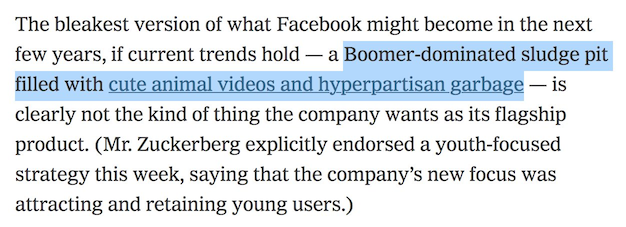
And let's see an apology from the NY Times for this horror in yesterday's paper about the people who use Facebook. Of course they ignore everything I write here, but even so, they should apologize, even if they don't care what one blogger thinks.

What Else Do the Leaked 'Facebook Papers' Show? Slashdotby EditorDavid on facebook at January 1, 1970, 1:00 am (cached at October 30, 2021, 4:35 pm)

The documents leaked to U.S. regulators by a Facebook whistleblower "reveal that the social media giant has privately and meticulously tracked real-world harms exacerbated by its platforms," reports the Washington Post. Yet it also reports that at the same time Facebook "ignored warnings from its employees about the risks of their design decisions and exposed vulnerable communities around the world to a cocktail of dangerous content." And in addition, the whistleblower also argued that due to Mark Zuckberg's "unique degree of control" over Facebook, he's ultimately personally response for what the Post describes as "a litany of societal harms caused by the company's relentless pursuit of growth." Zuckerberg testified last year before Congress that the company removes 94 percent of the hate speech it finds before a human reports it. But in internal documents, researchers estimated that the company was removing less than 5 percent of all hate speech on Facebook... For all Facebook's troubles in North America, its problems with hate speech and misinformation are dramatically worse in the developing world. Documents show that Facebook has meticulously studied its approach abroad, and is well aware that weaker moderation in non-English-speaking countries leaves the platform vulnerable to abuse by bad actors and authoritarian regimes. According to one 2020 summary, the vast majority of its efforts against misinformation — 84 percent — went toward the United States, the documents show, with just 16 percent going to the "Rest of World," including India, France and Italy... Facebook chooses maximum engagement over user safety. Zuckerberg has said the company does not design its products to persuade people to spend more time on them. But dozens of documents suggest the opposite. The company exhaustively studies potential policy changes for their effects on user engagement and other factors key to corporate profits. Amid this push for user attention, Facebook abandoned or delayed initiatives to reduce misinformation and radicalization... Starting in 2017, Facebook's algorithm gave emoji reactions like "angry" five times the weight as "likes," boosting these posts in its users' feeds. The theory was simple: Posts that prompted lots of reaction emoji tended to keep users more engaged, and keeping users engaged was the key to Facebook's business. The company's data scientists eventually confirmed that "angry" reaction, along with "wow" and "haha," occurred more frequently on "toxic" content and misinformation. Last year, when Facebook finally set the weight on the angry reaction to zero, users began to get less misinformation, less "disturbing" content and less "graphic violence," company data scientists found. The Post also contacted a Facebook spokeswoman for their response. The spokewoman denied that Zuckerberg "makes decisions that cause harm" and then also dismissed the findings as being "based on selected documents that are mischaracterized and devoid of any context..." Responding to the spread of specific pieces of misinformation on Facebook, the spokeswoman went as far to acknowledge that at Facebook, "We have no commercial or moral incentive to do anything other than give the maximum number of people as much of a positive experience as possible." She added that the company is "constantly making difficult decisions."

Read more of this story at Slashdot.

[no title] Scripting News(cached at October 30, 2021, 4:32 pm)

I bought a Tesla and a Peloton. Neither have arrived yet. When I ride my bike I like to listen to music, or a podcast or an audiobook. I don't need a coach. I bought the Pelo because it's the best bike. Let's see if I can use it that way. Same with the Tesla. I think they both want me to join the cult.
Vaccination Offers Better Protection Than Previous COVID-19 Infection Slashdotby BeauHD on medicine at January 1, 1970, 1:00 am (cached at October 30, 2021, 3:05 pm)

An anonymous reader quotes a report from The Hill: A new study from the [CDC] finds that vaccination provides better protection against hospitalization with COVID-19 than a previous infection with the virus. The analysis found people hospitalized with coronavirus-like symptoms were more than five times more likely to test positive for COVID-19 if they had had recent prior infection than if they were recently vaccinated. The study released Friday examined more than 7,000 people across nine states and 187 hospitals, comparing those who were unvaccinated and had previously had the coronavirus in the last three to six months and those who were vaccinated over the same time frame. The CDC urged even those who were previously infected to get their shots. [...] Overall, [CDC Director Rochelle Walensky] said at a press briefing earlier this week that the hospitalization rate among unvaccinated people is 12 times higher than for vaccinated people. The vaccination rate for those 12 and older has now reached 78 percent with at least one shot, but Walensky noted that still leaves more than 60 million eligible Americans unvaccinated.

Read more of this story at Slashdot.

NASA Wants Your Help Improving Perseverance Rover's AI Slashdotby BeauHD on nasa at January 1, 1970, 1:00 am (cached at October 30, 2021, 12:05 pm)

NASA is calling on any interested humans to contribute to the machine learning algorithms that help Perseverance get around. All you need to do is look at some images and label geological features. ExtremeTech reports: The project is known as AI4Mars, and it's a continuation of a project started last year using images from Curiosity. That particular rover arrived on Mars in 2012 and has been making history ever since. NASA used Curiosity as the starting point when designing Perseverance. The new rover has 23 cameras, which capture a ton of visual data from Mars, but the robot has to rely on human operators to interpret most of those images. The rover has enhanced AI to help it avoid obstacles, and it will get even better if you chip in. The AI4Mars site lets you choose between Opportunity, Curiosity, and the new Perseverance images. After selecting the kind of images you want to scope out, the site will provide you with several different marker types and explanations of what each one is. For example, the NavCam asks you to ID sand, consolidated soil (where the wheels will get good traction), bedrock, and big rocks. There are examples of all these formations, so it's a snap to get started.

Read more of this story at Slashdot.