US Health Insurers Caught Negotiating Worse Rates Than For Those With No Insurance Slashdotby EditorDavid on medicine at January 1, 1970, 1:00 am (cached at August 22, 2021, 10:35 pm)

In the U.S. healthcare system, "hospitals are charging patients wildly different amounts for the same basic services," reports the New York Times — citing an investigation into medical care costs at 60 major hospitals. This year the U.S. government ordered hospitals to publish complete lists of the prices they negotiate with private insurers, "and it provides numerous examples of major health insurers — some of the world's largest companies, with billions in annual profits — negotiating surprisingly unfavorable rates for their customers." In fact America's government-run Medicare health insurance for senior citizens is negotiating much lower rates than the privately-insured patients are getting, the Times points out — sometimes paying just 10% of what the major health plans are paying. "In many cases, insured patients are getting prices that are higher than they would if they pretended to have no coverage at all..." Until now, consumers had no way to know before they got the bill what prices they and their insurers would be paying. Some insurance companies have refused to provide the information when asked by patients and the employers that hired the companies to provide coverage. This secrecy has allowed hospitals to tell patients that they are getting "steep" discounts, while still charging them many times what a public program like Medicare is willing to pay. And it has left insurers with little incentive to negotiate well. The peculiar economics of health insurance also help keep prices high. Customers judge insurance plans based on whether their preferred doctors and hospitals are covered, making it hard for an insurer to walk away from a bad deal. The insurer also may not have a strong motivation to, given that the more that is spent on care, the more an insurance company can earn. Federal regulations limit insurers' profits to a percentage of the amount they spend on care. And in some plans involving large employers, insurers are not even using their own money. The employers pay the medical bills, and give insurers a cut of the costs in exchange for administering the plan.

Read more of this story at Slashdot.

Samsung Surpasses Intel to Become Top Semiconductor Manufacturer Slashdotby EditorDavid on intel at January 1, 1970, 1:00 am (cached at August 22, 2021, 9:35 pm)

Tom's Hardware reports: Based on revenue, Samsung Electronics has reclaimed the number one semiconductor manufacturer spot on the back of a strong Q2 2021, according to the latest IC Insight's The McClean Report, which investigates the state of the semiconductor industry in several areas. The South Korean company achieved a 19 percent increase in overall IC sales compared to Q1 2021, bringing in a total of $20.29 billion in the April-June period alone... On the other hand, Intel achieved a smaller three percent QoQ (Quarter-over-Quarter) increase that resulted in a cool $19.3 billion in chip sales. For reference, AMD, which is generally considered to have a competitive CPU portfolio compared to Intel, brought in a comparatively measly $3.85 billion... According to the present-day report, Samsung has achieved the top spot mainly due to ascending ASP (Average Sale Price) of NAND and DRAM, with the latter being a significant high-volume advantage over Intel, which doesn't produce RAM. Samsung had last been the top manufacturer back in Q3 2018 — again on the back of strong NAND and DRAM results in the midst of a market shortage.

Read more of this story at Slashdot.

Smartphone Company Alleged To Be a Scam Defrauding 300 Investors of $10 Million Slashdotby EditorDavid on cellphones at January 1, 1970, 1:00 am (cached at August 22, 2021, 8:35 pm)

In a 2015 video, PCMag's lead mobile analyst Sascha Segan showed off "One of the coolest phones at this year's CES." He's now written an article titled "How I Got Suckered by an (Alleged) $10M Phone Scam. The biggest mobile-phone mystery of the 2010s is finally coming to an ignominious end, as yesterday the U.S. attorney for Utah charged Chad Sayers, founder of entirely notional mobile phone firm Saygus, with conducting a $10 million fraud scheme. Saygus "had" a series of "phones" from 2009-2016 that existed as prototypes that the company took on trade shows and to press tours. There was never any real evidence of production runs. The U.S. Attorney now claims Sayers and associated took $10 million in investor money and lived on it without ever really planning to release a product. (I learned this via David Ruddock....) The phone kept just...not happening. Sayers' genius was that he produced just enough prototypes to show off and kept them in a constant state of pre-sale... "DEFENDANT failed to disclose that device certification with Verizon expired in 2013 and was never renewed," the Department of Justice notes. A new version of the phone then popped up again in 2015, this one supposedly covered in Kevlar with 320GB of storage. Sayers flogged that prototype until early 2016, at which point he said it was coming "next month." The Department of Justice says: "Between April 7, 2015 and January 10, 2017, DEFENDANT made at least 26 public statements on Twitter that its phone would be shipping 'this month,' 'this week,' or was otherwise launching, when in fact, it has never launched...." Sayers kept going on press tours and buying expensive trade-show booths with prototypes of phones that would never hit the market, drumming up enough gullible mainstream press coverage (myself included) to presumably attract a continual stream of investors with his claim of being the next big thing.

Read more of this story at Slashdot.

[no title] Scripting News(cached at August 22, 2021, 8:03 pm)

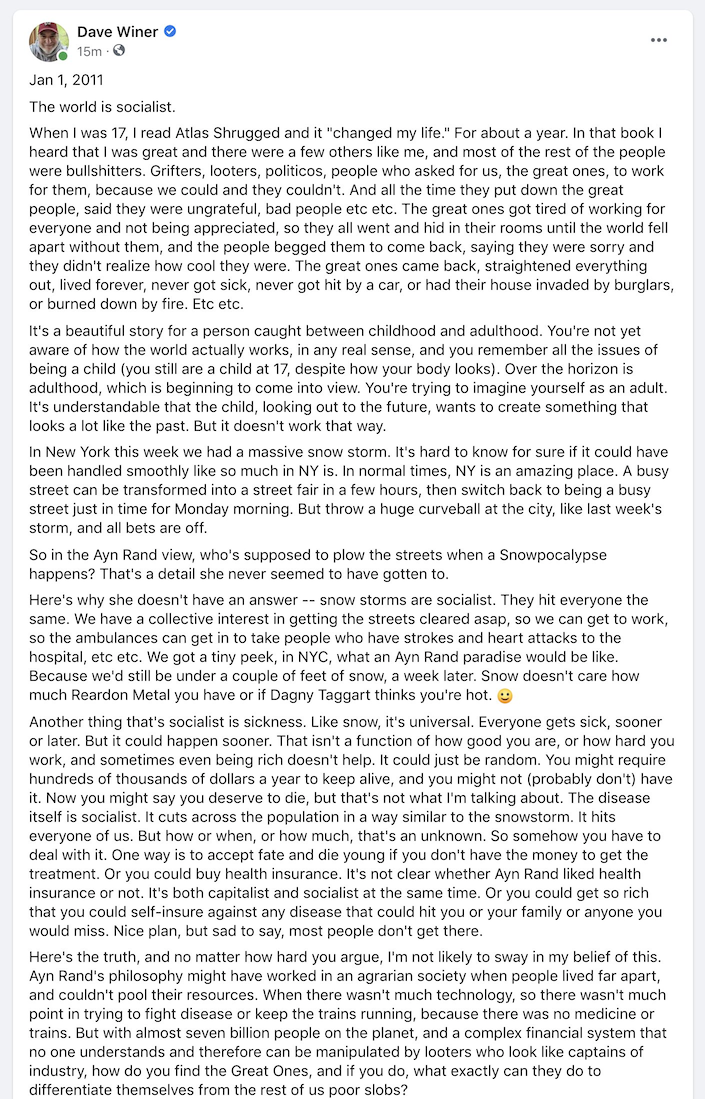
You'd think that by now Facebook would have figured out how to make a story read well on their website, by default, based on who's reading and what their vision is capable of. I can kind of read a story like this, but it involves a lot of squinting and scrolling and interpolating.
If Remote Work Lasts Two Years, Will Employees Ever Return to Offices? Slashdotby EditorDavid on it at January 1, 1970, 1:00 am (cached at August 22, 2021, 7:35 pm)

"With the latest wave of return-to-office delays from Covid-19, some companies are considering a new possibility: Offices may be closed for nearly two years," reports the Wall Street Journal. "That is raising concerns among executives that the longer people stay at home, the harder or more disruptive it could be to eventually bring them back." Many employees developed new routines during the pandemic, swapping commuting for exercise or blocking hours for uninterrupted work. Even staffers who once bristled at doing their jobs outside of an office have come to embrace the flexibility and productivity of at-home life over the past 18 months, many say. Surveys have shown that enthusiasm for remote work has only increased as the pandemic has stretched on. "If you have a little blip, people go back to the old way. Well, this ain't a blip," said Pat Gelsinger, chief executive officer of Intel Corp., whose company has benefited from the work-from-home boom. He predicts hybrid and remote work will remain the norm for months and years to come. "There is no going back...." [W]hat many have concluded over time is that their companies can operate largely effectively while remote, executives and workers say... As more time passes until offices reopen, it could become difficult to convince existing employees to willingly upend their new lives and return to pre-pandemic schedules in offices, executives say. Apple, Amazon, Facebook, and Lyft have now all postponed the return to their U.S. workplaces until 2022.

Read more of this story at Slashdot.

[no title] Scripting News(cached at August 22, 2021, 7:32 pm)

A perhaps surprising truth. We aren't free to ignore other people. For example, you're not allowed to shit in a public swimming pool. Think about it and all the other things you aren't free to do. It's not something you can argue about and live with other people.
Climate Change is Making Hurricanes Worse Slashdotby EditorDavid on earth at January 1, 1970, 1:00 am (cached at August 22, 2021, 6:35 pm)

The world's climate crisis is making hurricanes more potent, reports CNN: The proportion of high-intensity hurricanes has increased due to warmer global temperatures, according to a UN climate report released earlier this month. Scientists have also found that the storms are more likely to stall and lead to devastating rainfall and they last longer after making landfall. "We have good confidence that greenhouse warming increases the maximum wind intensity that tropical cyclones can achieve," Jim Kossin, senior scientist with the Climate Service, an organization that provides climate risk modeling and analytics to governments and businesses, told CNN. "This, in turn, allows for the strongest hurricanes — which are the ones that create the most risk by far — to become even stronger." Scientists like Kossin have observed that, globally, a larger percentage of storms are reaching the highest categories — 3, 4 and 5 — in recent decades, a trend that's expected to continue as global average temperature increases... A 2020 study published in the journal Nature also found storms are moving farther inland than they did five decades ago.... For every fraction of a degree the planet warms, according to the UN report, rainfall rates from high-intensity storms will increase, as warmer air can hold more moisture.

Read more of this story at Slashdot.

Journalism is oblivious Scripting News(cached at August 22, 2021, 6:03 pm)

Journalism says the pullout from Afghanistan was botched. Maybe so. Everything everyone does is botched, and that includes journalists, esp journalists, because no one is watching over them, reporting all their botchings.

Journalism is oblivious to the past or future. Everything is in the moment. A lot like Trump in that way.

Why aren't the people obsessed with Afghanistan like journalism is? Because it was always there.

That Afghanistan is being botched isn't news, it's just that journalism has decided for now to pay attention to it. Next week it'll be something else. Always a horse race. Biden has to win or lose.

Never mind the context, we're still one election away from complete disaster. At least 49% of the people aren't overlooking this important fact.

In other words journalism is wrong.

Could a Black Hole Surrounded by Energy-Harvesters Really Power a Civilization? Slashdotby EditorDavid on power at January 1, 1970, 1:00 am (cached at August 22, 2021, 5:35 pm)

"In the long-running TV show Doctor Who, aliens known as time lords derived their power from the captured heart of a black hole, which provided energy for their planet and time travel technology," writes Science magazine. "The idea has merit, according to a new study." Slashdot reader sciencehabit quotes their report: Researchers have shown that highly advanced alien civilizations could theoretically build megastructures called Dyson spheres around black holes to harness their energy, which can be 100,000 times that of our Sun. The work could even give us a way to detect the existence of these extraterrestrial societies... Black holes are typically thought of as consumers rather than producers of energy. Yet their huge gravitational fields can generate power through several theoretical processes. These include the radiation emitted from the accumulation of gas around the hole, the spinning "accretion" disk of matter slowly falling toward the event horizon, the relativistic jets of matter and energy that shoot out along the hole's axis of rotation, and Hawking radiation—a theoretical way that black holes can lose mass, releasing energy in the process. From their calculations, researchers concluded that the accretion disk, surrounding gas, and jets of black holes can all serve as viable energy sources. In fact, the energy from the accretion disk alone of a stellar black hole of 20 solar masses could provide the same amount of power as Dyson spheres around 100,000 stars, the team will report next month in the Monthly Notices of the Royal Astronomical Society. Were a supermassive black hole harnessed, the energy it could provide might be 1 million times larger still. If such technology is at work, there may be a way to spot it. According to the researchers, the waste heat signal from a so-called "hot" Dyson sphere—one somehow capable of surviving temperatures in excess of 3000 kelvin, above the melting point of known metals—around a stellar mass black hole in the Milky Way would be detectible at ultraviolet wavelengths. Such signals might be found in the data from various telescopes, including NASA's Hubble Space Telescope and Galaxy Evolution Explorer.

Read more of this story at Slashdot.

AI-Powered Tech Put a 65-Year-Old in Jail For Almost a Year Despite 'Insufficient Ev Slashdotby EditorDavid on ai at January 1, 1970, 1:00 am (cached at August 22, 2021, 5:05 pm)

"ShotSpotter" is an AI-powered tool that claims it can detect the sound of gunshots. To install it can cost up to $95,000 per square mile — every year — reports the Associated Press. There's just one problem. "The algorithm that analyzes sounds to distinguish gunshots from other noises has never been peer reviewed by outside academics or experts." "The concern about ShotSpotter being used as direct evidence is that there are simply no studies out there to establish the validity or the reliability of the technology. Nothing," said Tania Brief, a staff attorney at The Innocence Project, a nonprofit that seeks to reverse wrongful convictions. A 2011 study commissioned by the company found that dumpsters, trucks, motorcycles, helicopters, fireworks, construction, trash pickup and church bells have all triggered false positive alerts, mistaking these sounds for gunshots. ShotSpotter CEO Ralph Clark said the company is constantly improving its audio classifications, but the system still logs a small percentage of false positives. In the past, these false alerts — and lack of alerts — have prompted cities from Charlotte, North Carolina, to San Antonio, Texas, to end their ShotSpotter contracts, the AP found. And the potential for problems isn't just hypothetical. Just ask 65-year-old Michael Williams: Williams was jailed last August, accused of killing a young man from the neighborhood who asked him for a ride during a night of unrest over police brutality in May... "I kept trying to figure out, how can they get away with using the technology like that against me?" said Williams, speaking publicly for the first time about his ordeal. "That's not fair." Williams sat behind bars for nearly a year before a judge dismissed the case against him last month at the request of prosecutors, who said they had insufficient evidence. Williams' experience highlights the real-world impacts of society's growing reliance on algorithms to help make consequential decisions about many aspects of public life... ShotSpotter evidence has increasingly been admitted in court cases around the country, now totaling some 200. ShotSpotter's website says it's "a leader in precision policing technology solutions" that helps stop gun violence by using "sensors, algorithms and artificial intelligence" to classify 14 million sounds in its proprietary database as gunshots or something else. But an Associated Press investigation, based on a review of thousands of internal documents, emails, presentations and confidential contracts, along with interviews with dozens of public defenders in communities where ShotSpotter has been deployed, has identified a number of serious flaws in using ShotSpotter as evidentiary support for prosecutors. AP's investigation found the system can miss live gunfire right under its microphones, or misclassify the sounds of fireworks or cars backfiring as gunshots. Forensic reports prepared by ShotSpotter's employees have been used in court to improperly claim that a defendant shot at police, or provide questionable counts of the number of shots allegedly fired by defendants. Judges in a number of cases have thrown out the evidence... The company's methods for identifying gunshots aren't always guided solely by the technology. ShotSpotter employees can, and often do, change the source of sounds picked up by its sensors after listening to audio recordings, introducing the possibility of human bias into the gunshot detection algorithm. Employees can and do modify the location or number of shots fired at the request of police, according to court records. And in the past, city dispatchers or police themselves could also make some of these changes. Three more eye-popping details from the AP's 4,000-word exposé "One study published in April in the peer-reviewed Journal of Urban Health examined ShotSpotter in 68 large, metropolitan counties from 1999 to 2016, the largest review to date. It found that the technology didn't reduce gun violence or increase community safety..." "Forensic tools such as DNA and ballistics evidence used by prosecutors have had their methodologies examined in painstaking detail for decades, but ShotSpotter claims its software is proprietary, and won't release its algorithm..." "In 2018, it acquired a predictive policing company called HunchLab, which integrates its AI models with ShotSpotter's gunshot detection data to purportedly predict crime before it happens."

Read more of this story at Slashdot.

[no title] Scripting News(cached at August 22, 2021, 4:33 pm)

Journalism says the pullout from Afghanistan was botched. Everything everyone does is botched and that includes journalists, esp journalists, because no one is watching over them, reporting all their botchings.
$97 Million Stolen From Japanese Crypto Exchange Slashdotby EditorDavid on money at January 1, 1970, 1:00 am (cached at August 22, 2021, 2:05 pm)

"Hackers have drained Japanese cryptocurrency exchange Liquid of $97 million worth of Ethereum and other digital coins," reports Forbes: The company, in a tweet posted late Thursday, announced the compromise and said it is moving assets that were not affected into more secure "cold wallet" storage. The company has also suspended deposits and withdrawals... Liquid did not put a dollar figure on the amount, but blockchain analytics company Elliptic said its analysis estimates the losses at about $97 million... Of that, $45 million were in Ethereum tokens, which are being converted into Ether, preventing the hacker from having those assets frozen. Other cryptos taken in the heist include Bitcoin, XRP, and stablecoins.

Read more of this story at Slashdot.

Will Isaac Asimov's 'Foundation' Survive Its Transformation into a Streaming Series? Slashdotby EditorDavid on books at January 1, 1970, 1:00 am (cached at August 22, 2021, 10:05 am)

Apple TV+ has released a nearly three-minute long trailer for its upcoming series based on Isaac Asimov's Foundation books. Ars Technica calls the trailer "stunning." A mathematical genius predicts the imminent collapse of a galactic empire, and he and his protegé set plans in motion to preserve the foundational knowledge of their civilization in Foundation, Apple TV+'s adaptation of Isaac Asimov's hugely influential series of science fiction novels. It's a story that takes place across multiple planets over 1,000 years, with a huge cast of characters. That makes adapting it extremely difficult, particularly to film. But the streaming platform is betting that the series format will be better suited to bring Asimov's futuristic vision to life... The first teaser appeared in June 2020 at the Worldwide Developers Conference (WWDC). That included some behind-the-scenes images and brief commentary from showrunner David S. Goyer, who co-wrote Terminator: Dark Fate and Batman v. Superman. He noted all the past efforts to adapt Foundation over the last 50 years, as well as the enormous influence the series had on Star Wars... Asimov was strongly influenced by Edward Gibbons' The History of the Decline and Fall of the Roman Empire, particularly while writing the earlier books. This trailer really brings out the theme of embracing inevitable change, even if it's frightening — and there's nothing more frightening to a ruler than the imminent collapse of his empire... The first two episodes of Foundation will premiere on Apple TV+ on September 24, 2021. After that, new episodes will air weekly every Friday.

Read more of this story at Slashdot.
Comic for August 21, 2021 Dilbert Daily Strip(cached at August 22, 2021, 9:01 am)

Dilbert readers - Please visit Dilbert.com to read this feature. Due to changes with our feeds, we are now making this RSS feed a link to Dilbert.com.
Facebook Relents, Releases Report that Makes Them Look Bad Slashdotby EditorDavid on facebook at January 1, 1970, 1:00 am (cached at August 22, 2021, 6:05 am)

"Transparency is an important part of everything we do at Facebook," reads the first line of a first-quarter Content Transparency Report which Facebook later decided not to share with the public. They've now changed their mind, and released that report. The Hill summarizes its findings: Facebook said that an article about a doctor who passed away two weeks after getting a coronavirus vaccine was the [#1] top-performing link on the social media platform in the U.S. from January to March, according to a report released Saturday... [The Washington Post adds that this article "was promoted on Facebook by several anti-vaccine groups".] According to Facebook's report, the article was viewed over 53 million times... In addition, a website pushing coronavirus misinformation was one of the top 20 most visited sites on the platform, according to The Washington Post. Specifically, the Post calls that top-20 site "a right-wing anti-China publication that has promoted the violent QAnon conspiracy theories and misleading claims of voter fraud related to the 2020 election." Facebook had considered sharing the 100 most popular items in their newsfeed, the Post adds, but "The problem was that they feared what they might find..." The disclosure reflects the challenge of being open with the public at a time when the social network is being attacked by the White House as well as experts for fomenting the spread of health misinformation. Previously, the company had only shared how much covid-related misinformation it has removed, and has been careful not to acknowledge up to this point what role they've played in disseminating material that mislead the public about the virus and the vaccine. For months, executives have debated releasing both this report and other information, according to a person familiar with the company's thinking. In those debates, the conversations revolved around whether releasing certain data points were likely to help or hurt the company's already-battered public image. In numerous instances, the company held back on investigating information that appeared negative, the person said... Facebook's leadership has long felt that skepticism about any subject, including vaccines, should not be censored in a society that allows robust public debate... The challenge is that certain factual stories that might cast doubt on vaccines are often promoted and skewed by people and groups that are opposed to them. The result is that factual information can become part of an ideological campaign. Facebook has been slow to remove or block some of the leading anti-vaccine figures that spread such ideas. Some observations about Facebook's report: It only covers public content in a News Feed — so presumably it's failing to account for any misinformation that's shared only with a group's members. The report acknowledges that nearly 20% of posts in a News Feed come from a Group the user has joined. More than 1 in every 17 content views in the News Feed are recommended by Facebook's algorithms.

Read more of this story at Slashdot.