[no title] Scripting News(cached at August 15, 2021, 11:32 pm)

The Taliban are pawns as much as the previous Afghan govt was.
Fight Piracy With a Blockchain-Based Bounty System, Suggest Microsoft Researchers Slashdotby EditorDavid on microsoft at January 1, 1970, 1:00 am (cached at August 15, 2021, 11:05 pm)

TorrentFreak reports: A new paper published by Microsoft's research department proposes to tackle piracy with a blockchain-based bounty system titled "Argus." The system allows volunteers to report piracy in exchange for a reward. It uses the Ethereum blockchain and is transparent, practical, and secure, while limiting abusive reports and errors... Pirated content is traced back to the source through a unique watermark that corresponds with a secret code. When a pirated copy is reported, the status of the source (licensee) is changed to "accused." The system provides an appeal option, but if that fails, the accused status changes to "guilty...." Whether Microsoft has any plans to test the system in the wild is unknown. It theoretically works with various media types including images, audio and software... This idea isn't completely new, however, as the South African company Custos came up with a similar idea years ago. Microsoft's research notes that Argus is superior to Custos' solution as it can assess the severity of piracy and the strength of accusations. TorrentFreak points out that the paper also received input from researchers at Alibaba and Carnegie Mellon University. I like how the paper referenced the appropriately-named functions for parts of the process, including Report(), Appeal(), and SetGuilty().

Read more of this story at Slashdot.

[no title] Scripting News(cached at August 15, 2021, 11:02 pm)

opml.org is a mess, like all of my long-term tech projects, suffering from lack of focus, but no lack of experimentation! I've been going through the projects one by one, and now it's opml.org's turn. I have a staging site for the new version at 2021.opml.org. Lots of notes and links on that page.
Contractor Accuses Huawei of Stealing Technology, Pressuring Them for a 'Back Door' Slashdotby EditorDavid on china at January 1, 1970, 1:00 am (cached at August 15, 2021, 9:35 pm)

The Wall Street Journal reports: A long-running dispute between Huawei Technologies Co. and a small U.S.-based contractor has escalated to U.S. federal court, with the contractor alleging Huawei stole its technology and pressured it to build a "back door" into a sensitive law-enforcement project in Pakistan. The contractor, Buena Park, Calif.-based Business Efficiency Solutions LLC, or BES, says in a lawsuit filed Wednesday in California district court that Huawei required it to set up a system in China that gives Huawei access to sensitive information about citizens and government officials from a safe-cities surveillance project in Pakistan's second-largest city of Lahore... Muhammad Kamran Khan, chief operating officer of the Punjab Safe Cities Authority, which oversees the Lahore project, said the authority has begun looking into BES's allegations.

Read more of this story at Slashdot.

The Case Against Working Remotely Full-Time Slashdotby EditorDavid on it at January 1, 1970, 1:00 am (cached at August 15, 2021, 9:05 pm)

A new article in Time magazine argues it's time to "follow the science" on working from home. "The solution for the future is a structured hybrid model, acknowledging that working from home doesn't work long-term for most jobs, while still giving workers flexibility." (Alternate URL here.) One way to do that would be to allocate time slots — perhaps specific days — of in-office working for all employees to maintain workplace productivity and collaboration, while also allowing working from home to continue outside those hours... For some, remote work leads to increased productivity, as well as job satisfaction, particularly for those working in technical jobs that require minimal teamwork... But the science tells us that workers like them are in a minority and, however topical their case is, we should be cautious about applying such a drastic change across our economies. Since before the pandemic began I have been assessing multi-disciplinary collaboration in a work-from-home environment for my PhD research at Imperial College, London. Individuals employed on creative projects in virtual teams reported feeling more like a 'worker', and less like a member of a family. One respondent said of employers: "They don't see how early you show up in front of your computer...They don't see how hard I'm working." But more damaging than the effects of working from home on individuals, is what it does to teams. Remote work often breaks the mechanisms that allow a team to work together creatively. Studies have found that the best creative work occurs when a team is in a state of flow, or focuses its collective attention on a single problem together, known as 'team flow'. But remote work makes it harder to keep everyone engaged in solving that problem. In my study, many respondents said it was hard to gauge when a team member had zoned out during a Zoom call. There is currently no digital technology that can reliably create 'flow' remotely, and we shouldn't pretend there is. If it did exist, it wouldn't have taken the necessity of pandemic restrictions for us to work remotely — managers and employees would have already embraced it. There's other evidence that points to this problem. Utah-based virtual whiteboard app Lucidspark found that 75% of 1,000 respondents surveyed in September last year said collaboration was the thing that suffered most when working remotely. "It is clear from my research that fully autonomous working from home across all industries is neither desirable nor sustainable," the article concludes. "That's why we need to carve out a third way, where teams that thrive on collaboration are given mandatory times each week when everyone is expected to be in the office."

Read more of this story at Slashdot.

Debian 11 'Bullseye' Released As Stable Slashdotby EditorDavid on debian at January 1, 1970, 1:00 am (cached at August 15, 2021, 8:05 pm)

"One of the oldest and most renowned distributions of Linux has been released!" âwrites Slashdot reader Washuu2. Phoronix reports it took "just over two years in development." Debian 11 brings many new features as outlined this morning with the big upgrade to Linux 5.10 LTS, exFAT file-system support, control groups v2, yescrypt for password hashing, and a plethora of updated packages. GNOME 3.38, KDE Plasma 5.20, and Xfce 4.16 are among the desktop options for Debian 11. Debian.org adds: Do you want to celebrate the release? We provide some bullseye artwork that you can share or use as base for your own creations. Follow the conversation about bullseye in social media via the #ReleasingDebianBullseye and #Debian11Bullseye hashtags... Around the world, there were even several in-person and online release parties — with a few more upcoming!

Read more of this story at Slashdot.

[no title] Scripting News(cached at August 15, 2021, 7:32 pm)

Podcast: Pig is a beautiful movie because it's about showing people the beauty inside themselves, using the beauty inside yourself. I loved it because it resonated with what I've been doing in the recent past. Warning, there are spoilers in this podcast, but something to know about the movie is that it isn't the kind of movie that you can spoil with spoilers, but you have been warned.
Study Finds Fermented Foods May Alter Your Microbiome, Reduce Inflammation, and Impr Slashdotby EditorDavid on medicine at January 1, 1970, 1:00 am (cached at August 15, 2021, 6:35 pm)

A new study finds that eating fermented foods like yogurt, kimchi, sauerkraut and kombucha increase the diverse of gut microbes — and "may also lead to lower levels of body-wide inflammation, which scientists increasingly link to a range of diseases tied to aging," reports the New York Times: The latest findings come from a study published in the journal Cell that was carried out by researchers at Stanford University. They wanted to see what impact fermented foods might have on the gut and immune system, and how it might compare to eating a relatively healthy diet full of fruits, vegetables, beans, whole grains and other fiber-rich foods... [Among the study's participants], the fermented food group showed marked reductions in 19 inflammatory compounds... For people in the fermented foods group, the reductions in inflammatory markers coincided with changes in their guts. They began to harbor a wider and more diverse array of microbes, which is similar to what other recent studies of people who eat a variety of fermented foods have shown. The new research found that the more fermented foods people ate, the greater the number of microbial species that bloomed in their guts... Higher levels of gut microbiome diversity are generally thought to be a good thing. Studies have linked it to lower rates of obesity, Type 2 diabetes, metabolic disease and other ills... Suzanne Devkota, the director of Microbiome Research at Cedars-Sinai Medical Center in Los Angeles, who was not involved in the new study, said it has long been assumed that eating fermented foods had health benefits but that the new research provides some of the first "hard evidence" that it can influence the gut and inflammation.

Read more of this story at Slashdot.

The Worst 5% of Power Plants Produce 73% of Their Emissions Slashdotby EditorDavid on earth at January 1, 1970, 1:00 am (cached at August 15, 2021, 6:05 pm)

Ars Technica reports on a paper investigating how much each power plant contributes to global emissions, using data from 2018. "The study finds that many countries have many power plants that emit carbon dioxide at rates well above either the national or global average. "Shutting down the worst 5 percent of this list would immediately wipe out about 75 percent of the carbon emissions produced by electricity generation." It should surprise nobody that all the worst offenders are coal plants. But the distribution of the highest polluting plants might include a bit of the unexpected. For example, despite its reputation as the home of coal, China only has a single plant in the top-10 worst (bottom-10?). In contrast, South Korea has three on the list, and India has two. In general, China doesn't have many plants that stand out as exceptionally bad, in part because so many of its plants were built around the same time, during a giant boom in industrialization. As such, there's not much variance from plant to plant when it comes to efficiency. In contrast, countries like Germany, Indonesia, Russia, and the US all see a lot of variance, so they're likely to have some highly inefficient plants that are outliers. Put a different way, the authors looked at how much of a country's pollution was produced by the worst 5 percent when all of the country's power plants were ranked by carbon emissions. In China, the worst 5 percent accounted for roughly a quarter of the country's total emissions. In the US, the worst 5 percent of plants produced about 75 percent of the power sector's carbon emissions. South Korea had similar numbers, while Australia, Germany, and Japan all saw their worst 5 percent of plants account for roughly 90 percent of the carbon emissions from their power sector. When it comes to carbon emissions, the worst 5 percent of power plants account for 73 percent of the total power sector emissions globally. That 5 percent also produces over 14 times as much carbon pollution as it would if the plants were merely average... Simply boosting each plant's efficiency to the average for the country would drop power sector emissions by a quarter and up to 35 percent in countries like Australia and Germany. Switching them to natural gas, which produces less carbon dioxide per amount of energy released, would drop global emissions by 30 percent, with many countries (including the US) seeing drops of over 40 percent. Again, because China doesn't see a lot of variance among its plants, these switches would have less of an impact, being in the area of 10 percent drops in emissions. But the big winner is carbon capture and storage. Outfitting the worst of the plants with a capture system that was 85 percent efficient would cut global power sector emissions in half and total global emissions by 20 percent. Countries like Australia and Germany would see their power sector emissions drop by over 75 percent. Overall, these are massive gains, considering that it's not unreasonable to think that the modifications could be done in less than a decade. And they show the clear value of targeting the easiest wins when it comes to lowering emissions.

Read more of this story at Slashdot.

Hidden cameras spot New Forest pine marten BBC News | Science/Nature | UK Edition(cached at August 15, 2021, 5:30 pm)

A new study aims to discover more about how the rare creatures have bred in the New Forest.
How Data Scientists Pinpointed the Creepiest Word in Shakespeare's 'Macbeth' Slashdotby EditorDavid on ai at January 1, 1970, 1:00 am (cached at August 15, 2021, 5:05 pm)

Medium's technology blog OneZero provides a great example of the new field of "digital humanities": Actors and critics have long remarked that when you read Macbeth out loud, it feels like your voice and mouth and brain are doing something ever so slightly wrong. There's something subconsciously off about the sound of the play, and it spooks people. It's as if Shakespeare somehow wove a tiny bit of creepiness into every single line. The literary scholar George Walton Williams described the "continuous sense of menace" and "horror" that pervades even seemingly innocuous scenes. For centuries, Shakespeare fans and theater folk have wondered about this, but could never quite explain it. Then a clever bit of data analysis in 2014 uncovered the reason... It turns out that Macbeth uncanny flavor springs from the unusual way that Shakespeare deploys one particular word, over and over again. That word? "The...." As Hope and Witmore note, you'd expect Macbeth to refer to "my hand" and "my eye". By writing it as "the hand" and "the eye", Shakespeare neatly evokes the way Macbeth is beginning to be tormented by his own decisions; he disassociates from his own body. In a few acts he'll be a totally unravelled mess... [T]his is one of my favorite examples of using data analysis to ponder literature. The field of the "digital humanities" — which often involves using data analysis to study books — can get a bad rap sometimes... But what's so delightful about Hope and Witmore's work is how it's genuinely a cyborg, centaur piece of literary analysis... They started by pondering a phenomenon that has puzzled Shakespeare fans for centuries. They did some data analysis that pointed to the word "the". But to figure out why "the" was so key, they had to go back and reread the play closely, engaging in a very rich line-by-line literary analysis. The computation existed as a set of fresh alien eyes, telling the humans where to direct their attention. But it was up to the humans to find the meaning.

Read more of this story at Slashdot.

[no title] Scripting News(cached at August 15, 2021, 4:32 pm)

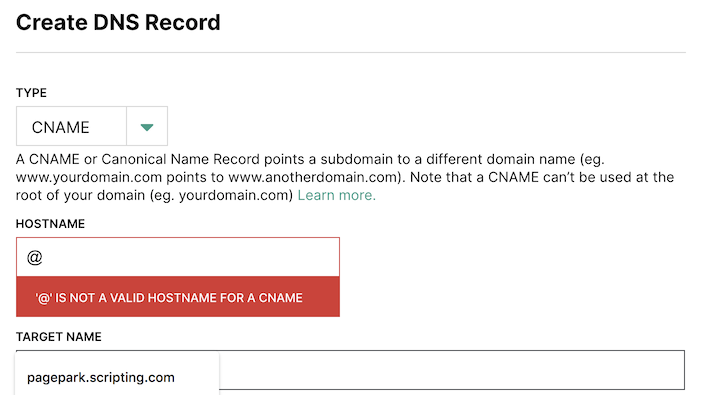
Hover, my primary registrar, did something important right. You could use a CNAME for any name, including the top level of a domain. It's so rational, I don't understand why all DNS service providers don't allow it. Except now it no longer appears to work on Hover. I'm trying to set up opml.org to be CNAME for pagepark.scripting.com. I don't want to hard-code it to a specific server IP address. The whole idea of having a name like pagepark.scripting.com is so that I can easily relocate it to new hardware someday without having to find all the places that have its IP address hard-coded. Here's a screen shot of what it says when I try to do that now. It appears to be a user interface thing only, the domains I set up previously using this feature still appear to work. If you have an idea what's going on, please post a note here.
Ethereum's Cryptocurrency Will 'Jettison' Mining for Speedier Proof-of-Stake Slashdotby EditorDavid on money at January 1, 1970, 1:00 am (cached at August 15, 2021, 12:35 pm)

"Ethereum is making big changes," writes Bloomberg. "Perhaps the most important is the jettisoning of the 'miners' who track and validate transactions on the the world's most-used blockchain network. Miners are the heart of a system known as proof of work. It was pioneered by Bitcoin and adopted by Ethereum, and has come under increasing criticism for its environmental impact: Bitcoin miners now use as much electricity as some small nations. Along with being greener and faster, proponents say the switch, now planned to be phased in by early 2022, will illustrate another difference between Ethereum and Bitcoin: A willingness to change, and to see the network as a product of community as much as code... The idea behind proof of stake is that the blockchain can be secured more simply if you give a group of people carrot-and-stick incentives to collaborate in checking and crosschecking transactions... It's thought that switching to proof of stake would cuts Ethereum's energy use, estimated at 45,000 gigawatt hours by 99.9%. Like any other venture depending on cloud computing, its carbon footprint would then be only be that of its servers. It also is expected to increase the network speed. That's important for Ethereum, which has ambitions of becoming a platform for a vast range of financial and commercial transactions. Currently, Ethereum handles about 30 transactions per second. With sharding, Vitalik Buterin, the inventor of Ethereum, thinks that could go to 100,000 per second. In a proof of stake system, it would be harder than in a proof of work system for a group to gain control of the process, but it would still be possible: The more Ether a person or group stakes, the better the chance of being chosen as a validator or attestor. Economic disincentives have been put in place to dissuade behavior that is bad for the network. The article also argues that Bitcoin's "growing dominance by huge, centralized mining farms" is "antithetical to a system that was designed to be decentralized."

Read more of this story at Slashdot.

Snopes.com Co-Founder Accused of Copying from Other Sites Without Attribution Slashdotby EditorDavid on themedia at January 1, 1970, 1:00 am (cached at August 15, 2021, 9:35 am)

The co-founder of the fact-checking website Snopes has been accused of publishing articles that are too accurate: copying text from other more authorative web sites. Snopes.com describes them as "sentences or paragraphs from various news sites pasted into Snopes news stories without appropriate attribution." BuzzFeed News writes: A BuzzFeed News investigation has found that between 2015 and 2019, Mikkelson wrote and published dozens of articles containing material plagiarized from news outlets such as the Guardian and the LA Times. After inquiries from BuzzFeed News, Snopes conducted an internal review and confirmed that under a pseudonym, the Snopes byline, and his own name, Mikkelson wrote and published 54 articles with plagiarized material... BuzzFeed News found dozens of articles on Snopes' site that include language — sometimes entire paragraphs — that appear to have been copied without attribution from news outlets that include the New York Times, CNN, NBC News, and the BBC... Snopes's subsequent internal review identified 140 articles with possible problems and 54 that were found to include appropriated material... "That was his big SEO/speed secret," said Binkowski, whom Snopes fired without explanation in 2018 (she currently manages the fact-checking site Truth or Fiction). "He would instruct us to copy text from other sites, post them verbatim so that it looked like we were fast and could scoop up traffic, and then change the story in real time. I hated it and wouldn't tell any of the staff to do it, but he did it all the time." Two other former employees also said that copying and rewriting content was part of Mikkelson's strategy for driving traffic to Snopes' site... Thanks to Slashdot reader PolygamousRanchKid for submitting this story. BuzzFeed notes that Mikkelson himself had also begun using a pseudonym "intended to mislead the trolls and conspiracy theorists who frequently targeted the site and its writers." That byline linked to a satirical bio claiming that in 2006 they'd "won the Pulitzer Prize for numismatics" (coin collecting) and were "also the winner of the Distinguished Conflagration Award of the American Society of Muleskinners for 2005." Snopes.com actually thanked BuzzFeed's reporter for letting them know, calling BuzzFeed's article "an example of dogged, watchdog journalism we cherish" (while adding "Our staff has moved quickly to fix the problem... Our reputation is dependent on our ability to get things right, and more importantly, to quickly correct the record when we are wrong.") Besides removing Mikkelson's purloined content (and preventing him, though he's still the site's co-owner, from publishing on it), Snopes.com says that in addition, "We will attempt to contact each news outlet whose reporting we appropriated to issue an apology." In an interview with BuzzFeed News, Mikkelson attributed the unattributed sentence-copying to his lack of formal journalism experience. "I wasn't used to doing news aggregation. A number of times I crossed the line to where it was copyright infringement. I own that...." I remember when Snopes.com was just an entertaining fringe web site debunking kooky claims turning up in forwarded emails or on Usenet. Was it a victim of its own success — drawn into the 24/7 news cycle, with its "race to be first"? Were they overwhelmed by the amount of misinformation being spread on social media that needed debunking? In a statement to BuzzFeed, Mikkelson had this to say: Snopes has grown beyond our roots as a "one-man band" website into a newsroom of dedicated, professional journalists who serve the public with trustworthy information. Thanks to their efforts, Snopes has published original reporting on the COVID-19 pandemic, the recent elections, Russian disinformation efforts and so much more. The last thing I ever wanted was to have my mistakes detract from their excellent work, and I'm doing everything I can to make it right. And on Twitter, BuzzFeed's reporter added that "I don't like that this story is being weaponized by bad actors like Steve Bannon to unfairly and baselessly smear the work of Snopes' staff writers who do good work and had no part in this."

Read more of this story at Slashdot.

Comic for August 14, 2021 Dilbert Daily Strip(cached at August 15, 2021, 9:31 am)

Dilbert readers - Please visit Dilbert.com to read this feature. Due to changes with our feeds, we are now making this RSS feed a link to Dilbert.com.