RISC Vs. CISC Is the Wrong Lens For Comparing Modern x86, ARM CPUs Slashdotby EditorDavid on amd at January 1, 1970, 1:00 am (cached at June 6, 2021, 11:05 pm)

Long-time Slashdot reader Dputiger writes: Go looking for the difference between x86 and ARM CPUs, and you'll run into the idea of CISC versus RISC immediately. But 40 years after the publication of David Patterson and David Ditzel's 1981 paper, "The Case for a Reduced Instruction Set Computer," CISC and RISC are poor top-level categories for comparing these two CPU families. ExtremeTech writes: The problem with using RISC versus CISC as a lens for comparing modern x86 versus ARM CPUs is that it takes three specific attributes that matter to the x86 versus ARM comparison — process node, microarchitecture, and ISA — crushes them down to one, and then declares ARM superior on the basis of ISA alone. The ISA-centric argument acknowledges that manufacturing geometry and microarchitecture are important and were historically responsible for x86's dominance of the PC, server, and HPC market. This view holds that when the advantages of manufacturing prowess and install base are controlled for or nullified, RISC — and by extension, ARM CPUs — will typically prove superior to x86 CPUs. The implementation-centric argument acknowledges that ISA can and does matter, but that historically, microarchitecture and process geometry have mattered more. Intel is still recovering from some of the worst delays in the company's history. AMD is still working to improve Ryzen, especially in mobile. Historically, both x86 manufacturers have demonstrated an ability to compete effectively against RISC CPU manufacturers. Given the reality of CPU design cycles, it's going to be a few years before we really have an answer as to which argument is superior. One difference between the semiconductor market of today and the market of 20 years ago is that TSMC is a much stronger foundry competitor than most of the RISC manufacturers Intel faced in the late 1990s and early 2000s. Intel's 7nm team has got to be under tremendous pressure to deliver on that node. Nothing in this story should be read to imply that an ARM CPU can't be faster and more efficient than an x86 CPU.

Read more of this story at Slashdot.

ROM Site Owner Made $30,000 a Year -- Now Owes Nintendo $2.1 Million Slashdotby EditorDavid on piracy at January 1, 1970, 1:00 am (cached at June 6, 2021, 10:05 pm)

An anonymous reader quotes Ars Technica: The now-unemployed owner of a shuttered ROM distribution site has been ordered to pay $2.1 million in damages to Nintendo after trying and failing to defend himself in the case. In September 2019, Nintendo filed a lawsuit against Los Angeles resident Matthew Storman over his operation of RomUniverse.com, which offered prominent downloads of "Nintendo Switch Scene Roms" and other copyrighted game files. At the time, Nintendo said that the site had been "among the most visited and notorious online hubs for pirated Nintendo video games" for "over a decade." Storman has admitted that, in 2019, the site made up the bulk of his $30,000 to $36,000 a year in income. This included direct revenue from the sale of "premium unlimited accounts" for $30 per year that provided users with faster downloads and no limits. By the time Storman signed a September 2020 agreement with Nintendo to shut the site down, he said he was deriving $800 a month from the site. According to court documents, Storman's income is now derived primarily from "unemployment and food stamps." In a motion for dismissal, Storman invoked the "safe harbor" protections of the Digital Millennium Copyright Act (DMCA), arguing that he was just a neutral service provider for users sharing files. He also pointed out that he had agreed to Nintendo's DMCA takedown requests in the past. During a deposition, though, Nintendo got Storman to admit that he had uploaded Nintendo's copyrighted ROM files himself, obliterating any attempts at a "safe harbor" claim... While Nintendo originally claimed that RomUniverse was responsible for "hundreds of thousands" of copyrighted downloads, that number was lowered to 50,000 based on evidence gleaned from screenshots of the site. Nintendo argued that each download cost it between $20 and $60 (the average cost of new games it sells) and that it had therefore lost between $1 and $3 million in revenue.

Read more of this story at Slashdot.
Will Labor Shortages Give Workers More Power? Slashdotby EditorDavid on ibm at January 1, 1970, 1:00 am (cached at June 6, 2021, 8:35 pm)

It's been argued that technology (especially automation) will continue weakening the position of workers. But today the senior economics correspondent for The New York Times argues a "profound shift" happening in America is instead something else. "For the first time in a generation, workers are gaining the upper hand..." Up and down the wage scale, companies are becoming more willing to pay a little more, to train workers, to take chances on people without traditional qualifications, and to show greater flexibility in where and how people work. The erosion of employer power began during the low-unemployment years leading up to the pandemic and, given demographic trends, could persist for years. March had a record number of open positions, according to federal data that goes back to 2000, and workers were voluntarily leaving their jobs at a rate that matches its historical high. Burning Glass Technologies, a firm that analyzes millions of job listings a day, found that the share of postings that say "no experience necessary" is up two-thirds over 2019 levels, while the share of those promising a starting bonus has doubled. People are demanding more money to take a new job. The "reservation wage," as economists call the minimum compensation workers would require, was 19 percent higher for those without a college degree in March than in November 2019, a jump of nearly $10,000 a year, according to a survey by the Federal Reserve Bank of New York... [T]he demographic picture is not becoming any more favorable for employers eager to fill positions. Population growth for Americans between ages 20 and 64 turned negative last year for the first time in the nation's history. The Congressional Budget Office projects that the potential labor force will grow a mere 0.3 to 0.4 percent annually for the remainder of the 2020s; the size of the work force rose an average of 0.8 percent a year from 2000 to 2020. The article describes managers now "being forced to learn how to operate amid labor scarcity... At the high end of the labor market, that can mean workers are more emboldened to leave a job if employers are insufficiently flexible on issues like working from home..." But it also notes a ride-sharing driver who switched to an IBM apprenticeship for becoming a cloud storage engineer, and a former Florida nightclub bouncer who became an IBM mainframe technician, "part of a deliberate effort by IBM to rethink how it hires and what counts as a qualification for a given job." [IBM] executives concluded that the qualifications for many jobs were unnecessarily demanding. Postings might require applicants to have a bachelor's degree, for example, in jobs that a six-month training course would adequately prepare a person for. "By creating your own dumb barriers, you're actually making your job in the search for talent harder," said Obed Louissaint, IBM's senior vice president for transformation and culture. In working with managers across the company on training initiatives like the one under which Mr. Lorick was hired, "it's about making managers more accountable for mentoring, developing and building talent versus buying talent." "I think something fundamental is changing, and it's been happening for a while, but now it's accelerating," Mr. Louissaint said.

Read more of this story at Slashdot.

Apple's MagSafe Devices May Affect Pacemakers Slashdotby EditorDavid on cellphones at January 1, 1970, 1:00 am (cached at June 6, 2021, 8:05 pm)

The American Heart Association is a research-funding nonprofit. One of its publications, The Journal of the American Heart Association, "has concurred with a previous report by the Heart Rhythm Journal which said close contact with an iPhone 12 affected certain implantable cardiac devices," writes Apple Insider. As with that report, the American Heart Association says the effect are solely when the iPhone is on or very near the implant... "Our study demonstrates that magnet reversion mode may be triggered when the iPhone 12 Pro Max is placed directly on the skin over an implantable cardiac device and thus has the potential to inhibit lifesaving therapies," say the report writers in the Journal of the American Heart Association. The testing involved placing the iPhone 12 Pro Max in very close proximity to a series of 11 different pacemakers and defibrillators... The degree of interference did vary across the testing, but all devices were affected. The report says that "the iPhone 12 Pro Max was able to trigger magnetic reversion mode at a distance up to 1.5cm [0.6 inches]." "Apple Inc, has an advisory stating that the newer generation iPhone 12 does not pose a greater risk for magnet interference when compared to the older generation iPhones," notes the report. "However, our study suggests otherwise as magnet response was demonstrated in 3/3 cases in vivo..." In January 2021, Apple updated its MagSafe support document to recommend that users keep the iPhone 12 six inches away from any medical implants.

Read more of this story at Slashdot.

EFF Argues 'If Not Overturned, a Bad Copyright Decision Will Lead Many Americans to Slashdotby EditorDavid on eff at January 1, 1970, 1:00 am (cached at June 6, 2021, 7:05 pm)

The EFF's senior staff attorney and their legal intern are warning that a bad copyright decision by a district court judge could lead many Americans to lose their internet access. "In going after ISPs for the actions of just a few of their users, Sony Music, other major record labels, and music publishing companies have found a way to cut people off of the internet based on mere accusations of copyright infringement." When these music companies sued Cox Communications, an ISP, the court got the law wrong. It effectively decided that the only way for an ISP to avoid being liable for infringement by its users is to terminate a household or business's account after a small number of accusations — perhaps only two. The court also allowed a damages formula that can lead to nearly unlimited damages, with no relationship to any actual harm suffered. If not overturned, this decision will lead to an untold number of people losing vital internet access as ISPs start to cut off more and more customers to avoid massive damages... The district court agreed with Sony that Cox is responsible when its subscribers — home and business internet users — infringe the copyright in music recordings by sharing them on peer-to-peer networks. It effectively found that Cox didn't terminate accounts of supposedly infringing subscribers aggressively enough. An earlier lawsuit found that Cox wasn't protected by the Digital Millennium Copyright Act's (DMCA) safe harbor provisions that protect certain internet intermediaries, including ISPs, if they comply with the DMCA's requirements. One of those requirements is implementing a policy of terminating "subscribers and account holders... who are repeat infringers" in "appropriate circumstances." The court ruled in that earlier case that Cox didn't terminate enough customers who had been accused of infringement by the music companies. In this case, the same court found that Cox was on the hook for the copyright infringement of its customers and upheld the jury verdict of $1 billion in damages — by far the largest amount ever awarded in a copyright case. The District Court got the law wrong... An ISP can be contributorily liable if it knew that a customer infringed on someone else's copyright but didn't take "simple measures" available to it to stop further infringement. Judge O'Grady's jury instructions wrongly implied that because Cox didn't terminate infringing users' accounts, it failed to take "simple measures." But the law doesn't require ISPs to terminate accounts to avoid liability. The district court improperly imported a termination requirement from the DMCA's safe harbor provision (which was already knocked out earlier in the case). In fact, the steps Cox took short of termination actually stopped most copyright infringement — a fact the district court simply ignored. The district court also got it wrong on vicarious liability... [T]he court decided that because Cox could terminate accounts accused of copyright infringement, it had the ability to supervise those accounts. But that's not how other courts have ruled. For example, the Ninth Circuit decided in 2019 that Zillow was not responsible when some of its users uploaded copyrighted photos to real estate listings, even though Zillow could have terminated those users' accounts. In reality, ISPs don't supervise the Internet activity of their users. That would require a level of surveillance and control that users won't tolerate, and that EFF fights against every day. The consequence of getting the law wrong on secondary liability here, combined with the $1 billion damage award, is that ISPs will terminate accounts more frequently to avoid massive damages, and cut many more people off from the internet than is necessary to actually address copyright infringement... They also argue that the termination of accounts is "overly harsh in the case of most copyright infringers" — especially in a country where millions have only one choice for broadband internet access. "Being effectively cut off from society when an ISP terminates your account is excessive, given the actual costs of non-commercial copyright infringement to large corporations like Sony Music." It's clear that Judge O'Grady misunderstood the impact of losing Internet access. In a hearing on Cox's earlier infringement case in 2015, he called concerns about losing access "completely hysterical," and compared them to "my son complaining when I took his electronics away when he watched YouTube videos instead of doing homework."

Read more of this story at Slashdot.

Is JSON easier to read than XML? Scripting News(cached at June 6, 2021, 7:03 pm)

Maybe: JSON is easier to read than XML.

  1. JSON is generally arranged as an outline,
  2. JSON generally has more whitespace, better arranged,
  3. XML is more dense, and
  4. Lists are easier to read vertically than horizontally.",

However there are no rules about how either JSON or XML are arranged, where the whitespace goes, how indentation works, or even if there is any whitespace or indentation, so it's possible to create totally unreadable data in either format.

I'm trying to think but nothing happens!

[no title] Scripting News(cached at June 6, 2021, 6:03 pm)

I'm writing a little app that archives my tweets in JSON-flavored OPML, just to see what might happen. If I put stuff in double-square brackets, for example, might a knowledge base pick it up and do something interesting with it? Hmmm. :-)
Proven Against Coronavirus, mRNA Can Do So Much More Slashdotby EditorDavid on medicine at January 1, 1970, 1:00 am (cached at June 6, 2021, 5:35 pm)

A long read in Wired argues that the mRNA vaccine revolution is just beginning. CNN explains why scientists are so excited: When the final Phase 3 data came out last November showing the mRNA vaccines made by Pfizer/BioNTech and Moderna were more than 90% effective, Dr. Anthony Fauci had no words. He texted smiley face emojis to a journalist seeking his reaction. This astonishing efficacy has held up in real-world studies in the U.S., Israel and elsewhere. The mRNA technology developed for its speed and flexibility as opposed to expectations it would provide strong protection against an infectious disease has pleased and astonished even those who already advocated for it... This approach that led to remarkably safe and effective vaccines against a new virus is also showing promise against old enemies such as HIV, and infections that threaten babies and young children, such as respiratory syncytial virus and metapneumovirus. It's being tested as a treatment for cancers, including melanoma and brain tumors. It might offer a new way to treat autoimmune diseases. And it's also being checked out as a possible alternative to gene therapy for intractable conditions such as sickle cell disease. In fact, Moderna is already working on personalized cancer vaccines, the article points out — and that's just the beginning. Two researchers whose technology underlies both the Modern and BioNTech/Pfizer vaccines are now also working on two vaccines against HIV, another one to prevent genital herpes, and two targeting influenza, including a so-called universal influenza vaccine that could protect against rapidly mutating flu strains, possibly offering years of protection with a single shot. And researchers have also studied mRNA vaccines to fight Ebola, Zika, rabies and cytomegalovirus.

Read more of this story at Slashdot.

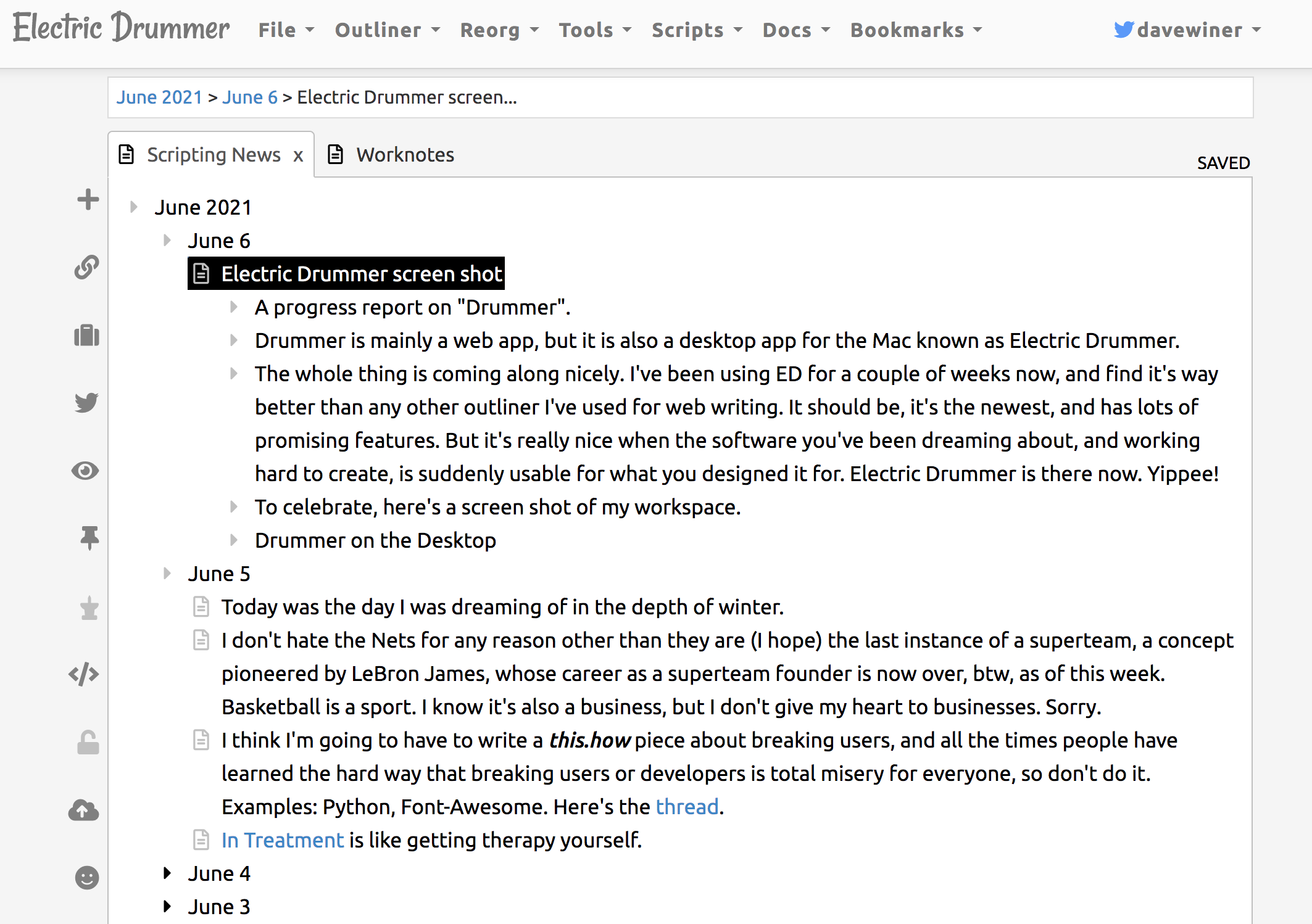
Electric Drummer screen shot Scripting News(cached at June 6, 2021, 5:32 pm)

A progress report on Drummer.

Drummer is mainly a web app, but it is also a desktop app for the Mac known as Electric Drummer.

The whole thing is coming along nicely. I've been using ED for a couple of weeks now, and find it's way better than any other outliner I've used for web writing. It should be, it's the newest, and has lots of promising features. But it's really nice when the software you've been dreaming about, and working hard to create, is suddenly usable for what you designed it for. Electric Drummer is there now. Yippee!

To celebrate, here's a screen shot of my workspace.

FBI Charges Woman With Writing Code For 'Trickbot' Ransomware Gang Slashdotby EditorDavid on crime at January 1, 1970, 1:00 am (cached at June 6, 2021, 5:06 pm)

Slashdot reader Charlotte Web summarizes a Department of Justice press release: The U.S. Department of Justice says "millions" of computers around the world were infected with the Trickbot malware, which was used "to harvest banking credentials and deliver ransomware." In February they arrested a 55-year-old woman in Miami, Florida, saying she and her associates "are accused of infecting tens of millions of computers worldwide, in an effort to steal financial information to ultimately siphon off millions of dollars through compromised computer systems," according to Special Agent in Charge Eric B. Smith of the FBI's Cleveland Field Office. In October ZDNet was calling Trickbot "one of today's largest malware botnets and cybercrime operations." Yesterday that woman — Alla Witte, aka "Max" — was arraigned in federal court in Cleveland, Ohio. According to the indictment, Witte worked as a malware developer for the Trickbot Group and wrote code related to the control, deployment, and payments of ransomware. From the Department of Justice announcement: The ransomware informed victims that their computer was encrypted, and that they would need to purchase special software through a Bitcoin address controlled by the Trickbot Group to decrypt their files. In addition, Witte allegedly provided code to the Trickbot Group that monitored and tracked authorized users of the malware and developed tools and protocols to store stolen login credentials... Witte and her co-conspirators allegedly worked together to infect victim computers with the Trickbot malware designed to capture online banking login credentials and harvest other personal information, including credit card numbers, emails, passwords, dates of birth, social security numbers and addresses. Witte and others also allegedly captured login credentials and other stolen personal information to gain access to online bank accounts, execute unauthorized electronic funds transfers and launder the money through U.S. and foreign beneficiary accounts... If convicted, Witte faces a maximum penalty of 30 years in prison for conspiracy to commit wire and bank fraud; 30 years in prison for each substantive bank fraud count; a two-year mandatory sentence for each aggravated identity theft count, which must be served consecutively to any other sentence; and 20 years in prison for conspiracy to commit money laundering. The indictment alleges that "beginning in November 2015, Witte and others stole money and confidential information from unsuspecting victims, including businesses and their financial institutions in the United States, United Kingdom, Australia, Belgium, Canada, Germany, India, Italy, Mexico, Spain, and Russia through the use of the Trickbot malware." The AP reports the group is now accused of targeting high-reward victims which included hospitals, schools, public utilities, and governments, as well as real estate and law firms and country clubs. Interestingly, this case is part of the U.S. Department of Justice's "Ransomware and Digital Extortion Task Force," with its Criminal Division working with the U.S. Attorneys' Offices and prioritizing the disruption, investigation, and prosecution of ransomware "by tracking and dismantling the development and deployment of malware, identifying the cybercriminals responsible, and holding those individuals accountable for their crimes," according to the department's statement. "The department, through the Task Force, also strategically targets the ransomware criminal ecosystem as a whole and collaborates with domestic and foreign government agencies as well as private sector partners to combat this significant criminal threat." "These charges serve as a warning to would-be cybercriminals," said Deputy Attorney General Lisa O. Monaco, "that the Department of Justice, through the Ransomware and Digital Extortion Task Force and alongside our partners, will use all the tools at our disposal to disrupt the cybercriminal ecosystem."

Read more of this story at Slashdot.

How Steve Jobs Wrote 'the Most Important Email in the History of Business' Slashdotby EditorDavid on iphone at January 1, 1970, 1:00 am (cached at June 6, 2021, 2:05 pm)

A new column in Inc. argues that 14 years ago, Steve Jobs sent the most important email in the history of business — a one-sentence email to Bertrand Serlet, the company's senior vice president of Software Engineering, that's just recently been made public (through Apple's trial with Epic): It reveals a conversation about the things Apple needs to be able to accomplish in order to allow third-party apps on the iPhone. Until that point, the iPhone only ran 16 apps pre-installed on every device. Jobs had famously said told developers that if they wanted to create apps for the iPhone, they could make web apps that ran in Safari... Except web apps aren't the same as native apps, and users immediately set about finding ways to jailbreak their devices in order to get apps on them. Apple had really no choice but to find a way to make it possible to develop apps through some kind of official SDK. Serlet lays out a series of considerations about protecting users, creating a development platform, and ensuring that the APIs needed are sustainable and documented. The list only has 4 things, but the point Serlet is trying to make is that it is important to Apple to "do it right this time, rather than rush a half-cooked story with no real support." Steve Jobs' reply was only one sentence long: "Sure, as long as we can roll it all out at Macworld on Jan 15, 2008." That's it. That's the entire response. Serlet's email is dated October 2, 2007. That means Jobs was giving him just over three months... Three months to do what the software engineer no doubt believed were critical steps if Apple was going to support apps on a platform that would eventually grow to over 1 billion devices worldwide and become one of the most valuable businesses of all time. As if that wasn't enough pressure, two weeks later, on October 17, Jobs publicly told developers that there would be an SDK available by February of 2008. It turns out it would actually be made available in March, and the App Store would launch later in July of that year. At the time, Apple's market cap was around $150 billion. Today, it's more than $2 trillion, largely based on the success of the iPhone, which is based — at least in part — on the success of the App Store. For that reason alone, I think it's fair to say — in hindsight — that one-sentence reply has no doubt proven to be the most important email in the history of business.

Read more of this story at Slashdot.

How Amazon Became an Engine For Anti-Vaccine Misinformation Slashdotby EditorDavid on business at January 1, 1970, 1:00 am (cached at June 6, 2021, 9:35 am)

Type "vaccines" into Amazon's search bar, and its auto-complete suggests "are dangerous" for your search. But that's just part of a larger problem, points out Fast Company (in an article shared by Slashdot reader tedlistens). For example, Amazon's search results are touting as "best sellers!" many books with some very bad science: Offered by small publishers or self-published through Amazon's platform, the books rehearse the falsehoods and conspiracy theories that fuel vaccine opposition, steepening the impact of the pandemic and slowing a global recovery. They also illustrate how the world's biggest store has become a megaphone for anti-vaccine activists, medical misinformers, and conspiracy theorists, pushing dangerous falsehoods in a medium that carries more apparent legitimacy than just a tweet. "Without question, Amazon is one of the greatest single promoters of anti-vaccine disinformation, and the world leader in pushing fake anti-vaccine and COVID-19 conspiracy books," says Peter Hotez, a pediatrician and vaccine expert at the Baylor College of Medicine. For years, journalists and researchers have warned of the ways fraudsters, extremists, and conspiracy theorists use Amazon to earn cash and attention. To Hotez, who has devoted much of his career to educating the public about vaccines, the real-world consequences aren't academic. In the U.S. and elsewhere, he says, vaccination efforts are now up against a growing ecosystem of activist groups, foreign manipulators, and digital influencers who "peddle fake books on Amazon...." Gradually, Amazon has taken a tougher approach to content moderation, and to a seemingly ceaseless onslaught of counterfeits, fraud, defective products, and toxic speech... Despite its sweeps, however, Amazon is still flooded with misinformation, and helping amplify it too: A series of recent studies and a review by Fast Company show the bookstore is boosting misinformation around health-related terms like "autism" or "covid," and nudging customers toward a universe of other conspiracy theory books. In one audit first published in January, researchers at the University of Washington surveyed Amazon's search results for four dozen terms related to vaccines. Among 38,000 search results and over 16,000 recommendations, they counted nearly 5,000 unique products containing misinformation, or 10.47% of the total. For books, they found that titles deemed misinformative appeared higher in search results than books that debunked their theories. "Overall, our audits suggest that Amazon has a severe vaccine/health misinformation problem exacerbated by its search and recommendation algorithms," write Prerna Juneja and Tanushee Mitra in their paper, presented last month at the CHI Conference on Human Factors in Computing Systems. "Just a single click on an anti-vaccine book could fill your homepage with several other similar anti-vaccine books..." Like any products on Amazon, or any content across social media platforms, anti-vaccine titles also benefit from an algorithmically-powered ranking system. And despite the company's aggressive efforts to battle fraud, it's a system that's still easily manipulated through false reviews... Much of the uproar about misinformation has focused on Facebook, YouTube, and Twitter, but Amazon's role deserves more attention, says Marc Tuters, an assistant professor of new media at the University of Amsterdam, who helped lead the Infodemic.eu study. The retailer sells half of all the books in the U.S. and its brand is highly trusted by consumers.

Read more of this story at Slashdot.

Comic for June 05, 2021 Dilbert Daily Strip(cached at June 6, 2021, 9:31 am)

Dilbert readers - Please visit Dilbert.com to read this feature. Due to changes with our feeds, we are now making this RSS feed a link to Dilbert.com.
Judge's Ruling Calls Disney's Star Wars Sequels 'Mediocre' and 'Schlocky' Slashdotby EditorDavid on starwars at January 1, 1970, 1:00 am (cached at June 6, 2021, 7:06 am)

"It is now written in the annals of legal history that Disney's Star Wars sequels, specifically The Last Jedi and The Rise of Skywalker, are mediocre," writes MovieWeb: This, according to Ninth Circuit Court Judge Kenneth K. Lee, who recently referred to the movies as such in a recent legal ruling... Judge Lee recently handed down a ruling in regards to a class action lawsuit against ConAgra Foods Inc. The case had to do with whether or not the company was responsible for placing a "100% Natural" label on bottles of Wesson Oil. ConAgra Foods no longer owns Wesson Oil.... And, as the judge found in his ruling, the company simply doesn't have the power to make that sort of call anymore.... This is where things get interesting. At this point in the ruling, Judge Lee decided to make a comparison, and that's where Star Wars comes in. It would seem the judge is a fan and he decided to liken the situation to Disney producing a trilogy of sequels after Lucasfilm was sold to them by George Lucas in 2012. And, in his professional, legal opinion, those movies were not up to snuff. "That is like George Lucas promising no more mediocre and schlocky Star Wars sequels shortly after selling the franchise to Disney. Such a promise would be illusory." That wasn't the end of it either. In a footnote at the end of that page in the document, Judge Lee added some clarification saying, "As evident by Disney's production of The Last Jedi and The Rise of Skywalker."

Read more of this story at Slashdot.

'TikTok Detected My ADHD Before I Did' Slashdotby EditorDavid on social at January 1, 1970, 1:00 am (cached at June 6, 2021, 3:35 am)

"It's kind of embarrassing to say, but the social media app TikTok figured out I had ADHD before I did," writes 23-year-old Australian journalist Matilda Boseley in The Guardian. "For 23 years my parents, my teachers, my doctor, my psychologist and my own brain all missed the warning signs, yet somehow it only took that app's algorithm a few days to accidentally diagnose me..." Growing up I had always had a nagging feeling that everyone else in the world was coping better than I was. Somehow they could remember appointments and deadlines, they had the discipline to keep an updated planner and they didn't drift off daydreaming in the middle of important conversations... I just felt like there were 10 TVs constantly switched on in my head, and with so much going on, all the small things would fall through the cracks. It wasn't until I downloaded TikTok that I truly considered I might have the disorder. See, the app is based around the "for you" page which curates a stream of videos for you. It starts out pretty generic, but as you "like" some videos, and quickly scroll past others, the app's algorithm builds a profile of you and your interests. And that profile is scarily accurate sometimes. It genuinely knew me better than I knew myself. What I think happened is that the algorithm noticed that every time a video titled something like "Five little known signs of ADHD in women" showed up on my feed I would watch it, fascinated, all the way to the end. So, like the dystopian capitalism machine it is, the app showed me more and more of these videos desperate to keep me on the app and extract every possible advertising cent my eyeballs could buy. But, as a side effect, all of a sudden I was seeing ADHD content made by women and for women, for the very first time. It was like someone putting everything that always felt weird in my brain into words. Forgetting something exists if you can't see it could be a problem with "object permanence". Being unable to stand up and tidy my apartment, despite desperately wanting to, might not be laziness; it could be "executive dysfunction". Suddenly it occurred to me, maybe I wasn't somehow just "worse at being a person" than everyone else. Maybe I simply didn't have enough dopamine in my brain. I can't overstate how liberating that felt. So I booked a doctor's appointment, and three referrals, four months and about $700 later my new psychiatrist looked straight into the webcam and said: "Yes, I think you clearly have ADHD and you've had it for your whole life." I cried from joy when he said it. Mental health experts told me it wasn't actually that surprising that hearing first-hand accounts of neurodivergence is what finally made the pin drop. In fact, Beyond Blue's lead clinical advisor Dr Grant Blashki said social media could be an extraordinarily powerful tool for increasing what the medical community refer to as "mental health literacy". In fact "learning you have ADHD on TikTok" is now such a common phenomenon that it's become its own meme on the app. There isn't any hard and fast data on the phenomenon but just from my own experience, since telling my friends about my diagnosis, no less than four people have come back to me saying they reckon they might have it too... At the end of the day I am so grateful for TikTok, and the creators that make ADHD videos. That algorithm has profoundly changed my life, undoubtedly for the better.

Read more of this story at Slashdot.