Chinese TV Maker Skyworth Under Fire For Excessive Data Collection That Users Call S Slashdotby msmash on privacy at January 1, 1970, 1:00 am (cached at May 11, 2021, 11:35 pm)

Chinese television maker Skyworth has issued an apology after a consumer found that his set was quietly collecting a wide range of private data and sending it to a Beijing-based analytics company without his consent. From a report: A network traffic analysis revealed that a Skyworth smart TV scanned for other devices connected to the same local network every 10 minutes and gathered data that included device names, IP addresses, network latency and even the names of other Wi-Fi networks within range, according to a post last week on the Chinese developer forum V2EX. The data was sent to the Beijing-based firm Gozen Data, the forum user said. Gozen is a data analytics company that specialises in targeted advertising on smart TVs, and it calls itself Chinaâs first "home marketing company empowered by big data centred on family data." The user did not identify himself, and efforts to contact the person received no reply. However, the post quickly picked up steam, touching a nerve among Chinese consumers and prompting angry comments. "Isn't this already the criminal offence of spying on people?" asked one user on Sina.com, a Chinese financial news portal. "Whom will the collected data be sold to, and who is the end user of this data?"

Read more of this story at Slashdot.
East Coast Facing Gas Shortage Due To Ransomware Attack Slashdotby msmash on security at January 1, 1970, 1:00 am (cached at May 11, 2021, 10:35 pm)

New submitter TheCowSaysMoo writes: Gas stations from Florida to Virginia began running dry and prices at the pump jumped on Tuesday as the shutdown of the biggest U.S. fuel pipeline by hackers extended into a fifth day and sparked panic buying by motorists. About 7.5% of gas stations in Virginia and 5% in North Carolina had no fuel on Tuesday as demand jumped 20%, tracking firm GasBuddy said. Prices rose to their highest in more than six years, and Georgia suspended sales tax on gas until Saturday to ease the strain on consumers. North Carolina declared an emergency. Colonial Pipeline has forecast that it will not substantially restore operations of the 5,500-mile pipeline network that supplies nearly half of the East Coast's fuel until the end of the week. The company preventively shut the pipeline on Friday after hackers locked its computers and demanded ransom, underscoring the vulnerability of U.S. energy infrastructure to cyberattack.

Read more of this story at Slashdot.
Google Plans To Double AI Ethics Research Staff Slashdotby msmash on google at January 1, 1970, 1:00 am (cached at May 11, 2021, 10:05 pm)

Alphabet's Google plans to double the size of its team studying artificial-intelligence ethics in the coming years, as the company looks to strengthen a group that has had its credibility challenged by research controversies and personnel defections. From a report: Vice President of Engineering Marian Croak said at The Wall Street Journal's Future of Everything Festival that the hires will increase the size of the responsible AI team that she leads to 200 researchers. Additionally, she said that Alphabet Chief Executive Sundar Pichai has committed to boost the operating budget of a team tasked with evaluating code and product to avert harm, discrimination and other problems with AI. "Being responsible in the way that you develop and deploy AI technology is fundamental to the good of the business," Ms. Croak said. "It severely damages the brand if things aren't done in an ethical way." Google announced in February that Ms. Croak would lead the AI ethics group after it fired the division's co-head, Margaret Mitchell, for allegedly sharing internal documents with people outside the company. Ms. Mitchell's exit followed criticism of Google's suppression of research last year by a prominent member of the team, Timnit Gebru, who says she was fired because of studies critical of the company's approach to AI. Mr. Pichai pledged an investigation into the circumstances around Ms. Gebru's departure and said he would seek to restore trust.

Read more of this story at Slashdot.

Testing local file system with Logseq Scripting News(cached at May 11, 2021, 7:32 pm)

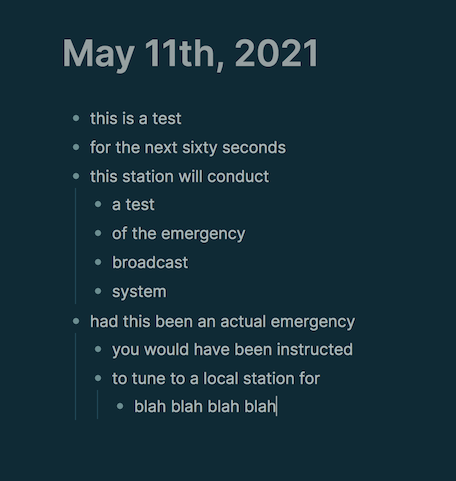
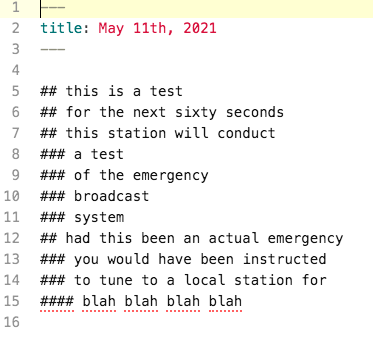
Okay I don't know much about either Logseq or local file systems, but I'm just trying it out, starting on this page. There was a box I clicked on that asked it to connect with the local file system. I was expecting something like localStorage, but it's not, it's better. The files are stored in a folder on my local system. That means they can be used by, or generated by, other apps. Very nice. I'm not sure what Logseq does with them from there, if they can be connected with other apps in some way.

Anyway, here are two screen shots.

Tech Giants Join Call for Funding Chip Production Slashdotby msmash on usa at January 1, 1970, 1:00 am (cached at May 11, 2021, 7:05 pm)

Some of the world's biggest chip buyers, including Apple, Microsoft and Alphabet's Google, are joining top chip-makers such as Intel to create a new lobbying group to press for government chip manufacturing subsidies. From a report: The newly formed Semiconductors in America Coalition, which also includes Amazon.com's Amazon Web Services, said Tuesday it has asked U.S. lawmakers to provide funding for the CHIPS for America Act, for which President Joe Biden has asked Congress to provide $50 billion. "Robust funding of the CHIPS Act would help America build the additional capacity necessary to have more resilient supply chains to ensure critical technologies will be there when we need them," the group said in a letter to Democratic and Republican leaders in both houses of the U.S. Congress. A global chip shortage has hit automakers hard, with Ford Motor saying it could halve second-quarter production. Automotive industry groups have pressed the Biden administration to secure chip supply for car factories. But Reuters last week reported administration officials were reluctant to use a national security law to redirect computer chips to automakers because doing so could hurt other industries. The new coalition includes some of those other chip-consuming industries, with members such as AT&T, Cisco Systems, General Electric, Hewlett Packard Enterprise and Verizon Communications. It cautioned against government actions to favor a single industry such as automakers.

Read more of this story at Slashdot.

[no title] Scripting News(cached at May 11, 2021, 7:03 pm)

Reading various discussions I see some people are using an experimental feature developed by Mozilla, a local sandboxed file system running in the browser and accessible via JavaScript. I'm taking a look at it.
[no title] Scripting News(cached at May 11, 2021, 7:03 pm)

BTW, here's my blog, and this is the OPML file it's generated from. Gives you an idea of how a chronologic outline can be turned into a publication. My blog has been running since 1994, and for most of it, I've been writing it in my outliner. I did take a few detours to use other tools I was working on, but realized eventually that the only writing tool for me is the outliner.
[no title] Scripting News(cached at May 11, 2021, 7:03 pm)

Interesting tweet from a person named SMS. "I would love to see how your outliner app can work with Logseq. A few Obsidian users had got Logseq to work with Obsidian on the same folder." Lots of new terms in that sentence. He posted a pointer to this post. Okay so Obsidian is something like Roam, but it's an open system, where Roam is a silo with lots of lock-in. So we like Obsidian over Roam, instantly -- simply because our tools (yours and mine) have a chance of participating, where Roam, well we can use their outliner, and get locked-in, which I don't see happening any time soon. LO2 is where we start. Since outlines are in an easily used and open format dating back over 20 years, and can be made accessible to any web-able app (by making them public), it should be possible to easily hook it up to Obsidian or any similarly open platform. This is a good place to start. Now, this has to be a community thing, because I'm busy working on a new product, and don't want to detour. And that's why we support open formats and protocols, so there are no limits on what users and devs can do. See my no-lock-in pledge. This isn't new, it's the same idea I've been using since I started developing commercial software, way back with ThinkTank in 1983.
Intel Unveils Full Tiger Lake-H Processor Line-Up For Higher Performance Laptops Slashdotby msmash on intel at January 1, 1970, 1:00 am (cached at May 11, 2021, 6:35 pm)

MojoKid writes: In January, Intel officially announced its Tiger Lake-H mobile platform, but today disclosed full details on the new, higher-end variant of Tiger Lake manufactured using 10nm SuperFIN technology, that brings with it a few significant platform enhancements beyond just its clock speed and core count boost. Intel is refreshing the lineup with higher-power and higher-performance Tiger Lake-H45 processors, with up to 8 physical cores (16 threads). In addition, the CPUs feature 20 reconfigurable PCI Express 4.0 lanes attached directly to the processor, which enable PCIe 4.0 NVMe RAID -- a first for any mobile platform. The platform features all of the latest IO and connectivity technologies, like Killer Wi-Fi 6 / 6E, Thunderbolt 4, and support for Resizable BAR. There are an array of consumer and commercial Tiger Lake-H based 11th Gen Intel Core H-series processors coming down the pipeline. The top-end consumer SKU is the Core i9-11980HK, which is an 8-core / 16-thread processor, with a base clock of 2.6GHz and maximum turbo clock of 5GHz on one or two cores. What also makes this particular processor interesting is that it is fully unlocked and overclockable via Intel's XTU utility. Intel has shipped millions of units volume to laptop OEMs already and expects to have laptops in market from all of the majors this month.

Read more of this story at Slashdot.

FCC Approves $7B Broadband Connectivity Fund Slashdotby msmash on communications at January 1, 1970, 1:00 am (cached at May 11, 2021, 5:35 pm)

The US Federal Communications Commission has unanimously approved the final rules to implement the $7.17 billion Emergency Connectivity Fund Program. The FCC program will provide funding for schools and libraries across the country to buy laptops, tablets, Wi-Fi hotspots and broadband connections to help students and teachers to access the internet for online learning during the pandemic. From a report: The program is part of President Joe Biden's $1.9 trillion American Rescue Plan. It also follows the FCC approving a plan in February to administer $3.2 billion in emergency relief to subsidize broadband for millions of Americans during the pandemic. That program will provide $50 per month to low-income households and $75 per month to households on Native American lands to cover the cost of broadband services starting May 12. It also provides $100 toward buying a laptop or tablet. "Between this Emergency Connectivity Fund Program and the Emergency Broadband Benefit Program, we are investing more than $10 billion in American students and households," Jessica Rosenworcel, acting chairwoman of the FCC, said in a statement Monday. "These investments will help more Americans access online education, healthcare and employment resources. They will help close the homework gap for students nationwide."

Read more of this story at Slashdot.

Apple Gave Zoom Access To Special API to Use iPad Camera During Split View Multitask Slashdotby msmash on apple at January 1, 1970, 1:00 am (cached at May 11, 2021, 5:05 pm)

AmiMoJo writes: Zoom, a hallmark platform used by millions during the global health crisis, has been given access to a special iPadOS API that allows the app to use the iPad camera while the app is in use in Split View multitasking mode. This case of special treatment was first brought to attention by app developer Jeremy Provost, who, in a blog post, explains that Zoom uses a special API that allows the app to continue using and accessing the âOEiPadâOE camera while the app is being used in Split View mode. Zoom can do this thanks to an "entitlement," which grants developers the ability to execute a particular capability with an API. As Provost notes, Apple publicly documents the ability for developers to apply for several different entitlements, such as ones related to CarPlay, HomeKit, and more. However, the special API that Zoom has been given is not offered to other developers by Apple, nor is its existence acknowledged by the company itself. On the Zoom Developer Forum, a staff member for the video conferencing platform had confirmed earlier in February that Zoom has access to the "com.apple.developer.avfoundation.multitasking-camera-access," or âOEiPadâOE Camera Multitasking entitlement. Further reading: Apple Offered Special App Store API Access To Hulu and Other Developers.

Read more of this story at Slashdot.

Facebook Ordered To Stop Collecting German WhatsApp Data Slashdotby msmash on facebook at January 1, 1970, 1:00 am (cached at May 11, 2021, 4:35 pm)

Facebook was ordered to stop collecting German users' data from its WhatsApp unit, after a regulator in the nation said the company's attempt to make users agree to the practice in its updated terms isn't legal. From a report: Johannes Caspar, who heads Hamburg's privacy authority, issued a three-month emergency ban, prohibiting Facebook from continuing with the data collection. He also asked a panel of European Union data regulators to take action and issue a ruling across the 27-nation bloc. The new WhatsApp terms enabling the data scoop are invalid because they are intransparent, inconsistent and overly broad, he said. "The order aims to secure the rights and freedoms of millions of users which are agreeing to the terms Germany-wide," Caspar said in a statement on Tuesday. "We need to prevent damage and disadvantages linked to such a black-box-procedure." The order strikes at the heart of Facebook's business model and advertising strategy. It echoes a similar and contested step by Germany's antitrust office attacking the network's habit of collecting data about what users do online and merging the information with their Facebook profiles. That trove of information allows ads to be tailored to individual users -- creating a cash cow for Facebook.

Read more of this story at Slashdot.

China Records Slowest Population Growth In Decades Slashdotby BeauHD on china at January 1, 1970, 1:00 am (cached at May 11, 2021, 3:05 pm)

An anonymous reader quotes a report from the BBC: China's population grew at its slowest pace in decades, according to government data released on Tuesday. The average annual growth rate was 0.53% over the past 10 years, down from a rate of 0.57% between 2000 and 2010 -- bringing the population to 1.41 billion. The results add pressure on Beijing to boost measures for couples to have more babies and avert a population decline. The results were announced in a once-a-decade census, which was originally expected to be released in April. The census was conducted in late 2020 where some seven million census takers had gone door-to-door to collect information from Chinese households. Given the sheer number of people surveyed, it is considered the most comprehensive resource on China's population, which is important for future planning. Ning Jizhe, head of the National Bureau of Statistics revealed that 12 million babies were born last year -- a significant decrease from the 18 million newborns in 2016. However he added that it was "still a considerable number." [...] China's working-age population -- which it defines as people aged between 16 and 59 -- has also declined by 40 million as compared to the last census in 2010. But chief methodologist Zeng Yuping said that the total size "remains big" with 880 million. "We still have an abundant labour force," he said. However, [principal economist from The Economist Intelligence Unit, Ms Yue Su] warned that going forward, continued drops in the labour force "will place a cap on China's potential economic growth." She added: "The demographic dividend that propelled the country's economic rise over recent decades is set to dissipate quickly." Last month, the Census Bureau reported that the United States population grew at the slowest rate since the 1930s, "a remarkable slackening that was driven by a leveling off of immigration and a declining birthrate," reports The New York Times.

Read more of this story at Slashdot.

IBM's CodeNet Dataset Can Teach AI To Translate Computer Languages Slashdotby BeauHD on programming at January 1, 1970, 1:00 am (cached at May 11, 2021, 12:05 pm)

IBM announced during its Think 2021 conference on Monday that its researchers have crafted a Rosetta Stone for programming code. Engadget reports: In effect, we've taught computers how to speak human, so why not also teach computers to speak more computer? That's what IBM's Project CodeNet seeks to accomplish. "We need our ImageNet, which can snowball the innovation and can unleash this innovation in algorithms," [Ruchir Puri, IBM Fellow and Chief Scientist at IBM Research, said during his Think 2021 presentation]. CodeNet is essentially the ImageNet of computers. It's an expansive dataset designed to teach AI/ML systems how to translate code and consists of some 14 million snippets and 500 million lines spread across more than 55 legacy and active languages -- from COBOL and FORTRAN to Java, C++, and Python. "Since the data set itself contains 50 different languages, it can actually enable algorithms for many pairwise combinations," Puri explained. "Having said that, there has been work done in human language areas, like neural machine translation which, rather than doing pairwise, actually becomes more language-independent and can derive an intermediate abstraction through which it translates into many different languages." In short, the dataset is constructed in a manner that enables bidirectional translation. That is, you can take some legacy COBOL code -- which, terrifyingly, still constitutes a significant amount of this country's banking and federal government infrastructure -- and translate it into Java as easily as you could take a snippet of Java and regress it back into COBOL. CodeNet can be used for functions like code search and clone detection, in addition to its intended translational duties and serving as a benchmark dataset. Also, each sample is labeled with its CPU run time and memory footprint, allowing researchers to run regression studies and potentially develop automated code correction systems. Project CodeNet consists of more than 14 million code samples along with 4000-plus coding problems collected and curated from decades' of programming challenges and competitions across the globe. "The way the data set actually came about," Puri said, "there are many kinds of programming competitions and all kinds of problems -- some of them more businesslike, some of them more academic. These are the languages that have been used over the last decade and a half in many of these competitions with 1000s of students or competitors submitting solutions." Additionally, users can run individual code samples "to extract metadata and verify outputs from generative AI models for correctness," according to an IBM press release. "This will enable researchers to program intent equivalence when translating one programming language into another." [...] IBM intends to release the CodeNet data to the public domain, allowing researchers worldwide equal and free access.

Read more of this story at Slashdot.

Voyager 1 Detects Plasma 'Hum' Slashdotby BeauHD on space at January 1, 1970, 1:00 am (cached at May 11, 2021, 10:05 am)

Obipale shares a report from Phys.Org: Voyager 1 -- one of two sibling NASA spacecraft launched 44 years ago and now the most distant human-made object in space -- still works and zooms toward infinity. The craft has long since zipped past the edge of the solar system through the heliopause -- the solar system's border with interstellar space -- into the interstellar medium. Now, its instruments have detected the constant drone of interstellar gas (plasma waves), according to Cornell University-led research published in Nature Astronomy. Examining data slowly sent back from more than 14 billion miles away, Stella Koch Ocker, a Cornell doctoral student in astronomy, has uncovered the emission. "It's very faint and monotone, because it is in a narrow frequency bandwidth," Ocker said. "We're detecting the faint, persistent hum of interstellar gas." This work allows scientists to understand how the interstellar medium interacts with the solar wind, Ocker said, and how the protective bubble of the solar system's heliosphere is shaped and modified by the interstellar environment.

Read more of this story at Slashdot.