About a year ago I decided to cut the cord and turn off the TV service from my cable provider, Spectrum. I returned my settop box, which I had never actually installed, because I used their Roku app instead.
I subscribed to YouTube TV so I could watch news and some sports. It concerned me that they didn't have MSG or SNY for the Knicks and Mets, but there wasn't much sports last year anyway, with the pandemic and lockdowns.
I went without HBO because I was getting that from Spectrum, and I binged on Netflix, Amazon, Hulu, and a few other services from time to time, but those were the main ones.
Then the Knicks season started. I could see from the highlights and news that this seson they were actually an exciting team, very unusual, I wanted to watch, so I set out on a lengthy search, because the information out there is so poor, only to learn that there is literally no way to get MSG and SNY, the broadcasters of Knicks and Mets games, without Spectrum. The local sports teams are not available to cable-cutters, at least not where I live.
As I wrote about this on my blog, I got lots of emails saying that this service or that would give me what I wanted. I even tried using Spectrum's "streaming" service, which you can order online, but none of them had the Knicks.
So I decided to undo the grand cable-cutting experiment, called Spectrum and got back on board with the cable TV service, got a new settop box, which will never be unpacked and will stay in a closet, and happily watched the Knicks during this very interesting, exciting and fun season.
But this piece is about HBO, not the Knicks.
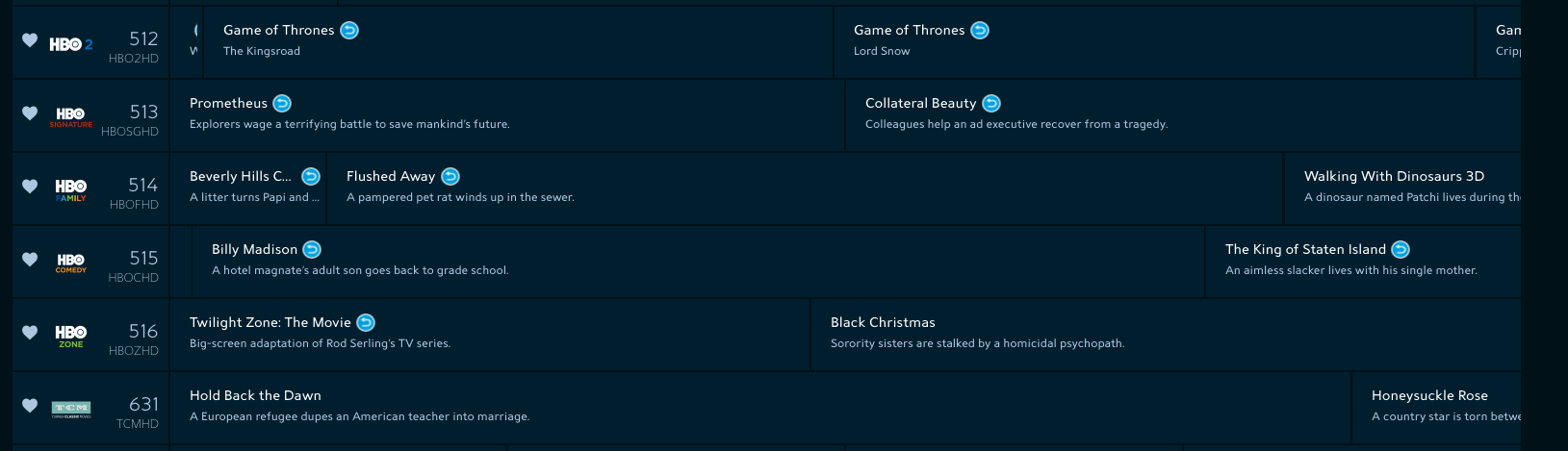
Now as a Spectrum user, I can use the HBO Max app. I've paid to access it. And at the same time, HBO appears in the Listings in the Spectrum app. So I added them to my favorites. So now when I have to choose between something to watch, HBO is one of the choices. And the big difference here is that they pick what to offer me, just like the old days. They have a schedule. And guess what, I watch a lot more HBO this way than I did when I have full choice over what to watch through the streaming app. This is the point of the story.
An example. Last night just before Ari Melber comes on at 6PM, I got bored with the usual stuff on CNN and MSNBC, so I looked around, and saw that The Godfather had just started. I switched to it, and there's Don Corleone sitting behind his desk with the cat in his lap, listening to Bonasera, the undertaker, completely blowing his pitch to the Don. It's a riveting scene. So much to watch. The performance of it. Comparing it to the boring plays they act out on CNN, for months, is ridiculous. One is a masterpiece, the other is completely lost, worthless, not even good for passing the time while playing games on my iPad.
BTW, I watched The Godfather all the way to the end. I didn't get up once. It was the best couple of hours I had spent on entertainment in years.
Browsing on HBO Max, I would never think to click on The Godfather as I'm bored looking for something to watch. I think other people have observed this too. Most of my time on these apps is spent looking for something to watch, as opposed to watching.
The idea of scheduled broadcasts is actually very appealing, to my surprise! I thought for sure the revolution was permanent, that we would always be programming our TV-watching experience for ourselves once we had the chance. But there are real problems with that approach.
- How do I know if something is good? I have no idea. And to find out, I have to search for the title on Metacritic, see the total score, and then skim the reviews. A lot of typing and waiting and reading, so I don't do it very often. Much faster just to go on to the next one.
- I might have heard of a show or movie I want to watch, but I have no idea if it's playing somewhere I can access. For example, I was looking for Howard's End, because the story was written by the author of a book I had just read and loved. Amazon has a big advantage here, you can get almost everything, but mostly they are not included in the video bundle, so you have to pay extra. I figure I'm already paying enough to all the streaming services, I should watch something that's included, and eventually Howard's End will show up.
On the other hand, I guess I'll pretty much always watch The Godfather, or Kill Bill 2 when given a chance to. There are actually a lot of movies like that. And now, unlike the past, there are no commercials, and they leave the sex and violence in. And the Knicks, which I watched instead of Maddow, oy! What a game. The ups and downs, tragedy and heroic play, the back-stories and history -- all in just an hour. MSNBC, comparitively, is transparently nothing. The best they have is a powerless Congressperson who is ridiculously corrupt and popular (maybe) on Fox who has been caught. They can't explain why anyone should care. They need a new purpose.