A Folding iPhone Could Be Coming In 2023 Slashdotby BeauHD on iphone at January 1, 1970, 1:00 am (cached at March 2, 2021, 11:05 pm)

Analyst Ming-Chi Kuo says that Apple could be launching a folding iPhone in 2023, and that the phone could have a screen between 7.5 and eight inches. The Verge reports: There have been numerous reports about Apple prototyping a folding iPhone, but according to MacRumors, Kuo says that the product has "not yet officially kicked off." According to Kuo, the screen will be iPad Mini-sized when folded out, so it seems as if Apple is going for the Galaxy Fold approach of having a regular-sized phone that folds out into a small tablet, rather than the Z Flip or Razr approach of having a compact folding phone. (This is a bummer to me, but it seems like the folding phablet approach is the most popular at the moment.) It's unclear who would be making those folding displays -- there have been rumors of Apple working with both LG and Samsung. While the rumors of a prototype and this report from Kuo indicate that Apple is indeed working on a folding phone, it's not something to wait around for just yet. Kuo's 2023 launch date is dependent on Apple being able to figure out "key technology and mass production issues." As we've seen, folding phones can be hard to get right. If Apple can do it, though, it could be in the position to do what it does best: adopt a technology after other companies have figured out the bugs and pitfalls, and release a product that seems polished in comparison.

Read more of this story at Slashdot.
Google-Free<nobr> <wbr></nobr>/e/ OS Is Now Selling Preloaded Phones In the US, Star Slashdotby BeauHD on android at January 1, 1970, 1:00 am (cached at March 2, 2021, 10:35 pm)

An anonymous reader quotes a report from Ars Technica: /e/ OS, the "open-source, pro-privacy, and fully degoogled" fork of Android, is coming to Canada and the USA. Of course, you've always been able to download the software in any region, but now (as first spotted by It's Foss News) the e Foundation will start selling preloaded phones in North America. Previously, /e/ only did business in Europe. Like normal, the e Foundation's smartphone strategy is to sell refurbished Samsung devices with /e/ preloaded. In the US, there are only two phones right now: the Galaxy S9 for $379.99 or a Galaxy S9+ for $429.99. North Americans still have reason to be jealous of Europe, where you can get /e/ preloaded on a Fairphone, which is also Europe-exclusive. These Samsung phones are used devices, but the site says the devices have "been checked and reconditioned to be fully working at our partner's facilities." The phones have a one-year warranty and are described as "Good-as-New" with "no surprises." An /e/ device means you'll be getting a fork of Android 10, and for ongoing support, the e Foundation says, "We aim to support with at least 3 years of software updates and security patches." /e/ OS was founded by Gael Duval, the creator of Mandrake Linux, and the project describes itself as a "non-profit project in the public interest." /e/ is built a lot like a Linux distribution, in that it takes a curated collection of other open source projects, merges them into a single product, and does its best to fill in the remaining gaps. In this case, /e/ is based on LineageOS, the Android community's open source, device-ready version of Google's Android source code. The primary contribution of /e/ is filling in all the gaps left by the lack of Google apps, so there's an /e/ app store, an /e/ cloud storage and account system, and various Google-replacement apps like a Chromium-based browser, a fork of K-9 Mail for email, contacts, search, photos, etc. The company is even trying to build a Google Assistant replacement. Actually getting regular Android apps to run on a forked version of Android is a challenge. Google Play Services is built into many apps for things like push notifications, and there's a good chance that functionality won't work on /e/ OS. These apps will at least run on /e/ OS instead of exiting outright, thanks to the inclusion of MicroG, an open source project that hijacks Google API calls.

Read more of this story at Slashdot.
PayPal In Talks To Buy Crypto Custody Firm Curv, Reports Say Slashdotby msmash on bitcoin at January 1, 1970, 1:00 am (cached at March 2, 2021, 10:05 pm)

PayPal is said to be in the process of buying Curv, a technology firm that powers the secure storage of cryptocurrency, news outlet CoinDesk reported Tuesday, citing three sources familiar with the situation. From the report: Israeli news outlet Calcalist reported Tuesday that Curv was being sold for between $200 million and $300 million, without naming the buyer. "PayPal is buying Curv for $500 million," a source from within the digital asset custody space told CoinDesk on Monday. "From where I'm hearing it, I'm pretty sure it's true." Several people in the cryptocurrency space have said PayPal, which made an entrance to the crypto space last year, turned its attention to Curv after talks to buy crypto custody and trading firm BitGo fell through last year. PayPal offered $750 million in cash for BitGo, two sources familiar with the deal told CoinDesk. Bloomberg has corroborated the talks.

Read more of this story at Slashdot.
Intel Told To Pay $2.18 Billion After Losing Texas Patent Trial Slashdotby msmash on intel at January 1, 1970, 1:00 am (cached at March 2, 2021, 9:34 pm)

Intel was told to pay $2.18 billion after losing a patent-infringement trial over technology related to chip-making. From a report: Intel infringed two patents owned by closely held VLSI Technology, a federal jury in Waco, Texas, said. The jury found $1.5 billion for infringement of one patent and $675 million for infringement of the second. Intel, the world's largest chipmaker, denied infringing either of the patents and said one was invalid because it claimed to cover work done by Intel engineers, but the jury rejected those arguments. The patents had been owned by Dutch chipmaker NXP Semiconductors, which would get a cut of any damage award, Intel lawyer William Lee of WilmerHale told jurors in closing arguments Monday. VLSI, founded four years ago, has no products and its only potential revenue is this lawsuit, he said. VLSI "took two patents off the shelf that hadn't been used for 10 years and said, 'We'd like $2 billion,"' Lee told the jury. The "outrageous" demand by VLSI "would tax the true innovators."

Read more of this story at Slashdot.

[no title] Scripting News(cached at March 2, 2021, 9:32 pm)

Podcast about where we're at with Cuomo.
[no title] Scripting News(cached at March 2, 2021, 9:03 pm)

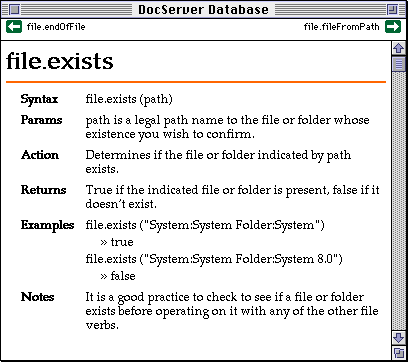
DocServer was a Mac app, before there was a web, that let you read the verb docs for the UserLand scripting language. Once we transitioned to the web, DocServer became a web app, managed by our website framework. I had forgotten it was an app before it was a website. And, btw, it was fully scriptable, as were all the apps we were making at the time. Here's a screen shot.
[no title] Scripting News(cached at March 2, 2021, 9:03 pm)

DocServer screen shot, late 80s?
PlayStation Store Will Stop Selling Movies Nobody Bought Slashdotby msmash on sony at January 1, 1970, 1:00 am (cached at March 2, 2021, 8:34 pm)

An anonymous reader shares a report: Have you ever bought a movie or TV show through the PlayStation Store? Me neither. As a result, Sony announced today it will remove them, starting August 31, 2021. "We've seen tremendous growth from PlayStation fans using subscription-based and ad-based entertainment streaming services on our consoles," Sony wrote in a post over on the PlayStation Blog. "With this shift in customer behavior, we have decided to no longer offer movie and TV purchases and rentals through PlayStation Store." As a multimedia company producing movies and TV alongside music and games, it made sense for Sony to sell all of it through various iterations of the PlayStation's digital storefront, in theory at least. In practice, it seems like console owners were mostly just interested in buying games, especially following the rise of Netflix and Amazon Prime.

Read more of this story at Slashdot.

How Microsoft Plans To Give Virtual Reality Apps a Big Boost Slashdotby msmash on microsoft at January 1, 1970, 1:00 am (cached at March 2, 2021, 8:05 pm)

The market for virtual and augmented reality products has developed slower than expected, but Microsoft is seeking to accelerate the sector by making it much easier for people to connect from different locations and with different kinds of devices. From a report: The ultimate goal of the new effort, dubbed Microsoft Mesh, is to allow, for example, a person in an office in New York using Facebook's Oculus VR headset to collaborate with a person in Seattle using Microsoft's HoloLens 2 glasses. Using Mesh-compatible hardware and software, the two people would be able to see virtual representations of each other appearing in their offices, talking and moving in real time as if they were present. And both would be able to see a common view of virtual charts or digital objects projected before them that they could change or manipulate. At least that's the vision that Microsoft demonstrated for the first time in public at its Ignite conference on Tuesday. Ultimately, Mesh could be used to connect users on a variety of VR gadgets, PC and Mac computers, and smartphones. But getting all the various hardware makers to agree to use Microsoft's standards may not be as easy as the company hopes. And while Microsoft's HoloLens and popular collaboration software like Teams and Office will be compatible with Mesh, other software developers also may be wary of depending on the company for such critical functionality. "This has been the dream for mixed reality, the idea from the very beginning," Alex Kipman, a Microsoft technical fellow working on the project, explained at the demonstration. "You can actually feel like you're in the same place with someone sharing content or you can teleport from different mixed reality devices and be present with people even when you're not physically together."

Read more of this story at Slashdot.

[no title] Scripting News(cached at March 2, 2021, 8:03 pm)

Why aren't there teams owned by corporations. Imagine if Amazon had an NBA team. I'm guessing they'd figure out new ways to monetize it.
Microsoft's Dream of Decentralized IDs Enters the Real World Slashdotby msmash on it at January 1, 1970, 1:00 am (cached at March 2, 2021, 7:05 pm)

For years, tech companies have touted blockchain technology as a means to develop identity systems that are secure and decentralized. The goal is to build a platform that could store information about official data without holding the actual documents or details themselves. Instead of just storing a scan of your birth certificate, for example, a decentralized ID platform might store a validated token that confirms the information in it. Then when you get carded at a bar or need proof of citizenship, you could share those pre-verified credentials instead of the actual document or data. Microsoft has been one of the leaders of this pack -- and is now detailing tangible progress toward its vision of a decentralized digital ID. From a report: At its Ignite conference today, Microsoft announced that it will launch a public preview of its "Azure Active Directory verifiable credentials" this spring. Think of the platform as a digital wallet like Apple Pay or Google Pay, but for identifiers rather than credit cards. Microsoft is starting with things like university transcripts, diplomas, and professional credentials, letting you add them to its Microsoft Authenticator app along with two-factor codes. It's already testing the platform at Keio University in Tokyo, with the government of Flanders in Belgium, and with the United Kingdom's National Health Service. "If you have a decentralized identifier I can verify, say, where you went to school and I don't need you to send me all of the information," says Joy Chik, corporate vice president for Microsoft's cloud and enterprise identity division. "All I need is to get that digital credential and because it's already been verified I can trust it." Microsoft will release a software development kit in the coming weeks that organizations can use to start building applications that issue and request credentials. And long-term the company says it hopes the system could be used around the world for everything from renting an apartment to establishing identity for refugees who are struggling without documents -- a dream of virtually all decentralized identification efforts. In the NHS pilot, for example, healthcare providers can request access to professional certifications from existing NHS health care workers, who can in turn choose to allow that access, streamlining a process for transferring to another facility that previously required a much more involved back and forth. Under Microsoft's set-up, you can also revoke access to your credentials if the recipient no longer needs access.

Read more of this story at Slashdot.

[no title] Scripting News(cached at March 2, 2021, 7:03 pm)

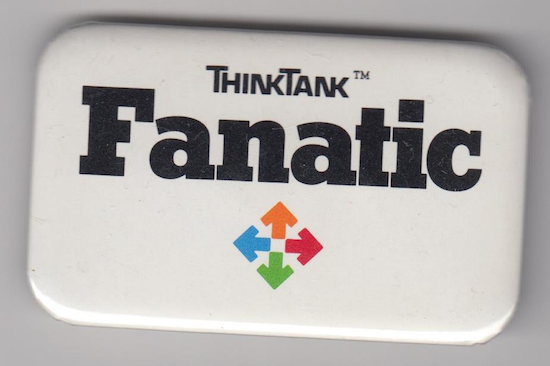
We called our users fanatics.
[no title] Scripting News(cached at March 2, 2021, 7:03 pm)

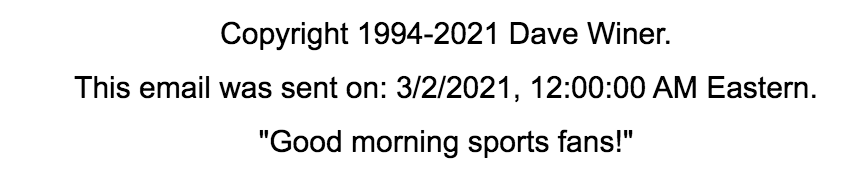
In mid-February I made a change to my script scheduler to attempt to get rid of drift, so that the nightly email would go out more or less precisely at midnight. The fix worked. Sometimes it's one second after midnight, but usually it's exact. The important thing is that any difference is not cumulative, it gets back on track on its own the next day. Here's a screen shot of footer on last night's email.
SmartThings Starts Saying Goodbye To Its Hardware Slashdotby msmash on internet at January 1, 1970, 1:00 am (cached at March 2, 2021, 6:34 pm)

Stacey Higginbotham: If you own a 2013 SmartThings hub (that's the original) or a SmartThings Link for the Nvidia Shield TV, your hardware will stop working on June 30 of this year. The device depreciation is part of the announced exodus from manufacturing and supporting its own hardware and the Groovy IDE that Samsung Smartthings announced last summer. SmartThings has set up a support page for customers still using those devices to help those users transition to newer hubs. That transition will also include a discount for users of the affected devices if they want to purchase the latest Aeotec version of the SmartThings hub. If you're still using either of the older devices you should expect an email that will provide a discount code to buy the Aeotec hub through TheSmartestHouse.com. That discount will be available until April 15.

Read more of this story at Slashdot.

[no title] Scripting News(cached at March 2, 2021, 6:33 pm)

BTW, if you download Netflix shows to a mobile device, why does the app refuse to open if you don't have a net connection? What was the point of downloading them? I swear it used to work. How did I watch Netflix shows on airplanes?