The Problem With Problem Sharks Slashdotby msmash on earth at January 1, 1970, 1:00 am (cached at January 1, 2021, 11:05 pm)

A marine biologist's ideas for singling out sharks that attack humans have prompted objections from other shark scientists. From a report: The war on sharks has been waged with shock and awe at times. When a shark bit or killed a swimmer, people within the past century might take out hundreds of the marine predators to quell the panic, like executing everyone in a police lineup in order to ensure justice was dispensed on the guilty party. Eric Clua, a professor of marine biology at the Ecole Pratique des Hautes Etudes in Paris, said the rationale behind shark culls in the past was simple: fewer sharks, fewer attacks. That reasoning also drives methods such as shark nets and baited hooks, which are currently in use at a number of Australian and South African beaches that are frequently visited by sharks. Nature, he notes, pays too great a price. "They are killing sharks that are guilty of nothing," said Dr. Clua, who studies the ocean predators up close in the South Pacific. Dr. Clua said he has found a way to make precision strikes on sharks that have attacked people through a form of DNA profiling he calls "biteprinting." He believes it's usually just solo "problem sharks" that attack humans repeatedly, analogizing them to terrestrial predators that have been documented behaving the same way. Instead of culling every bear, tiger or lion when only one has serially attacked people, wildlife managers on land usually focus their ire on the culprit. Dr. Clua said that problem sharks could be dispatched the same way. This summer, Dr. Clua and several colleagues published their latest paper on collecting DNA from the biteprints of large numbers of sharks. Once a database is built, DNA could be collected from the wounds of people who were bitten by sharks, and matched to a known shark. The offending fish would then need to be found and killed. Critics have taken issue with every facet of this plan.

Read more of this story at Slashdot.
Party Like It's 1925 On Public Domain Day Slashdotby msmash on books at January 1, 1970, 1:00 am (cached at January 1, 2021, 10:05 pm)

Neda Ulaby, writing for NPR: What a year it was for Anglo-American literature and the arts! 1925 was the year of heralded novels by F. Scott Fitzgerald and Virginia Woolf, seminal works by Sinclair Lewis, Franz Kafka, Gertrude Stein, Agatha Christie, Theodore Dreiser, Edith Wharton, Aldous Huxley ... and a banner year for musicians, too. Bessie Smith, Ma Rainey, the Gershwins, Duke Ellington and Fats Waller, among hundreds of others, made important recordings. And 1925 marked the release of canonical movies from silent film comedians Buster Keaton and Harold Lloyd. As of today, every single one of those works has entered the public domain. "That means that copyright has expired," explains Jennifer Jenkins, a law professor at Duke University who directs its Center for the Study of the Public Domain. "And all of the works are free for anyone to use, reuse, build upon for anyone -- without paying a fee."

Read more of this story at Slashdot.

New York City Subway Now Supports Tap-To-Pay At All Stations Slashdotby msmash on transportation at January 1, 1970, 1:00 am (cached at January 1, 2021, 9:05 pm)

The Metropolitan Transportation Authority announced Thursday that it had completed the rollout of tap-to-pay scanners at all subway stations and on all of its buses throughout the city. From a report: The MTA has been installing the system, called OMNY, since May 2019 as part of a modernization effort to phase out the plastic MetroCards that have been in use since the '90s. The new tap-to-pay system is available at 472 stations and on 5,800 buses in total, the MTA said. [...] For now, you need a phone that supports NFC-based mobile payments in order to use the OMNY system. Later in 2021, the MTA will begin selling tap-to-pay cards that can be used in place of a phone -- an important addition since not all riders own a smartphone.

Read more of this story at Slashdot.

[no title] Scripting News(cached at January 1, 2021, 9:03 pm)

I keep getting offers from UberEats which somehow evade GMail's filters for promotions. It's a reminder only that UberEats doesn't deliver to where I live.
[no title] Scripting News(cached at January 1, 2021, 9:03 pm)

Why do academics and journalists praise other academics and journalists? It's a club. Very often the insights of some brilliant journo or academic are as ordinary as a blogger or some random person on Facebook. But the name of the pub or uni makes what they say Important. I think this is part of why our society is so mediocre. Too much inbreeding. Too much trying to please, without telling what you really see. No one passing on a good idea simply because it is a good idea. There is supposedly a tradition of speaking the truth no matter how much trouble it creates, in both academia and journalism, but in practice, not really.
[no title] Scripting News(cached at January 1, 2021, 9:03 pm)

The best podcasts are the ones with experts who simply share their expertise. So many podcasts begin with a long discussion about how everyone feels, with lots of chuckling and self-praise and inside jokes. No. One. Cares. The first time I noticed this was a podcast about The Americans, a great show that I loved, with cast members. That's cool. Talk about the characters you play. But I really don't care where you, the actor, grew up. Exceptions are obvious. If you're a Beatle, go ahead and talk about yourself. If you're Jack Nicholson or Meryl Streep, yes please. I would like to know what makes Joni Ernst tick. But most experts aren't interesting as people. Your audience is looking to learn something, so teach us.
[no title] Scripting News(cached at January 1, 2021, 8:33 pm)

Facebook is useful. Journalism is evil. This contrarian view is brought to you by open media. You will never hear these simple ideas on closed corporate media.
An Interview With an Anonymous Amazonian Slashdotby msmash on cloud at January 1, 1970, 1:00 am (cached at January 1, 2021, 8:05 pm)

Logic magazine has interviewed an anonymous engineer at Amazon Web Services. An excerpt from the story, which touches a wide-range of topics including controversial work with the military and police and takes on other cloud providers: So when you use AWS, part of what you're paying for is security. Right; it's part of what we sell. Let's say a prospective customer comes to AWS. They say, "I like pay-as-you-go pricing. Tell me more about that." We say, "Okay, here's how much you can use at peak capacity. Here are the savings we can see in your case." Then the company says, "How do I know that I'm secure on AWS?" And this is where the heat turns up. This is where we get them. We say, "Well, let's take a look at what you're doing right now and see if we can offer a comparable level of security." So they tell us about the setup of their data centers. We say, "Oh my! It seems like we have level five security and your data center has level three security. Are you really comfortable staying where you are?" The customer figures, not only am I going to save money by going with AWS, I also just became aware that I'm not nearly as secure as I thought. Plus, we make it easy to migrate and difficult to leave. If you have a ton of data in your data center and you want to move it to AWS but you don't want to send it over the internet, we'll send an eighteen-wheeler to you filled with hard drives, plug it into your data center with a fiber optic cable, and then drive it across the country to us after loading it up with your data. What? How do you do that? We have a product called Snowmobile. It's a gas-guzzling truck. There are no public pictures of the inside, but it's pretty cool. It's like a modular datacenter on wheels. And customers rightly expect that if they load a truck with all their data, they want security for that truck. So there's an armed guard in it at all times. It's a pretty easy sell. If a customer looks at that option, they say, yeah, of course I want the giant truck and the guy with a gun to move my data, not some crappy system that I develop on my own.

Read more of this story at Slashdot.

Forget the Streaming Wars -- Pandemic-Stricken 2020 Lifted Netflix and Others Slashdotby msmash on tv at January 1, 1970, 1:00 am (cached at January 1, 2021, 7:05 pm)

The past 12 months were billed as the year when a flood of new entrants would force streaming services to wage an all-out war for subscribers. Instead, incumbents and rookies alike feasted on a base of shut-in customers eager for more things to watch. From a report: The largest streaming services finished 2020 with combined U.S. subscriber numbers more than 50% higher than a year ago, according to a Wall Street Journal analysis of data from market-research firms MoffettNathanson and HarrisX. They enjoyed a captive audience. The coronavirus pandemic triggered lockdowns that sent millions of Americans home, leaving many people with more time to watch movies and shows from the couch. The virus also prompted movie theaters to shut down and sports leagues to go on hiatus for months, further boosting streaming services' appeal. "Instead of a streaming war, there's been streaming coexistence and parallel growth," said Dritan Nesho, HarrisX's chief executive. New services such as Walt Disney's Disney+ grew rapidly without necessarily harming established players such as Netflix and Hulu, he said. "Disney+ did not displace existing services," Mr. Nesho said. "It complemented them."

Read more of this story at Slashdot.

[no title] Scripting News(cached at January 1, 2021, 6:33 pm)

As was pointed out by Brian Dear on Twitter, it's now January 1, 2021, and I still haven't received a letter or email from the US government telling me how and when I'm going to get my Covid vaccine. As a user of Medicare, I am surprised they haven't yet sent me an email about this. This is actually the kind of thing they do at Medicare.
Google Maps' Moat is Evaporating Slashdotby msmash on business at January 1, 1970, 1:00 am (cached at January 1, 2021, 6:05 pm)

An anonymous reader shares an analysis: See, Google Maps is not just an app on your phone. It's also a suite of developer tools that power countless other applications that are used by millions of people every day. And that part of the business is known as the Google Maps Platform (but most of the time I hear it referred to as the Google Maps API). In 2018, Google inexplicably decided to self-sabotage their enterprise maps business by raising their prices ~1,400% overnight. The only time in my life that I've ever felt envious of commission-based sales people was in the wake of that announcementâS -- âSI would have really liked to work at Mapbox as an order-taker that following quarter. Still, today, you need an MBA with a specialization in Mind Games to understand the Google Maps Platform pricing scheme, and it helps to have a joint law degree to navigate their terms of service. In fact, the ToS are so Draconian, they're the subject of investigations by the House Subcommittee on Antitrust, Commercial, and Administrative Law. My favorite tidbit from their recent report, Competition in Digital Markets quotes an anonymous Google Maps Platform customer: Several developers stated that Google Maps introduced greater licensing restrictions as it gained a stronger market position. One noted that Google's control over what now serves as a key mapping technology has allowed Google to call all the shots. "We license Google Maps and it's essentially a contract of adhesion. It's full of restrictions and we aren't able to negotiate any changes," the developer said. These are the actions of an organization that is annoyed they ever let people become their customers. And for what? A few hundred million in fees, maybe? That's likely nothing compared to the billions in advertising revenue from consumers searching for the best hamburger in town. So why not jack up the prices, lock down the data, and let 'em churn, baby, churn? The trouble is, Google isn't the only game in town anymore. If they keep alienating their customers and pursuing a proprietary data strategy at all costs, they're going to continue to lose ground to competition while spending more than ever just to tread water.

Read more of this story at Slashdot.

Japan's Brand New Anti-Piracy Law Goes Live Slashdotby msmash on japan at January 1, 1970, 1:00 am (cached at January 1, 2021, 5:05 pm)

A few hours ago and after years of preparation, amendments to Japan's copyright law came into effect, aiming to criminalize those who download unlicensed manga, magazines, and academic texts from the Internet. From a report: While uploading pirated content has always been illegal, the new law is quite specific in that it criminalizes the downloading of unlicensed content. While that could take place in a simultaneous upload environment such as BitTorrent, it seems most likely that people will obtain content from websites instead. That presents some roadblocks to enforcement so we asked Ina how, from a technical perspective, will the authorities track, obtain evidence, and prosecute people who simply download content (comics, movies, music etc) to their machines but don't distribute? "The authorities shall use digital forensic technologies to track suspects' activities and collect evidence. The details of such technologies have not been publicly available," Masaharu Ina from Japan-based anti-piracy group CODA explained. "There are certain special units specialized in cyber crimes in each prefecture. For example, the Tokyo Metropolitan Police has its own Cyber Crime Control Unit. But the police do not investigate unless the person commits the crime repeatedly, intentionally and maliciously, i.e. innocent light downloaders shall not be prosecuted."

Read more of this story at Slashdot.

[no title] Scripting News(cached at January 1, 2021, 4:33 pm)

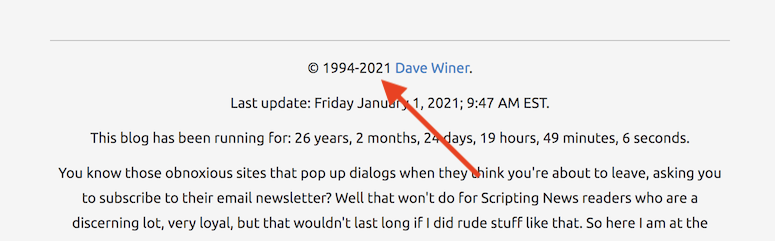
The monthly ritual is done, and another year of the OPML archive is complete. The copyright notice at the bottom of each page now says 2021.
[no title] Scripting News(cached at January 1, 2021, 4:33 pm)

Congratulations. You survived 2020. So did I. We did it.
Amazon To Expand Its Childhood-To-Career CS Program To India Later This Year Slashdotby msmash on education at January 1, 1970, 1:00 am (cached at January 1, 2021, 1:35 pm)

theodp writes: According to an Amazon job listing for a contract position, the e-tailer is seeking a lead for a new Amazon Future Engineer program in India that's set to launch in 2021. "The initial research for Amazon Future Engineer in India," Amazon explains, "is currently underway and we look to the chosen candidate to dive deep into operationalizing the program to what is relevant for India and the student needs. The role involves working with local non-profits and government officials to deeply understand the needs of the students. They will utilize this research and feedback to build trust and implement a unique program addressing needs for different aged students, childhood to career. They will quickly diagnose any structural barriers with CS education policy/adoption by region, while also exercising a bias for action to get programs launched in 2021. This role will require strategic planning, ability to manage a budget and implement programs at a large scale." In its press release celebrating record-breaking holiday sales in 2020, Amazon on Monday pointed out that its Amazon Future Engineer (AFE) program more than doubled its reach in the U.S. during the pandemic and is now serving more than 5,000 schools and 550,000 students in need with computer science coursework, largely by providing access to online courses from Edhesive. Launched in 2018 with the goal of inspiring 10+ million kids each year to explore CS, Amazon explained that AFE is part of a $50 million commitment it made to CS and STEM education in 2017. Microsoft President Brad Smith later revealed in his 2019 book Tools and Weapons that the $50 million investments in CS+STEM education that Amazon, Microsoft, Google, Facebook, and Salesforce each committed to in 2017 were part of a $300 million private sector pledge that Smith indicated was needed to get Ivanka Trump to persuade her father to fund K-12 CS; the President ultimately issued an Executive Order requiring the U.S. Dept. of Education to spend $1 billion on K-12 CS+STEM education.

Read more of this story at Slashdot.