[no title] Scripting News(cached at November 11, 2020, 11:04 pm)

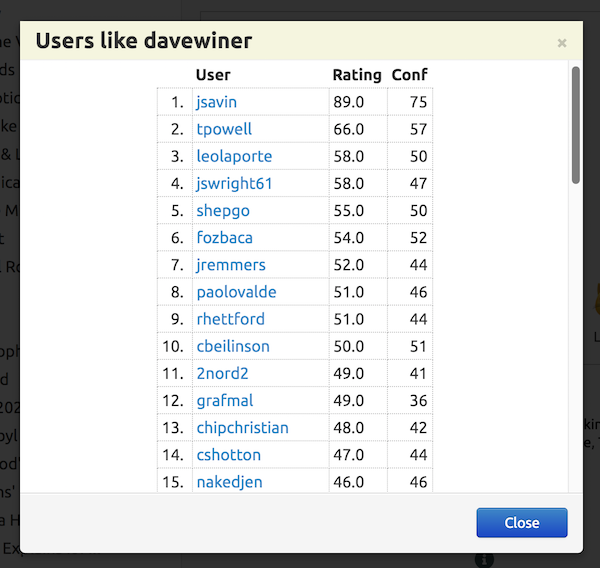
Did you get a chance to try the Similar Users command in BingeWorthy? It came out in the middle of the election frenzy. When you choose the command, BingeWorthy looks through the database and finds people who like similar programs to you. You may get ideas by looking at their picks. Here's a screen shot of what it shows me.
No, the New MacBook Air is Not Faster Than 98% of PC Laptops Slashdotby msmash on intel at January 1, 1970, 1:00 am (cached at November 11, 2020, 10:36 pm)

Gordon Mah Ung, writing at PC World: Let me just say it outloud, OK? Apple is full of it. I'm referring to Apple's claim that its fanless, Arm-based MacBook Air is "faster than 98 percent of PC laptops." Yes, you read that correctly: Apple officials literally claimed that the new MacBook Air using Apple's custom M1 chip is faster than 98 percent of all PC laptops sold this year. Typically, when a company makes such a claim, it publishes a benchmark, a performance test or actual details on what it's basing that marketing claim on. This to prevent lawyers from launching out of missile silos across the world. Apple's website restates the claim by stating: "M1 is faster than the chips in 98 percent of PC laptops sold in the past year." The site also includes a detail note that states: "Testing conducted by Apple in October 2020 using preproduction 13-inch MacBook Pro systems with Apple M1 chip and 16GB of RAM. Performance measured using select industry-standard benchmarks. PC configurations from publicly available sales data over the last 12 months. Performance tests are conducted using specific computer systems and reflect approximate performance of MacBook Pro." So, not only does Apple not say what tests it's basing its claims on, it doesn't even say where it sources the comparable laptops. Does that mean the new fanless MacBook Air is faster than, say, Asus' stupidly fast Ryzen 4000 based, GeForce RTX 2060-based Zephyrus G14? Does it mean the MacBook Air is faster than Alienware's updated Area 51M? The answer, I'm going to guess is "no." Not at all. Is it faster than the miniLED-based MSI Creator 17? Probably not, either. And what is that "performance" claim hinged on? CPU performance? GPU performance? Performance running Windows? Is it using the same application running on both platforms? Is it experiential? Is this running Red Dead Redemption II or Call of Duty: Black Ops Cold War? Is it running CyberLink's PowerDirector? Is it running Fortnite? While I have absolutely no idea what Apple is basing its claims on, I can tell you that I am 98 percent sure that any of the above laptops listed will wreck the MacBook Air doing any of the tasks I just named. When Apple makes its claims, my guess is they are comparing the new M1 to Intel-based processors ranging from Atom to Celeron N to Core i3 and up, all with integrated graphics. But by not defining the word "performance," all this becomes just pure marketing spin. And is it really fair to compare a $999 MacBook to one that costs $150? Because $150 PCs are included in the 98 percent of laptops sold. Maybe Apple should compare its own $150 MacBook Air against a $150 Chromebook or Windows-based laptop. Of course, that would mean Apple would have to sell a product that most people can afford. I have no doubt the M1 will be impressive, but do I think it's going to compare to 8-cores of Ryzen 4000 performance or a GeForce RTX 2060? No.

Read more of this story at Slashdot.

McDonald's McPlant is Coming For Beyond Meat's Crown Slashdotby msmash on science at January 1, 1970, 1:00 am (cached at November 11, 2020, 10:06 pm)

McDonald has announced plans to introduce its own plant-based burger option to the menu in select markets as soon as next year. From a report: The company made its plans public this week at an investor meeting. The McPlant -- the McPlant! -- uses a fake-meat amalgamation of McDonald's own creation, rather than partnering with an existing plant-based company like Impossible Foods as other chains have. (Beyond Meat and McDonalds co-created the plant-based patty .) "McPlant is crafted exclusively for McDonald's, by McDonald's," McDonald's international president Ian Borden said at this week's meeting. The reveal is a pretty drastic reversal of McDonald's public-facing strategy around plant-based options. If Borden's initial announcement is to be believed, the company doesn't just see it as a single menu option -- rather, McDonald's hopes the McPlant will prove successful enough to extend to a full plant-based menu.

Read more of this story at Slashdot.

Deutsche Bank Research: Tax Home Workers 'To Help Those Who Cannot' Slashdotby msmash on business at January 1, 1970, 1:00 am (cached at November 11, 2020, 9:36 pm)

An anonymous reader shares a report: Working from home should be taxed to help support workers whose jobs are under threat, a report has suggested. Deutsche Bank Research suggests a tax of 5% of a worker's salary if workers choose to work from home when they are not forced to by the current pandemic. The tax would be paid for by employers and the income generated would be paid to people who cannot work from home. This could earn $48 billion if introduced in the US and would help redress the balance, the bank says. It argues this is only fair, as those who work from home are saving money and not paying into the system like those who go out to work. In the UK, Deutsche Bank calculates the tax would generate a pot of $9.1 billion a year, which could pay out grants of $2,640 a year to low-income workers and those under threat of redundancy "For years we have needed a tax on remote workers," wrote Deutsche Bank strategist Luke Templeman. "Covid has just made it obvious. Quite simply, our economic system is not set up to cope with people who can disconnect themselves from face-to-face society."

Read more of this story at Slashdot.

Google's Play Store Identified as Main Distribution Vector For Most Android Malware Slashdotby msmash on android at January 1, 1970, 1:00 am (cached at November 11, 2020, 8:36 pm)

The official Google Play Store has been identified as the primary source of malware installs on Android devices in a recent academic study -- considered the largest one of its kind carried out to date. From a report: Using telemetry data provided by NortonLifeLock (formerly Symantec), researchers analyzed the origin of app installations on more than 12 million Android devices for a four-month period between June and September 2019. In total, researchers looked at more than 34 million APK (Android application) installs for 7.9 million unique apps. [...] The results showed that around 67% of the malicious app installs researchers identified came from the Google Play Store. Google did not respond to a request for comment made by ZDNet almost three weeks ago.

Read more of this story at Slashdot.

Raspberry Pi 4 Can Be Safely Overclocked To 2.15 GHz Slashdotby msmash on hardware at January 1, 1970, 1:00 am (cached at November 11, 2020, 8:06 pm)

szczys writes: When the Raspberry Pi 400 (a keyboard form-factor single board computer) was released last week, the company hinted at overclocking. Testing has now shown that the heat spreader used in that design does an excellent job. The chip was already clocked at 1.8 GHz, versus the stock 1.5 GHz in the original Raspberry Pi 4 Model B board. But it can be safely overclocked to 2.15 GHz, as can the Compute Module 4 with an adequate heat sink. At 2.0 GHz, the Pi 400 got up above 60 C and showed signs of continuing to warm up even after 50 minutes, but it was nowhere near throttling. So I tried 2.2 GHz, at which speed the CPU refused to boot entirely. Backing down to 2.15 GHz, it ran just fine, so I left it for three hours. It settled in at a cozy 62.5 C, which is warm, but well within specs. I ran the CM4 with the larger heatsink at 1.8 GHz to give some basis for comparison to the cheap heatsinks. What a big difference a big hunk of aluminum makes! It settled in at a comfortable 68 C or so. Even pushing it up to 2.15 GHz and leaving it for a couple hours, it stayed just a hair below 70C (158F) -- a safe margin on the throttling threshold -- and only a few degrees warmer than that huge heat spreader in the Pi 400. Further reading: The Verdict After Hackaday's Teardown of a Raspberry Pi 400: 'Very, Very Slick'.

Read more of this story at Slashdot.

Come June 1, All of Your New Photos Will Count Against Your Free Google Storage Slashdotby msmash on cloud at January 1, 1970, 1:00 am (cached at November 11, 2020, 7:36 pm)

Come June 1, 2021, Google will change its storage policies for free accounts -- and not for the better. Basically, if you're on a free account and a semi-regular Google Photos user, get ready to pay up next year and subscribe to Google One. From a report: Currently, every free Google Account comes with 15 GB of online storage for all your Gmail, Drive and Photos needs. Email and the files you store in Drive already counted against those 15 GB, but come June 1, all Docs, Sheets, Slides, Drawings, Forms or Jamboard files will count against the free storage as well. Those tend to be small files, but what's maybe most important here, virtually all of your Photos uploads will now count against those 15 GB as well. That's a bid deal because today, Google Photos lets you store unlimited images (and unlimited video, if it's in HD) for free as long as they are under 16MP in resolution or you opt to have Google degrade the quality. Come June of 2021, any new photo or video uploaded in high quality, which currently wouldn't count against your allocation, will count against those free 15 GB. [...] In addition to these storage updates, there's a few additional changes worth knowing about. If your account is inactive in Gmail, Drive or Photos for more than two years, Google 'may' delete the content in that product.

Read more of this story at Slashdot.

[no title] Scripting News(cached at November 11, 2020, 7:34 pm)

Trump et al had months to prepare for this coup, most of us can't even believe it's happening.
Birds' genetic secrets revealed in global DNA study BBC News | Science/Nature | UK Edition(cached at November 11, 2020, 7:30 pm)

Scientists have sequenced the "code of life" of species from almost every branch of the bird family tree.
[no title] Scripting News(cached at November 11, 2020, 7:04 pm)

More exploration into the world of Fargo blogging. Here's the OPML source for Kim Parker's blog. Kim Parker is a fictitious person, a support person at a tech company called Bloatware. Her blog was the example I used in the docs for Fargo's CMS. Not sure why I used #attributes instead of using outline attributes, which are hidden and out of the way. But there you have it. A 2013 blogging system, does it differently than Old School. It's more like Frontier's CMS.
Disaster 'Prepping' Was Once an American Pastime. Today, It's Mainstream Again. Slashdotby msmash on news at January 1, 1970, 1:00 am (cached at November 11, 2020, 6:36 pm)

Prepping was seen as a fringe hobby for survivalists and reality TV. Then came the pandemic. From a report: There's a reason "preppers," people who plan for the worst-case scenario, like to talk about the zombie apocalypse. The idea of an army of walking dead swarming the country pervades their thoughts because, says Roman Zrazhevskiy, "If you prepare as if a zombie apocalypse is going to happen, you have all the bases covered." That means: an escape route, medical supplies, a few weeks' worth of food. Zrazhevskiy has been thinking about this for decades. He was born in Russia a few months after the nuclear meltdown at Chernobyl. At the dinner table, his family often talked about the disaster and what went wrong. Then, after they relocated to New York, Zrazhevskiy stood on the waterfront outside his Brooklyn high school on September 11, 2001, and watched the World Trade Center towers collapse. Even then, he had a small go-bag prepared with disaster supplies. Now, he's the guy who has a kit and a checklist for every occasion, including taking his toddler to the beach. Zrazhevskiy lives in Texas and runs survival outfitters Ready to Go Survival and Mira Safety. In 2019, with protests in Hong Kong, wildfires in Australia, and the threat of war with Iran, business boomed. But when the CDC announced the U.S.'s first confirmed coronavirus case last January, business reached "a whole new level," says Zrazhevskiy. His companies spent the next couple of months scrambling to fill backorders. The flood of new customers had so many questions that he hired seven full-time staffers just to answer emails. "It's kind of a customer service nightmare," he says. "People are really flipping out." In a public imagination fueled by reality TV, preppers are lonely survivalists, members of fanatical religious groups, or even wealthy Silicon Valley moguls who buy luxury underground bunkers and keep a getaway helicopter fueled. But in reality preppers range from New Yorkers with extra boxes of canned goods squeezed in their studio apartments to wilderness experts with fully stocked bunkers.

Read more of this story at Slashdot.

Face For Sale: Leaks and Lawsuits Blight Russia Facial Recognition Slashdotby msmash on privacy at January 1, 1970, 1:00 am (cached at November 11, 2020, 6:06 pm)

The rise of cloud computing and AI have popularised face recognition technology globally, but at what cost? From a report: When Anna Kuznetsova saw an ad offering access to Moscow's face recognition cameras, all she had to do was pay 16,000 roubles ($200) and send a photo of the person she wanted spying on. The 20-year-old -- who was acting as a volunteer for a digital rights group investigating leaks in Moscow's pervasive surveillance system -- sent over a picture of herself and waited. Two days later and her phone buzzed. The seller had forwarded the paralegal a detailed list of all the addresses in the Russian capital where she had been spotted by cameras over the previous month, her lawyers said. "It was really incredible," said Sarkis Darbinyan, a lawyer for Roskomsvoboda, the group behind the investigation. "We got a report of all her movements in Moscow." The incident is now under police investigation. Far from an aberration, the incident is at the centre of one of several lawsuits brought in recent months by rights activists against the Russian authorities over their use of face recognition. The rise of cloud computing and AI technologies have popularised the technology globally, with supporters saying it promises greater security and efficiency. But the backlash is growing, too, as critics say benefits come at the cost of lost privacy and increased surveillance.

Read more of this story at Slashdot.

Climate change: Hurricanes get stronger on land as world warms BBC News | Science/Nature | UK Edition(cached at November 11, 2020, 5:30 pm)

North Atlantic tropical storms are stronger for longer when they hit land because of global warming.
Chrome To Block Tab-Nabbing Attacks Slashdotby msmash on chrome at January 1, 1970, 1:00 am (cached at November 11, 2020, 5:06 pm)

Google will deploy a new security feature in Chrome next year to prevent tab-nabbing, a type of web attack that allows newly opened tabs to hijack the original tab from where they were opened. From a report: The new feature is scheduled to go live with Chrome 88, to be released in January 2021. While the term "tab-nabbing" refers to a broad class of tab hijacking attacks [see OWASP, Wikipedia], Google is addressing a particular scenario. This scenario refers to situations when users click on a link, and the link opens in a new tab (via the "target=_blank" attribute). These new tabs have access to the original page that opened the new link. Via the JavaScript "window.opener" function, the newly opened tabs can modify the original page and redirect users to malicious sites. This type of attack has powered quite a few phishing campaigns across the years. To mitigate this threat, browser makers like Apple, Google, and Mozilla have created the rel="noopener" attribute.

Read more of this story at Slashdot.

Coronavirus: Denmark shaken by cull of millions of mink BBC News | Science/Nature | UK Edition(cached at November 11, 2020, 5:00 pm)

Why the "Cluster 5" coronavirus mutation in fur farms has led to a nationwide cull and a political outcry.