Massachusetts Votes on Expanding Access To Car Data, 'Could Set the National Standar Slashdotby EditorDavid on transportation at January 1, 1970, 1:00 am (cached at November 1, 2020, 11:05 pm)

On Tuesday Massachusetts will vote on expanding the state's right-to-repair law to include more access to car data, in an initiated state statute known as "Question 1." Wired reports: The measure is meant to address how data sharing will work as cars start to suck in and share more wireless data. The Coalition for Safe and Secure Data, backed by giant automakers, is urging state residents to vote No, arguing that easier access to this data poses security risks. At the core of the issue is the not-insignificant question of what expanded access to wireless car data might look like and how secure that is. It's not just a question of who can repair a car and access the data, but who owns the data in the first place. The answer could ripple across the industry for years to come, which is why both sides of Question 1 have poured millions of dollars into the fight. And because the U.S. has been slower to address these issues in federal legislation, Question 1 could have impact beyond Massachusetts state lines. Ultimately, the measure "could set the national standard for cars," according to Kyle Wiens, the founder of California-based iFixit and a vocal right-to-repair advocate... If a majority of Massachusetts residents vote Yes on Question 1 this fall, carmakers would have to install standardized, open data-sharing platforms on any cars with telematics systems starting with model year 2022. "Owners of motor vehicles with telematics systems would get access to mechanical data through a mobile device application," the ballot summary reads... Early polling suggests the state of Massachusetts will vote overwhelmingly in favor Question 1... "Hopefully this means we have an open-standard development process," Wiens tells Wired, "with all cars in the U.S. using the same standard, and a new world of innovation around mobile apps."

Read more of this story at Slashdot.
Millions of Americans Plan to Relocate Thanks to Telework, Survey Finds Slashdotby EditorDavid on stats at January 1, 1970, 1:00 am (cached at November 1, 2020, 10:05 pm)

NPR reports: An astonishing 14 million to 23 million Americans intend to relocate to a different city or region as a result of telework, according to a new study released by Upwork, a freelancing platform. The survey was conducted Oct. 1 to 15 among 20,490 Americans 18 and over. The large migration is motivated by people no longer confined to the city where their job is located. The pandemic has shifted many companies' view on working from home... Another study conducted by United Van Lines, a major household moving company, found that people wanted to relocate out of New York state at a higher rate than the national average. And, by the beginning of September, the requests to leave San Francisco had grown to more than double the U.S. average. The survey was conducted between March and August. Nationally, there is a 32% increase in moving interest compared with this time last year, the United Van Lines survey found. Interestingly, currently San Francisco actually has the lowest positivity rate from coronavirus testing of any major metropolitan area in America — suggesting the migrations aren't motivated by a flight from the pandemic itself. Instead Upwork's chief economist calls their data "an early indicator of the much larger impacts that remote work could have in increasing economic efficiency and spreading opportunity."

Read more of this story at Slashdot.

New Huawei Chip Factory May Help It Avoid US Trade Ban Slashdotby EditorDavid on china at January 1, 1970, 1:00 am (cached at November 1, 2020, 9:05 pm)

In August the U.S. announced restrictions aimed at preventing Huawei from obtaining semiconductors without a special license. It might work, reports Engadget: Huawei might have a way to avoid some of the worst consequences of tightening U.S. trade restrictions, provided it's willing to be patient. Financial Times sources claim Huawei is planning a dedicated chip factory in Shanghai that would make parts for its core telecom infrastructure business. It would be run by a partner, the city-backed Shanghai IC R&D Center, and would be considered experimental until it's ready to make chips Huawei can use. The plant would start by making chips based on a very old 45-nanometer process before moving to 28nm chips by late 2021. That would be advanced enough to make chips for smart TVs and Internet of Things devices, the tipsters said. It would reach 20nm by late 2022, when it could make "most" of its 5G cellular hardware. Between this and a stockpile of chips, Huawei could theoretically keep its telecom hardware business running with relatively little disruption.

Read more of this story at Slashdot.

iCloud Outage Now Affecting 14 Different Apple Services Slashdotby EditorDavid on cloud at January 1, 1970, 1:00 am (cached at November 1, 2020, 8:05 pm)

Apple's "System Status" page indicates 14 current issues, some of which began nearly five hours ago. CNET reports the services affected "include Find My, iCloud Account & Sign In, iCloud Backup, iCloud Bookmarks & Tabs, iCloud Calendar, iCloud Contacts, iCloud Drive, iCloud Keychain, iCloud Mail, iCloud Storage Upgrades, Photos and Screen Time." Engadget writes "the timing is less than ideal, even if this is likely to be a small interruption in the grander scheme of things." The issue comes weeks after an outage that affected both iCloud and Apple's media services. It also follows mere days after the debut of Apple One, where iCloud storage (also affected by the outage) plays an important role.

Read more of this story at Slashdot.

Officials Raise Concerns About Software for the Most Powerful Rocket Ever Flown Slashdotby EditorDavid on nasa at January 1, 1970, 1:00 am (cached at November 1, 2020, 6:35 pm)

NASA's 322-foot rocket "Space Launch System" rocket "would be the most powerful rocket ever flown, eclipsing both the Saturn V that flew astronauts to the moon and SpaceX's Falcon Heavy," reports the Washington Post. But "it's not the rocket's engines that concern officials but the software that will control everything the rocket does, from setting its trajectory to opening individual valves to open and close." Computing power has become as critical to rockets as the brute force that lifts them out of Earth's atmosphere, especially rockets like the SLS, which is really an amalgamation of parts built by a variety of manufacturers: Boeing builds the rocket's "core stage," the main part of the vehicle. Lockheed Martin builds the Orion spacecraft. Aerojet Rocketdyne and Northrop Grumman are responsible for the RS-25 engines and the side boosters, respectively. And the United Launch Alliance handles the upper stage. All of those components need to work together for a mission to be successful. But NASA's Aerospace Safety Advisory Panel recently said it was concerned about the disjointed way the complicated system was being developed and tested... Also troubling to the safety panel was that NASA and its contractors appeared not to have taken "advantage of the lessons learned" from the botched flight last year of Boeing's Starliner spacecraft, which suffered a pair of software errors that prevented it from docking with the International Space Station as planned and forced controllers to cut the mission short. NASA has since said that it did a poor job of overseeing Boeing on the Starliner program, and has since vowed to have more rigorous reviews of its work, especially its software testing... NASA pushed back on the safety panel's findings, saying in a statement that "all software, hardware, and combination for every phase of the Artemis I mission is thoroughly tested and evaluated to ensure that it meets NASA's strict safety requirements and is fully qualified for human spaceflight." The agency and its contractors are "conducting integrated end-to-end testing for the software, hardware, avionics and integrated systems needed to fly Artemis missions," it said.

Read more of this story at Slashdot.

Zuckerberg Acknowledges 'Risk of Civil Unrest' After US Elections, Promises Newsfeed Slashdotby EditorDavid on facebook at January 1, 1970, 1:00 am (cached at November 1, 2020, 5:35 pm)

ZDNet reports: Facebook founder and CEO Mark Zuckerberg told analysts on a conference call Thursday evening that the company plans to post notices at the top of users' news feeds on November 3rd discrediting any claims by either candidate in the U.S. presidential election that they have won the election if the site deems the claim premature... The move, said Zuckerberg, is being made because "There is a risk of civil unrest across the country, and given this, companies like ours need to go well beyond what we've done before." The conference call with analysts followed a third-quarter earnings report Thursday afternoon in which Facebook's results topped expectations, helped by gains in active users that also were higher than Wall Street expected. Zuckerberg said Facebook "helped 4.4 million people register [to vote] exceeding the goal that we set for ourselves this summer."

Read more of this story at Slashdot.

[no title] Scripting News(cached at November 1, 2020, 5:03 pm)

I did the usual beginning of the month rollover for the blog, but this time I also made the October archive into a shareable outline. You can click this link to open the outline in LO2. You can think of it as the source code for Scripting News, October 2020.
[no title] Scripting News(cached at November 1, 2020, 5:03 pm)

This tweet really grabbed me. "I intubated a relatively healthy 86 year old man with covid in the ER at 4:30 this morning. He was alone, I was the last person he spoke with and he was confused. He’ll likely die in the ICU, alone. I don’t make any extra money for that."
Linux Foundation Creates Its Own Versions of Apple/Google Coronavirus Tracing Apps Slashdotby EditorDavid on medicine at January 1, 1970, 1:00 am (cached at November 1, 2020, 4:35 pm)

"The Linux Foundation has formed a new group to provide public health authorities with free technology for tracking the spread of the coronavirus and future epidemics," writes Business Insider. Launched in July, the group has already released two apps "that notify users if they've been in contact with someone who has tested positive with COVID-19." Since these apps are open source, people can contribute code and customize them, allowing regions with similar needs to collaborate, general manager at Linux Foundation Public Health, Dan Kohn, told Business Insider. Developers that want to build an app off these projects can access or download the source code. These apps take advantage of technology launched by Apple and Google, which can be integrated into any app, that uses Bluetooth on people's smartphones to track who a user has been in close proximity with, without identifying the specific people. If anyone tests positive for COVID-19 and uploads that information to a database run by a local public health authority, any user who has been in close contact with that person will get a notification through their app saying they may have been exposed — again, without identifying who has COVID-19. If someone knows that they may have been exposed, they can either self-quarantine or get tested. "Essentially we think exposure notification could have a big impact on reducing the overall rate of exposure," Kohn said. An Oxford University study in April said that if about 60% of the population used a contact tracing app, it could grind the diseases spread to a halt. Researchers on the team also found that digital contact tracing can cut down spread even at much lower levels of usage.

Read more of this story at Slashdot.

[no title] Scripting News(cached at November 1, 2020, 4:33 pm)

Trump is a troll, and trolls thrive on novelty. They always have to be increasing the rage. From the Trolling howto: "Immunity to outrage builds up over time. What pissed people off six months ago will barely show up as a blip today. Luckily for Trump as he rises in stature, from poll-leader, to presumptive nominee, to one of two possible Presidents, his tweets automatically get more outrageous, because now they have half the weight of the office of POTUS behind them." Four years later his stature has not increased, and the tweets are just as crude. So his trolling juice doesn't work this time. No one cares. On the Trippi podcast his guest Mike Murphy said once you've seen Gallagher smash a watermelon, you don't need to go back and see it again. That's Trump. Gallagher, Carrot Top, Joan Rivers, Don Rickles, Rodney Dangerfield. We've been there done that and all we got was Covid-19.
[no title] Scripting News(cached at November 1, 2020, 4:33 pm)

I wish I had a big Pause button, let's just hold here for a while. I'm more comfortable living in limbo than knowing the outcome of Tuesday's election. I'm sure everyone feels the same. I don't have any advice. Maybe buy something sinful and consume it with wild abandon. Or maybe read up on emigration out of the US, or painless ways to end it all.
[no title] Scripting News(cached at November 1, 2020, 4:33 pm)

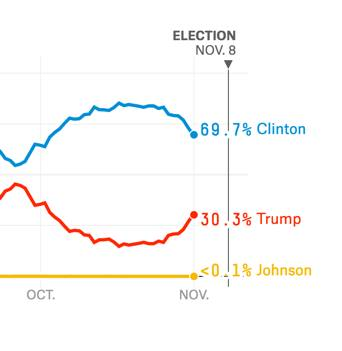
On Facebook, I'm getting another look at all the things I posed in the run-up to the 2016 election. One of the threads was a screen shot of the 538 graph showing the probability of a Clinton win over Trump over time. It took a real dive when Comey announced he was investigating emails found on Anthony Weiner's laptop. He couldn't look first and then announce it if they found anything, which of course they didn't. Nate Silver said, in the aftermath of the election, when people complained about the polls, that Trump had a greater than 30% chance of winning. A baseball player who hits .300 is a pretty good hitter. 30% ain't zero. That said Comey made it 30%. The odds were a lot lower before his announcement.
[no title] Scripting News(cached at November 1, 2020, 4:03 pm)

I finally understand what agile means in programming, and of course, I've been doing it from the beginning of my programming career. Get something working, try it out, learn from it, perhaps go in a different direction, but always checking what I'm doing by using it and listening to users. Mitch Kapor, who I learned a lot from at Personal Software in the early 80s, worked this way. I ran Living Videotext on these principles. Everything UserLand did was developed this way. Now that I understand what it means, I might try to factor all the writing that's out there about it into a few words that explain the difference. I once encountered anti-agile development in a company where the software was developed using DoD procedures. Their philosophy was design the whole thing up front and give pieces of the project to different groups of programmers, who never saw the full spec, so no one knew what they were working on. The company went out of business very quickly, only to form the core of another company, which also went out of business.
The US Military Has Experienced 55,443 COVID-19 Cases - Including Vice Chief of Spac Slashdotby EditorDavid on usa at January 1, 1970, 1:00 am (cached at November 1, 2020, 3:35 pm)

UPI reports: Space Force's vice chief of space operations tested positive for COVID-19 Wednesday, Space Force announced. According to a press release issued jointly by the Space Force and the Air Force, Gen. David D. Thompson took a test for the virus after learning that a close family member had tested positive. Air Force spokeswoman Ann Stefanek said Thompson has not shown symptoms of COVID-19 so far and was on leave last week, but returned to the Pentagon for work on Monday and Tuesday to address a virtual symposium for the National Defense Industrial Association and Texas A&M University. He is now self-isolating and working from home... As of Thursday morning a total of 55,443 COVID-19 cases had been reported in the [U.S.] military since the beginning of the pandemic, with 8,839 of those reported among Air Force personnel.

Read more of this story at Slashdot.

Could RISC-V Processors Compete With Intel, ARM, and AMD? Slashdotby EditorDavid on intel at January 1, 1970, 1:00 am (cached at November 1, 2020, 12:35 pm)

"As promised, SiFive has unveiled a new computer featuring the company's SiFive FU740 processor based on RISC-V architecture," reports Liliputing: The company, which has been making RISC-V chips for several years, is positioning its new SiFive HiFive Unmatched computer as a professional development board for those interested in working with RISC-V. But unlike the company's other HiFive boards, the new Unmatched model is designed so that it can be easily integrated into a standard PC... SiFive says the system can support GNU/Linux distributions including Yocto, Debian, and Fedora. "SiFive is releasing the HiFive Unleashed in an effort to afford developers the ability to build RISC-V based systems, using readily available, off-the-shelf parts," explains Forbes: SiFive says it built the board to address the market need for easily accessible RISC-V hardware to further advance development of new platforms, products, and software using the royalty-free ISA... A short video demo shows the HiFive Unmatched installed in a common mid-tower PC chassis, running the included Linux distro, with an AMD Radeon graphics card pushing the pixels. In the video, the HiFive Unmatched is compiling an application and is shown browsing the web and opening a PDF. SiFive also notes that video playback is accelerated in hardware with the included version of Linux. "At the moment, these development PCs are early alternatives, most likely targeted at hobbyists and engineers who may snap them up when they become available in the fourth quarter for $665," notes VentureBeat. But they add that "While it's still early days, it's not inconceivable that RISC-V processors could someday be alternatives to Intel-based PCs and PC processors." The startup has raised $190 million to date, and former Qualcomm executive Patrick Little recently joined SiFive as CEO. His task will be to establish the company's RISC-V processors as an alternative to ARM. This move comes in the wake of Nvidia's $40 billion acquisition of the world's leading processor architecture. If Little is also looking to challenge Intel and AMD in PCs, he'll have his work cut out for him. For starters, SiFive is currently focused on Linux-based PCs, not Microsoft Windows PCs. Secondly, SiFive wouldn't build these processors or computers on its own. Its customers — anyone brave enough to take on the PC giants — would have to do that. "I wouldn't see this as SiFive moving out of the box. It's more like they're expanding their box," said Linley Group senior analyst Aakash Jani. "They're using their core architecture to enable other chip designers to build PCs, or whatever they plan to build."

Read more of this story at Slashdot.