How Ransomware Puts Your Hospital At Risk Slashdotby EditorDavid on security at January 1, 1970, 1:00 am (cached at October 17, 2020, 11:35 pm)

nickwinlund77 quotes a New York Times opinion piece: In March, several cybercrime groups rushed to reassure people that they wouldn't target hospitals and other health care facilities during the Covid-19 pandemic. The operators of several prominent strains of ransomware all announced they would not target hospitals, and some of them even promised to decrypt the data of health care organizations for free if one was accidentally infected by their malware. But any cybersecurity strategy that relies on the moral compunctions of criminals is doomed to fail, particularly when it comes to protecting the notoriously vulnerable computer systems of hospitals. So it's no surprise that Universal Health Services was hit by ransomware late last month, affecting many of its more than 400 health care facilities across the United States and Britain. Or that clinical trials for a Covid-19 vaccine have been held up by a similar ransomware attack disclosed in early October. Or that loose-knit coalitions of volunteers all over the world are working around the clock to try to protect the computer systems of hospitals that are already straining under the demands of providing patient care during a global pandemic. In the midst of the Covid-19 pandemic, the potential consequences of these cyberattacks are terrifying. Hospitals that have lost access to their databases or had their networks infected by ransomware may not be able to admit patients in need of care or may take longer to provide those patients with the treatment they need, if they switch to relying on paper records... Every hospital and clinic should be re-evaluating their computer networks right now and ramping up the protections they have in place to prevent their services from being interrupted by malware or their sensitive patient data from being stolen.

Read more of this story at Slashdot.
College President Resigns After 712 Students Test Positive For Covid-19 Slashdotby EditorDavid on education at January 1, 1970, 1:00 am (cached at October 17, 2020, 9:36 pm)

CNN reports: The president of the State University of New York at Oneonta has resigned, as the school grapples with hundreds of reported Covid-19 cases within the university since the beginning of the semester... SUNY Oneonta has reported 712 student cases of Covid-19 since residence halls opened on August 17... The resignation of the sitting president of SUNY Oneonta comes after the university decided not to test students or quarantine them on arrival. Soon after, the University saw an uptick in positive results. By the time leadership tried to take punitive measures against students for disobeying social distancing orders, the virus had spread... SUNY Oneonta has about 6,700 students enrolled, according to its website. In an official statement the school's chancellor said the president now wanted to "pursue other opportunities." But one student told CNN the outbreak was partly the fault of the student body. "I believe that much of the spreading could have been prevented if the students hadn't partied or hadn't gone anywhere without masks on."

Read more of this story at Slashdot.

Tesla Owner: I Butt-Dialed a $4,280 Autopilot Upgrade -- And They Haven't Refunded Slashdotby EditorDavid on cellphones at January 1, 1970, 1:00 am (cached at October 17, 2020, 9:05 pm)

CNBC reports: On September 24th, physician Dr. Ali Vaziri was unpleasantly surprised by a mobile alert from his bank, which said he had just purchased a $4,280 upgrade for his Tesla Model 3. The large transaction, he quickly surmised, was a "butt dial" or accidental purchase made through the Tesla app on his iPhone. "My phone was in my jeans," Vaziri told CNBC. "I took it out, put it on this charger that comes with your Tesla and that's it. A minute later? I got the text. I've never purchased anything through the Tesla app before...." Moments after he received the mobile alert from his bank, Vaziri called his local Tesla store and service center. They couldn't help directly, but gave him the number for a customer service hotline. He called the number, and requested a refund. Instead of processing the doctor's refund request on the spot, the customer service rep told Vaziri to click on the refund button in his Tesla app to process his request. Vaziri informed them there was no such button in the Tesla app, just some text and a link to the refund policy. An e-mail he received from Tesla confirming the unauthorized purchase contained only vague information about a refund, and no buttons to click or links to a page where he could process a refund request either. The email, which Vaziri shared with CNBC, drove him to Tesla's support web site, which in turn told him to call his local service center. To this date, Vaziri says, Tesla customer service has not provided him with a refund, nor has the call center provided him with so much as a confirmation number or e-mail to acknowledge his calls about the refund. Instead, he processed a stop payment request through his credit card company.

Read more of this story at Slashdot.

How Repubs get reporters to repeat their dirt Scripting News(cached at October 17, 2020, 8:33 pm)

Repub says opponent X beats his wife.

Reporter asks Is it true that you beat your wife?

The viewer just remembers X beats his wife.

There is a science to this. Linguistics.

Shame our reporters are either complicit, naive, ignorant, greedy, or Republican. You pick.

[no title] Scripting News(cached at October 17, 2020, 8:33 pm)

I am usually interested in the MLB and NBA playoffs, but this year I practically ignored them. The reason, in retrospect, is that sports is all about the ritual, the continutity, the historic connection. Novelty feels wrong. For example, I still haven't gotten over the Designated Hitter Rule, and the three-point shot in basketball still seems like an innovation. I like sports because they connect to the past. I went to games as a kid with ancestors who are now gone. "What did the Mets do?" was the beginning of every kitchen table conversation in the house I grew up in. It was the default. To this day my brain says those words when it's idle. This season was a heroic effort for both sports, esp the NBA with its bubble, but the only heroism that gets me to pay attention to sport is what happens on the court and on the field.
[no title] Scripting News(cached at October 17, 2020, 8:03 pm)

Hello Republicans.
[no title] Scripting News(cached at October 17, 2020, 8:03 pm)

I don't know what happens with my Nightly Email app if there's nothing on the blog for a day. Not wanting to find out, I posted this.
[no title] Scripting News(cached at October 17, 2020, 8:03 pm)

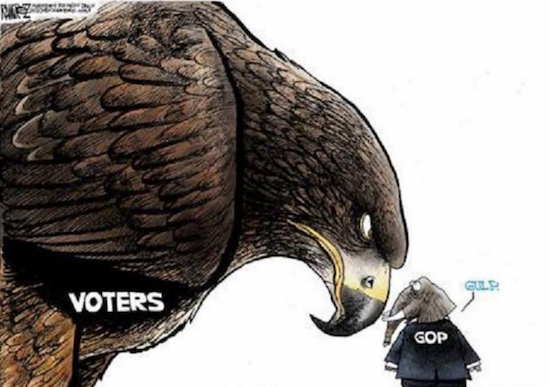
I voted for a libtard. I hope that makes nazi wingnuts cry.
US Antitrust Regulators Could Target Google's Chrome Browser For Breakup Slashdotby EditorDavid on chrome at January 1, 1970, 1:00 am (cached at October 17, 2020, 7:35 pm)

Slashdot reader alternative_right shares a report from Politico: Justice Department and state prosecutors investigating Google for alleged antitrust violations are considering whether to force the company to sell its dominant Chrome browser and parts of its lucrative advertising business, three people with knowledge of the discussions said... The conversations — amid preparations for an antitrust legal battle that the Department of Justice is expected to begin in the coming weeks — could pave the way for the first court-ordered break-up of a U.S. company in decades. The forced sales would also represent major setbacks for Google, which uses its control of the world's most popular web browser to aid the search engine that is the key to its fortunes. Discussions about how to resolve Google's control over the $162.3 billion global market for digital advertising remain ongoing, and no final decisions have been made, the people cautioned, speaking anonymously to discuss confidential discussions. But prosecutors have asked advertising technology experts, industry rivals and media publishers for potential steps to weaken Google's grip... A major antitrust report that the House Judiciary Committee released this week found that Chrome's market share allows Google to "effectively set standards for the industry," an issue of particular relevance as Chrome phases out cookies. "Google's ad-based business model can prompt questions about whether the standards Google chooses to introduce are ultimately designed primarily to serve Google's interests," the House report said. "Market participants are concerned that while Google phases out third-party cookies needed by other digital advertising companies, Google can still rely on data collected throughout its ecosystem." Friday Politico reported the antitrust suit against Google is likely to be filed "early next week, but without the sign-on of any Democratic attorneys general, four people familiar with the case said Friday — upending the Trump administration's hopes to enlist bipartisan support for its fight against the internet giant..." Instead a bipartisan group of states "expects to file an antitrust complaint challenging Google's search practices at a later date, the people said. That group, led by Democratic attorneys general in Colorado and Iowa along with Nebraska's Republican attorney general, has expressed concern about what they view as the Justice Department's narrow approach to the case, the people said. Filing a separate suit would allow more leverage if the Department of Justice negotiates a settlement with Google they don't like, they said."

Read more of this story at Slashdot.

Home-Made Covid Vaccine Appeared to Work, but Questions Remained Slashdotby EditorDavid on medicine at January 1, 1970, 1:00 am (cached at October 17, 2020, 6:35 pm)

"Josiah Zayner's plan was simple: replicate a Covid-19 vaccine that had worked in monkeys, test it on himself and then livestream the experiment online over a period of months," reports Bloomberg. "Zayner discovered, testing a vaccine is far more complicated than he had imagined." Even though his experiment yielded a promising result, Zayner found too many unanswered questions to say that it worked. For one, it wasn't clear whether antibodies he found in his own body in extremely tiny measures before the experiment began made a difference... As the U.S. rushes to bring a vaccine to market far faster than has ever been done, Zayner said he has discovered why the long, slow process of clinical trials shouldn't be rushed. A promising early stage result is just that: promising... Initially, Zayner assumed that the experiment he named Project McAfee, after the antiviral software, would be relatively straightforward. The vaccine selected had triggered protective immunity against the virus in rhesus macaque monkeys in a paper published in May. Zayner was able to order the same spike protein sequence from the DNA-synthesis company the researchers had used. The plan: He and two fellow biohackers — Daria Dantseva in Ukraine and David Ishee in Mississippi — would themselves test the concoction they ordered online. They would then livestream the entire process online over several months, with the first showing to occur in June. But early on in the experiment, complications arose. Before starting, Zayner took a test at Lab Corp Inc. that told him he didn't already have antibodies to the virus. But when he performed a similar test on himself shortly afterward, he found that he did have some antibodies, just not enough to produce a positive result on Lab Corp's test. While those antibodies didn't appear to be the neutralizing type, he wondered whether the result came because the vaccine was picking up signals from antibodies to a different virus — or how this faint antibody signal might affect things. "I'm very suspicious of my own data," he said. He's not alone. Hank Greely, a bioethicist at Stanford University, said Zayner's experiment pointed out an underappreciated reality of vaccine development. "Actually making the vaccine isn't that hard," he said. "It's testing it and knowing that it's safe — and knowing that it's effective...." Zayner's next project will focus on showing people how to grow chicken cells to make their own fake meat. With vaccines, Zayner concluded, "Large scale clinical trials are probably required, because it is so messy."

Read more of this story at Slashdot.

A Chicken Nugget Was Just Launched Into Space Slashdotby EditorDavid on space at January 1, 1970, 1:00 am (cached at October 17, 2020, 5:35 pm)

A British supermarket celebrated its 50th anniversary by playing with its food — specifically, one lucky piece of breaded protein: The grocery store chain hired Sent Into Space to launch the chicken nugget into space. According to its website, Sent Into Space is the "world's leading space marketing company, specialising in space-themed marketing campaigns and publicity stunts." "From a site in rural Wales, the nugget traveled through the Earth's atmosphere to an altitude of 110,000 feet (that's 33.5 km) where it floated in the region known as Near Space," Sent Into Space wrote in a statement on its website. That would be 20.7 miles. The nugget spent an hour "floating" in space in low pressure and temperatures that can drop to -65 degrees Celsius, according to Sent Into Space... The nugget was launched near the company's headquarters in Wales in a gas-filled weather balloon with an auxiliary satellite tracking system and integrated camera support. The Irish News reported that the nugget descended at 200 mph, with a parachute deploying around 62,000 feet for the nugget's protection.

Read more of this story at Slashdot.

Trump Scrambles To Loosen America's Biometric Data and Gig Worker Regulations Slashdotby EditorDavid on usa at January 1, 1970, 1:00 am (cached at October 17, 2020, 4:35 pm)

"Facing the prospect that President Trump could lose his re-election bid, his cabinet is scrambling to enact regulatory changes affecting millions of Americans in a blitz so rushed it may leave some changes vulnerable to court challenges," reports the New York Times: The effort is evident in a broad range of federal agencies and encompasses proposals like easing limits on how many hours some truckers can spend behind the wheel, giving the government more freedom to collect biometric data and setting federal standards for when workers can be classified as independent contractors rather than employees. In the bid to lock in new rules before Jan. 20, Mr. Trump's team is limiting or sidestepping requirements for public comment on some of the changes and swatting aside critics who say the administration has failed to carry out sufficiently rigorous analysis. Some cases, like a new rule to allow railroads to move highly flammable liquefied natural gas on freight trains, have led to warnings of public safety threats... If Democrats take control of Congress, they will have the power to reconsider some of these last-minute regulations, through a law last used at the start of Mr. Trump's tenure by Republicans to repeal certain rules enacted at the end of the Obama administration. But the Trump administration is also working to fill key vacancies on scientific advisory boards with members who will hold their seats far into the next presidential term, committees that play an important role in shaping federal rule making... The Homeland Security Department is also moving, again with an unusually short 30-day comment period, to adopt a rule that will allow it to collect much more extensive biometric data from individuals applying for citizenship, including voice, iris and facial recognition scans, instead of just the traditional fingerprint scan. The measure, which the agency said was needed to curb fraud, would also allow it for the first time to collect DNA or DNA test results to verify a relationship between an application for citizenship and someone already in the United States.

Read more of this story at Slashdot.

Sweden's New Car Carrier Is the World's Largest Wind-Powered Vessel Slashdotby BeauHD on transportation at January 1, 1970, 1:00 am (cached at October 17, 2020, 3:05 pm)

An anonymous reader quotes a report from CNN: Oceanbird might look like a ship of the future, but it harks back to ancient maritime history -- because it's powered by the wind. The transatlantic car carrier is being designed by Wallenius Marine, a Swedish shipbuilder, with support from the Swedish government and several research institutions. With capacity for 7,000 vehicles, the 650 foot-long vessel is a similar size to conventional car carriers, but it will look radically different. The ship's hull is topped by five telescopic "wing sails," each 260 feet tall. Capable of rotating 360 degrees without touching each other, the sails can be retracted to 195 feet in order to clear bridges or withstand rough weather. The sails, which will be made of steel and composite materials, need to be this size to generate enough propulsive power for the 35,000-ton ship. Although "the general principles of solid wing sails is not new," designing the Oceanbird's sails has been a challenge, says Mikael Razola, a naval architect and research project manager for Oceanbird at Wallenius Marine. That's because these are the tallest ship sails that have ever been constructed. "This ship, at the top of the mast, will be more than 100 meters (328 feet) above the water surface," says Razola. "When you move up into the sky that much, wind direction and velocity change quite a lot." Oceanbird has a projected top speed of about 10 knots and will take around 12 days to cross the Atlantic. While that's considerably slower than standard car carriers, which can travel at 17 knots, the Oceanbird will emit 90% less CO2 than conventional car carriers. Razola says their plan is "to see Oceanbird sailing in 2024."

Read more of this story at Slashdot.

Ammonite: Who was the real Mary Anning? BBC News | Science/Nature | UK Edition(cached at October 17, 2020, 2:00 pm)

In a romantic Victorian-era drama, Kate Winslet plays the role of fossilist Mary Anning. Who was she?
Unlocking the secrets of 'six-headed chief' burial BBC News | Science/Nature | UK Edition(cached at October 17, 2020, 2:00 pm)

Archaeologists have used DNA analysis to help explain who was buried in the ancient Highlands grave.