Long Before Cambridge Analytica, Simulmatics Linked Data and Politics Slashdotby BeauHD on books at January 1, 1970, 1:00 am (cached at September 14, 2020, 11:35 pm)

NPR reporter Shannon Bond reports of a little-known -- and now nearly entirely forgotten -- company called Simulmatics, which had technology that used vast amounts of data to profile voters and ultimately help John F. Kennedy win the 1960 election. From the report: The [...] company was called Simulmatics, the subject of Harvard historian and New Yorker writer Jill Lepore's timely new book, If Then: How the Simulmatics Corporation Invented the Future. Before Cambridge Analytica, before Facebook, before the Internet, there was Simulmatics' "People Machine," in Lepore's telling: "A computer program designed to predict and manipulate human behavior, all sorts of human behavior, from buying a dishwasher to countering an insurgency to casting a vote." Lepore unearths Simulmatics' story and makes the argument that, amid a broader proliferation of behavioral science research across academia and government in the 1960s, the company paved the way for our 21st-century obsession with data and prediction. Simulmatics, she argues, is "a missing link in the history of technology," the antecedent to Facebook, Google and Amazon and to algorithms that attempt to forecast who will commit crimes or get good grades. "It lurks behind the screen of every device," she writes. If Then presents Simulmatics as both ahead of its time and, more often than not, overpromising and under-delivering. The company was the brainchild of Ed Greenfield, an advertising executive straight out of Mad Men, who believed computers could help Democrats recapture the White House. He wanted to create a model of the voting population that could tell you how voters would respond to whatever a candidate did or said. The name Simulmatics was a contraction of "simulation" and "automation." As Greenfield explained it to investors, Lepore writes: "The Company proposes to engage principally in estimating probable human behavior by the use of computer technology." The People Machine was originally built to analyze huge amounts of data ahead of the 1960 election, in what Lepore describes as, at the time, "the largest political science research project in American history."

Read more of this story at Slashdot.
Nikola Admits Prototype Was Rolling Downhill In Promo Video Slashdotby BeauHD on transportation at January 1, 1970, 1:00 am (cached at September 14, 2020, 11:05 pm)

In late 2016, Nikola Motor Company founder Trevor Milton unveiled a prototype of the Nikola One truck, claiming it "fully functions and works, which is really incredible." A couple years later, in January 2018, the company showed the Nikola One truck moving rapidly along a two-lane desert highway. But last week, the short-selling investment firm Hindenburg Research published a bombshell report, accusing Nikola Motors of massive fraud, having no proprietary technology and vastly overstating the capabilities of their prototypes to investors. Incredibly, "Hindenburg reported that the truck in the 'Nikola One in motion' video wasn't moving under its own power," reports Ars Technica. "Rather, Nikola had towed the truck to the top of a shallow hill and let it roll down. The company allegedly tilted the camera to make it look like the truck was traveling under its own power on a level roadway." From the report: On Monday morning, Nikola sent out a lengthy press release titled "Nikola Sets the Record Straight on False and Misleading Short Seller Report." While the statement nitpicks a number of claims in the Hindenburg report, it tacitly concedes Hindenburg's main claim about the Nikola One. Nikola now admits that the Nikola One prototype wasn't functional in December 2016 and still wasn't functional when the company released the "in motion" video 13 months later. Nikola claims that the gearbox, batteries, inverters, power steering, and some other components of the truck were functional at the time of the December 2016 show. But Nikola doesn't claim that the truck had a working hydrogen fuel cell or motors to drive the wheels -- the two key components Hindenburg stated were missing from the truck in December 2016. And Nikola now admits that it never got the truck to fully function. "As Nikola pivoted to the next generation of trucks, it ultimately decided not to invest additional resources into completing the process to make the Nikola One drive on its own propulsion," Nikola wrote in its Monday statement. Instead, Nikola pivoted to working on its next vehicle, the Nikola Two. So what about that video of the Nikola One driving across the desert? "Nikola never stated its truck was driving under its own propulsion in the video," Nikola wrote. "Nikola described this third-party video on the Company's social media as 'In Motion.' It was never described as 'under its own propulsion' or 'powertrain driven.' Nikola investors who invested during this period, in which the Company was privately held, knew the technical capability of the Nikola One at the time of their investment."

Read more of this story at Slashdot.

ARM Co-Founder Starts 'Save Arm' Campaign To Keep Independence Amid $40 Billion Nvid Slashdotby BeauHD on business at January 1, 1970, 1:00 am (cached at September 14, 2020, 10:05 pm)

An anonymous reader quotes a report from TechCrunch: Arm Holdings, the U.K. semiconductor company, made history for the second time today, becoming the country's biggest tech exit when Nvidia announced over the weekend that it would buy it from SoftBank for $40 billion in an all-stock deal. (Arm's first appearance in the record books? When SoftBank announced in 2016 that it would acquire the company for $32 billion.) But before you can say advanced reduced instruction set computing machine, the deal has hit a minor hitch. One of Arm's co-founders has started a campaign to get the U.K. to interfere in the deal, or else call it off and opt for a public listing backed by the government. Hermann Hauser, who started the company in 1990 along with a host of others as a spin-out of Acorn Computers, has penned an open letter to the U.K.'s Prime Minister Boris Johnson in which he says that he is "extremely concerned" about the deal and how it will impact jobs in the country, Arm's business model and the future of the country's economic sovereignty independent of the U.S. and U.S. interests. Hauser has also created a site to gather public support -- savearm.co.uk -- and to that end has also started to collect signatures from business figures and others. He's calling on the government to intervene, or to at least create legally binding provisions, tied to passing the deal to guarantee jobs, create a way to enforce Nvidia not getting preferential treatment over other licensees and secure an exemption from CFIUS regulation "so that U.K. companies are guaranteed unfettered access to our own microprocessor technology." "This puts Britain in the invidious position that the decision about who ARM is allowed to sell to will be made in the White House and not in Downing Street," he writes. "Sovereignty used to be mainly a geographic issue, but now economic sovereignty is equally important. Surrendering UK's most powerful trade weapon to the US is making Britain a US vassal state." Meanwhile, Nvidia CEO and co-founder Jensen Huang said: "This will drive innovation for customers of both companies," adding that Nvidia "will maintain Arm's open licensing model and customer neutrality... We love Arm's business model. In fact, we intend to expand Arm's licensing portfolio with access to Nvidia's technology. Both our ecosystems will be enriched by this combination." Hauser responded by saying: "Do not believe any statements which are not legally binding."

Read more of this story at Slashdot.

Chrome playing video halts screen saver Scripting News(cached at September 14, 2020, 10:03 pm)

A few weeks ago my Mac stopped going to sleep when I left. Not only will this burn out the monitor, it's a security problem.

I tried rebooting. No help.

Tried quitting all my apps. Then the screen saver would start.

Now to figure out which app was the culprit. I figured it was Dropbox, my first guess for anything going wrong. Sorry. But it wasn't Dropbox.

Turns out it was Chrome. If it thinks you're watching a video, it will keep the Mac from going to sleep. I had a window from Agora open, because I was interested in it and planned to go back to learn more. Well it has a video on the home page. It didn't even register with me.

So I closed that window, waited a minute, with Chrome running, and the screen saver kicked in.

A reminder if you have this problem in the future.

Pandemic May Permanently Replace Some Human Jobs With Machines Slashdotby msmash on robot at January 1, 1970, 1:00 am (cached at September 14, 2020, 9:35 pm)

The coronavirus pandemic has the potential to permanently replace some humans with machines, according to a new study on Monday from the Federal Reserve Bank of Philadelphia. From a report: Layoffs have been higher among workers in industries that can be automated, which increases the risk those jobs will become permanently obsolete, according to the study by economists Lei Ding and Julieth Saenz Molina. At the same time, the spread of Covid-19 has accelerated automation in industries that have been hit hard by the virus or that don't permit remote work. The longer the recession lasts, the deeper the impact of automation will be. "In case the COVID-19 crisis evolves into a prolonged economic crisis, many job losses in automatable occupations could become permanent in the post-pandemic economy, similar to what happened during the recovery from the Great Recession," Ding and Saenz Molina wrote. Industries that were already facing a high risk of automation lost 4.2 more jobs per 100 than jobs in sector facing fewer threats by technology, the study shows, which analyzes data through August.

Read more of this story at Slashdot.

[no title] Scripting News(cached at September 14, 2020, 9:33 pm)

Poll: Whether or not you approve of what Woodward did, in withholding the audio of Trump confession re Covid harm, suppose other reporters are withholding life-saving information. Do you approve?
Google To Launch Pixel 5, New Chromecast, and Smart Speaker Later This Month Slashdotby msmash on google at January 1, 1970, 1:00 am (cached at September 14, 2020, 9:05 pm)

Google is planning to launch its Pixel 5 smartphone, a new Chromecast, and a new smart speaker later this month. From a report: Google has started inviting members of the media to a special event on September 30th, promising new hardware. "We invite you to learn all about our new Chromecast, our latest smart speaker, and our new Pixel phones," reads the invite. Google already confirmed its plans to launch a Pixel 5 later this year, complete with 5G connectivity. The Pixel maker revealed its launch plans alongside the introduction of the Pixel 4A last month, promising 5G versions of the Pixel 5 and Pixel 4A in the US, Canada, the United Kingdom, Ireland, France, Germany, Japan, Taiwan, and Australia.

Read more of this story at Slashdot.

CISA: Chinese State Hackers Are Exploiting F5, Citrix, Pulse Secure, and Exchange Bu Slashdotby msmash on security at January 1, 1970, 1:00 am (cached at September 14, 2020, 8:35 pm)

The Cybersecurity and Infrastructure Security Agency (CISA) has published a security advisory today warning of a wave of attacks carried out by hacking groups affiliated with China's Ministry of State Security (MSS). From a report: CISA says that over the past year, Chinese hackers have scanned US government networks for the presence of popular networking devices and then used exploits for recently disclosed vulnerabilities to gain a foothold on sensitive networks. The list of targeted devices includes F5 Big-IP load balancers, Citrix and Pulse Secure VPN appliances, and Microsoft Exchange email servers. For each of these devices, major vulnerabilities have been publicly disclosed over the past 12 months, such as CVE-2020-5902, CVE-2019-19781, CVE-2019-11510, and CVE-2020-0688, respectively. According to a table summarizing Chinese activity targeting these devices published by CISA today, some attacks have been successful and enabled Chinese hackers to gain a foothold on federal networks.

Read more of this story at Slashdot.

Microsoft Wants To Take on Amazon in Connecting Satellites To the Cloud Slashdotby msmash on cloud at January 1, 1970, 1:00 am (cached at September 14, 2020, 7:35 pm)

Microsoft is looking to challenge Amazon in offering a service that connects satellites directly to the company's cloud computing network, according to documents the company filed with the Federal Communications Commission last month. From a report: The effort shows how the two largest providers of cloud infrastructure -- data centers in far-flung places that can host websites and run applications with a smorgasbord of computing and storage services -- regularly seek to one-up each other. That way, the companies can appear ready and willing to meet many of the needs of prospective customers. Microsoft plans to connect a Spanish imaging satellite to two ground stations -- both located in Microsoft's home state of Washington -- to show that it can directly download satellite "data to the Azure Cloud for immediate processing," the FCC documents said. A ground station, sometimes called an earth station, is the vital link for transmitting data to and from satellites in orbit. Microsoft notably proposed to construct one of the two ground stations itself at its data center in Quincy, Wash. The FCC on Sept. 2 authorized Microsoft to perform proof-of-concept demonstrations of the service. The authorization gives Microsoft a six month license that allows for communications and imagery data downloads. The Spanish satellite, called Deimos-2, was launched into orbit in June 2014. The satellite is operated by a subsidiary of Canadian satellite imagery company UrtheCast and, for the tests, the Deimos-2 satellite will only be in range of Microsoft's antennas for "just a few minutes."

Read more of this story at Slashdot.

Microsoft's Underwater Data Centre Resurfaces After Two Years Slashdotby msmash on storage at January 1, 1970, 1:00 am (cached at September 14, 2020, 7:05 pm)

Two years ago, Microsoft sank a data centre off the coast of Orkney in a wild experiment. That data centre has now been retrieved from the ocean floor, and Microsoft researchers are assessing how it has performed, and what they can learn from it about energy efficiency. From a report: Their first conclusion is that the cylinder packed with servers had a lower failure rate than a conventional data centre. When the container was hauled off the seabed around half a mile offshore after being placed there in May 2018, just eight out of the 855 servers on board had failed. That compares very well with a conventional data centre. "Our failure rate in the water is one-eighth of what we see on land," says Ben Cutler, who has led what Microsoft calls Project Natick. The team is speculating that the greater reliability may be connected to the fact that there were no humans on board, and that nitrogen rather than oxygen was pumped into the capsule.

Read more of this story at Slashdot.

[no title] Scripting News(cached at September 14, 2020, 6:33 pm)

When species go extinct, other species they keep in check will grow, possibly explode. If it were bats, for example, that might mean more Covid-19 type viruses. Human-killing viruses come from bats because they have more powerful immune systems than we do.It's all balanced.
The LG Wing's Twisting Screen Offers a New Spin on the Dual-Screen Smartphone Slashdotby msmash on technology at January 1, 1970, 1:00 am (cached at September 14, 2020, 6:05 pm)

LG is no stranger to two-screen smartphones in recent years, but the company has just officially announced its boldest foray into a dual-screen device in recent memory: the LG Wing. It's a wild-looking, swiveling-display smartphone that looks to -- quite literally -- offer a new spin on what a phone can do. From a report: The new phone is inspired by LG's current trends of dual-screen smartphones like the G8X ThinQ and the Velvet, along with the company's classic swiveling LG VX9400 feature phone released over a decade ago. The Wing is set to be the first device under LG's new "Explorer Project" branding, aimed at exploring ways to "breathe new life into what makes a smartphone." Wing's most interesting feature, of course, is the two OLED panels. The first is a standard 6.8-inch main screen without any bezels or notches (instead, LG has chosen to go with a pop-up lens, since apparently the Wing didn't have enough moving parts to worry about). But it's the second 3.9-inch panel that's underneath the main display that makes the Wing 2020's most unique-looking phone. Instead of folding out for two full-size (or one flexible) panels side by side, the Wing's main display twists around and up to reveal the second screen, in a shape that looks a lot like a Tetris T-block.

Read more of this story at Slashdot.

[no title] Scripting News(cached at September 14, 2020, 6:03 pm)

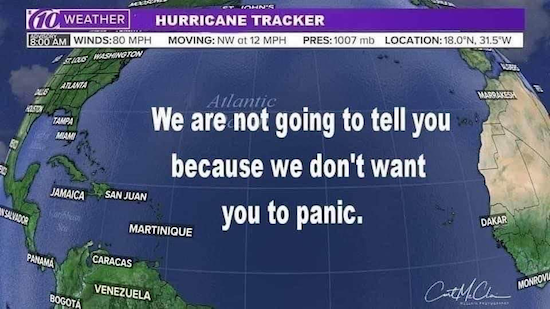
Latest hurricane tracker.
Venus Might Host Life, New Discovery Suggests Slashdotby msmash on space at January 1, 1970, 1:00 am (cached at September 14, 2020, 5:35 pm)

There is something funky going on in the clouds of Venus. Telescopes have detected unusually high concentrations of the molecule phosphine -- a stinky, flammable chemical typically associated with feces, farts and rotting microbial activity -- in an atmospheric layer far above the planet's scorching surface. From a report: The finding is curious because here on Earth, phosphine is essentially always associated with living creatures, either as a by-product of metabolic processes or of human technology such as industrial fumigants and methamphetamine labs. Although toxic to many organisms, the molecule has been singled out as a potentially unambiguous signature of life because it is so difficult to make through ordinary geological or atmospheric action. Swathed in sulfuric acid clouds and possessing oppressive surface pressures and temperatures hot enough to melt lead, Venus is a hellish world. But the particular cloud layer where the phosphine is present happens to be relatively balmy, with ample sunlight and Earth-like atmospheric pressure and temperature. The results will have to be carefully vetted by the scientific community. Yet they seem likely to spark renewed interest in exploring our sister planet next door. "It's a really puzzling discovery because phosphine doesn't fit in our conception of what kinds of chemicals should be in Venus's atmosphere," says Michael Wong, an astrobiologist at the University of Washington. Planetary scientist Sanjay Limaye of the University of Wisconsin-Madison agrees. "The bottom line is we don't know what's going on," he says. (Neither Wong nor Sanjay were involved in the work.) After the sun and moon, Venus is the brightest object visible to the naked eye in Earth's sky. For thousands of years, people told stories about the glittering jewel that appeared around sunrise and sunset. Venus's brilliance is what made it attractive to Jane Greaves, a radio astronomer at Cardiff University in England. She typically focuses her attention on distant newborn planetary systems but wanted to test her molecular identification abilities on worlds within our cosmic backyard. In 2017 Greaves observed Venus with the James Clerk Maxwell Telescope (JCMT) on Mauna Kea in Hawaii, searching for bar code-like patterns of lines in the planet's spectrum that would indicate the presence of different chemicals. While doing so, she noticed a line associated with phosphine. The data suggested the molecule was present at around 20 parts per billion in the planet's atmosphere, a concentration between 1,000 and a million times greater than that in Earth's atmosphere. "I was stunned," Greaves says. Further reading: The original paper in the journal Nature Astronomy; and the case for life on Venus.

Read more of this story at Slashdot.

Venus: Will private firms win the race to the fiery planet? BBC News | Science/Nature | UK Edition(cached at September 14, 2020, 5:30 pm)

With interest in the possibility of life at Venus, there's an imperative to get more spacecraft to the planet.