Apple Watch Fall Detection Credited With Saving Unresponsive Arizona Man Slashdotby BeauHD on medicine at January 1, 1970, 1:00 am (cached at June 5, 2020, 11:35 pm)

The Apple Watch's Fall Detection feature is being credited as helping save an unresponsive man in Chandler, Arizona. AppleInsider reports: Fall Detection, introduced on the Apple Watch Series 4, can detect if a user takes a hard fall and will alert local emergency services if they don't respond within 60 seconds. The potentially life-saving capabilities of that feature were on display on April 23, when police dispatchers in Chandler received a 911 call from an automated voice, according to local media outlet KTAR. The auto-generated message indicated that an Apple Watch wearer had fallen and was not responding, and also provided authorities with the exact latitude and longitude of the man's location. When officers and the Chandler Fire Department showed up, they found that the man had fainted and collapsed.

Read more of this story at Slashdot.

Solving Online Events Slashdotby msmash on internet at January 1, 1970, 1:00 am (cached at June 5, 2020, 11:05 pm)

Benedict Evans: I suspect part of the answer to this is actually that a lot of physical events will come back in some form as we emerge from lockdown. But this also makes me think that there will be new tools with much more radically new approaches, and some new behaviours and habits. Hence, it's often struck me that networking events are pretty inefficient and random. If you're going to spend an hour or two in a room with 50 or 500 people, then you could take that as a purely social occasion and enjoy yourself. But if your purpose is to have professionally useful conversations, then what proportion of the people in the room can you talk to in an hour and how likely is it that they'll be the right ones? Who's there? I sometimes suggest it would be helpful if we all wore banners, as in the image at the top, so that you could look across the room and see who to talk to. (First Tuesday did something like this in 1999, with different coloured badges.) This might just be that I'm an introvert asking for a machine to manage human connections for me (and I am), but there is also clearly an opportunity to scale the networking that happens around events in ways that don't rely on random chance and alcohol tolerance. A long time ago Twitter took some of that role, and the explosion of online dating also shows how changing the way you think about pools and sample sets changes outcomes. In 2017, 40% of new relationships in the USA started online. Next, before lockdown, you would often have planned to schedule a non-urgent meeting with a partner or client or connection 'when we're in the same city.' That might be at some specific event, but it might also just be for some ad hoc trip -- 'next time I'm in the Bay Area' or 'next time you're in New York.' In January most people would never actually have thought of making a video call, but today every meeting is a video call, so all of those meetings can be a video call too, and can happen this week rather than 'next time I fly to that city' -- or 'at CES/NAB/MIPCOM.' In the last few months video calls have broke through that habit. I wonder what happens if we accelerate all of those meetings in that way. To argue against some of this, James Turrell has said that part of the value of Roden Crater's remoteness is that you have to really care to go there. Getting a plane and a hotel and a ticket, and taking days of time, has some of the same effect for a conference -- it gives a selection filter for people who care. There is value in aggregating people around a professional interest graph, and in doing that in a focused way, perhaps even around a particular time. (There are also, of course, exclusionary effects to this.)

Read more of this story at Slashdot.

States Are Leaning Toward a Push To Break Up Google's Ad Tech Business Slashdotby BeauHD on google at January 1, 1970, 1:00 am (cached at June 5, 2020, 11:05 pm)

An anonymous reader quotes a report from CNBC: The state attorneys general investigating Google for potential antitrust violations are leaning towards pushing for a breakup of its ad technology business as part of an expected suit, people familiar with the situation told CNBC. Fifty attorneys general have been probing Google's business practices for months, alongside a similar probe being led by the U.S. Department of Justice. Both the states and the DOJ are looking to file a suit against the internet giant as soon as within the next few months, people familiar with the situation told CNBC. The states and the Justice Department have not yet officially decided whether to combine their expected suits, the people said, though they have been collaborating closely. Both have been investigating Google's search, ad technology and android business. The attorneys general investigating Google, which is owned by Alphabet, haven't yet definitively ruled out pushing for alternatives for its ad technology business, like imposing restrictions on how it runs its business, one of the sources said. A suit may also include a push for both that option and breaking up the ad tech business. "Critics have said that Google bundles its ad tools so that rivals can't afford to match its offerings and that its operation of search results, YouTube, Gmail and other services to hinder ad competition," reports CNBC. "They also say that Google owns all sides of the 'auction exchange' through which ads are sold and bought, giving it an unfair advantage." Google's two main deals that provided it the crucial foothold into advertising technology, DoubleClick in 2007 and AdMob in 2009, were years ago. Because of this, it may be difficult for Google to push for a break up of the business.

Read more of this story at Slashdot.

[no title] Scripting News(cached at June 5, 2020, 11:03 pm)

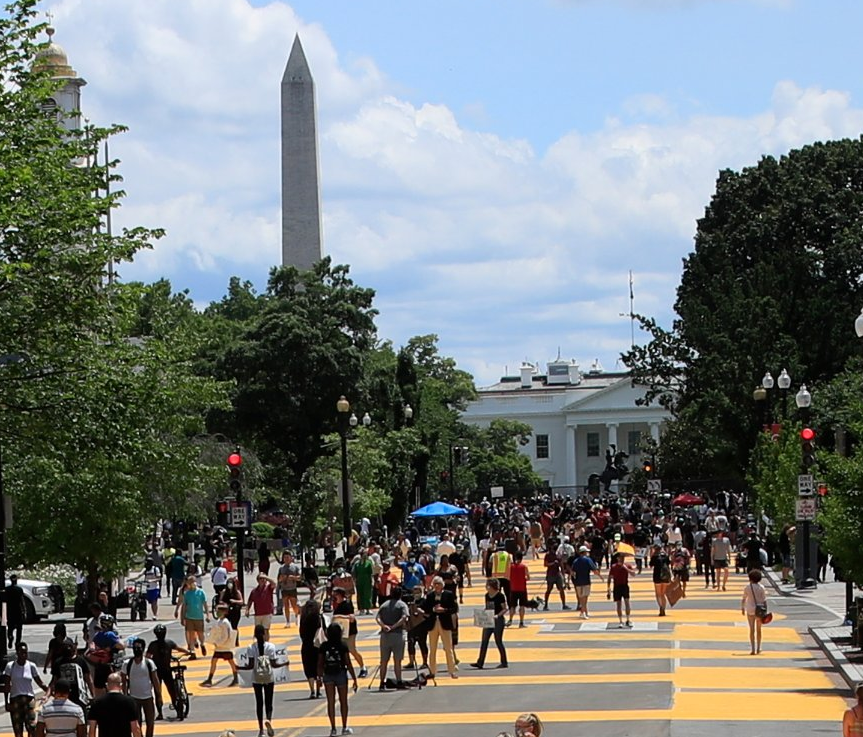
Where the BLM street is relative to the White House.
Instacart Makes Changes To Tip Policy Following Shopper Complaints Slashdotby msmash on business at January 1, 1970, 1:00 am (cached at June 5, 2020, 10:35 pm)

Instacart announced today that it is changing its tip policy to protect its growing shopper network from tip-baiting. Tip-baiting, a grotesque tactic, is when customers bait shoppers with a big tip and then reduce the tip to zero after they receive their groceries. It emerged as Instacart's demand skyrocketed due to the pandemic and people being unable to go to the grocery store. From a report: Instacart continues to say that tip-baiting is rare and that less than 0.5% of orders have tips removed after delivery. It says tip totals have doubled for shoppers since the COVID-19 pandemic began. However, the policy change shows progress on how the company treats its shopper network, who have been essential as shelter-in-place orders keep people and the immunocompromised from going to grocery stores. Instacart is now requiring customers who remove tips after delivery to leave feedback, and claims it will deactivate any customer who consistently removes tips. The company also said that it is reducing the tip-adjustment window (the time period for how long a customer can change the tip) from three days to 24 hours. The smaller window, ideally, would limit the amount of time that a shopper needs to wait for a final tip. Along with the tip changes, Instacart is updating its Instant cashout feature, first launched in 2019. Shoppers will now be able to cash out tips 24 hours after they complete a delivery for more immediate access to money. The company is also waiving all cashout fees for shoppers using Visa cards until the end of July 2020. Instant Cashout is also expanding to Canada.

Read more of this story at Slashdot.

Under Pressure, UK Government Releases NHS COVID Data Deals With Big Tech Slashdotby msmash on uk at January 1, 1970, 1:00 am (cached at June 5, 2020, 9:35 pm)

From a report: Hours before facing court proceedings from openDemocracy over its massive NHS COVID-19 data deal with private tech firms, the UK government has caved to pressure and released all the contracts governing its deals with Amazon, Microsoft, Google, and controversial AI firms Faculty and Palantir. The contracts, released to openDemocracy and tech justice firm Foxglove today, reveal details of what has been described as an 'unprecedented' transfer of personal health information of millions of NHS users to these private tech firms. Significantly, the contracts reveal that the Dominic Cummings-linked firm Faculty is being paid more than $1.3m to provide AI services for the NHS. The documents also show that terms of that deal were changed after initial demands for transparency were made by Foxglove under the Freedom of Information Act. The contracts show that companies involved in the NHS datastore project, including Faculty and Palantir, were originally granted intellectual property rights (including the creation of databases), and were allowed to train their models and profit off their unprecedented access to NHS data.

Read more of this story at Slashdot.

Matthew Green on Zoom Not Offering End-To-End Encryption To Free Users Slashdotby msmash on encryption at January 1, 1970, 1:00 am (cached at June 5, 2020, 9:05 pm)

Earlier this week video conferencing service Zoom said it will not offer its forthcoming, complete version of end-to-end encryption to its free users so that it can work better with law enforcement to curb abuse on the platform. Matthew Green, who teaches cryptography at Johns Hopkins, looks at the broader implication of this move: Obviously I don't think you should have to pay for E2E encryption. The thing that's really concerning me is that there's a strong push from the US and other governments to block the deployment of new E2E encryption. You can see this in William Barr's "open letter to Facebook." But this is part of an older trend. Law enforcement and intelligence agencies can't get Congress to ban E2E, so they're using all the non-legislative tools they have to try to stop it. And, it turns out, this works. Not against the big entrenched providers who have already deployed E2E. But against the new upstarts who want to use crypto to solve trust problems. And the Federal government has an enormous amount of power. Power over tools like Section 230. Power to create headaches for people. But even without Congressional assistance, the executive branch has vast power to make procurement and certification decisions. So if you're a firm that wants to deploy E2E to your customers, even if there's a pressing need, you face the specter of going to war with an immensely powerful government that has very strong negative feelings about broad access to encryption. And this is a huge problem. Because some companies have infrastructure all over the world. Some companies carry incredibly valuable and sensitive corporate data (even at their "free" tiers) and there are people who want that data. Encryption is an amazing tool to protect it. The amazing thing about this particular moment is that, thanks to a combination of the pandemic forcing us all online, more people than ever are directly exposed by this. "Communications security" isn't something that only activists and eggheads care about. Now for companies that are exposed to this corrupt dynamic, there's an instinct to try to bargain. Split the baby in half. Deploy E2E encryption, but only maybe a little of it. E2E for some users, like paying customers and businesses, but not for everyone. And there's some logic to this position. The worst crimes, like distribution of child abuse media, happen in the free accounts. So restricting E2E to paid accounts seems like an elegant compromise, a way to avoid getting stepped on by a dragon. But I personally think this is a mistake. Negotiating with a dragon never ends well. And throwing free-tier users into the dragon's mouth feels even worse. But the real takeaway, and why I hope maybe this issue will matter to you, is that if the Federal government is able to intimidate one company into compromising your security. Then what's going to happen to the next company? And the next? Once the precedent is set that E2E encryption is too "dangerous" to hand to the masses, the genie is out of the bottle. And once corporate America accepts that private communications are too politically risky to deploy, it's going to be hard to put it back. Anyway, this might be an interesting academic debate if we were in normal times. But we're not. Anyone who looks at the state of our government and law enforcement systems -- and feels safe with them reading all our messages -- is living in a very different world than I am.

Read more of this story at Slashdot.

Apple Launches Open Source Project to Let Password Management Apps Create Strong Pas Slashdotby msmash on programming at January 1, 1970, 1:00 am (cached at June 5, 2020, 8:35 pm)

Apple today informed developers that it has launched a new open source project that's designed to let those who develop password management apps create strong passwords compatible with popular websites. From a report: The new Password Manager Resources open source project allows password management apps to integrate website-specific requirements used by the iCloud Keychain password manager to generate strong, unique passwords. "Many password managers generate strong, unique passwords for people, so that they aren't tempted to create their own passwords by hand, which leads to easily guessed and reused passwords. Every time a password manager generates a password that isn't actually compatible with a website, a person not only has a bad experience, but a reason to be tempted to create their own password. Compiling password rule quirks helps fewer people run into issues like these while also documenting that a service's password policy is too restrictive for people using password managers, which may incentivize the services to change," the company said.

Read more of this story at Slashdot.

Reddit Co-founder Ohanian Resigns From Board, Urges Company To Replace Him With a Bl Slashdotby msmash on social at January 1, 1970, 1:00 am (cached at June 5, 2020, 8:05 pm)

Reddit Co-founder Alexis Ohanian on Friday announced his resignation from the company's board, saying he was stepping down and urging the company to replace him with a black candidate. From a report: "I'm writing this as a father who needs to be able to answer his black daughter when she asks: "What did you do?'" Ohanian wrote in a blog post. Ohanian, who is married to professional tennis player Serena Williams, also committed to using future gains from his Reddit stock to serve the black community and focus on curbing racial hate. To start, Ohanian said he would donate $1 million to former NFL player and activist Colin Kaepernick's Know Your Rights Camp. "I believe resignation can actually be an act of leadership from people in power right now. To everyone fighting to fix our broken nation: do not stop," Ohanian said.

Read more of this story at Slashdot.

[no title] Scripting News(cached at June 5, 2020, 7:33 pm)

Every town in America should have a Black Lives Matter street.
How Apple Decides Which Products Are 'Vintage' and 'Obsolete' Slashdotby msmash on apple at January 1, 1970, 1:00 am (cached at June 5, 2020, 7:05 pm)

Maddie Stone, writing for OneZero: For the past eight years, I've been working mainly on a late 2012 iMac. I'm no Luddite, but the computer has held up well over the years, and I've never felt the need to replace it. Recently, though, my iMac developed its first serious tic: The fan has started to power on loudly every time the computer goes to sleep. While the computer is long past warranty, I decided to call up Apple to see if the company could offer any help. When I did, I learned my iMac is considered "vintage" and was told Apple won't touch it. [...] According to Apple, "vintage" devices are those that the company discontinued selling more than five and less than seven years ago. Once Apple hasn't sold a product for seven years, it's considered "obsolete," meaning the company won't offer any repair services. But vintage products exist in a liminal space: Despite what I learned when I called Apple Support, Apple Stores as well as AASPs (Apple Authorized Service Provide) can, in theory, repair them for you "subject to availability of inventory, or as required by law," according to Apple. In practice, people in the repair community told me Apple isn't particularly interested in fixing vintage tech. "The AASPs I've spoken to in the past have told me they don't bother with customers looking to repair older devices," said Rob Link, a right-to-repair advocate who owns a company that sells repair parts for older devices including iPhones, iPods, and iPads. In the past, Link said, he would call up AASPs to see if they had older parts to sell "but I would stop when no one did." "If you're taking in a vintage piece of equipment [to an AASP], outside of them still having something sitting on the shelf from years before, you're not going to be able to get service," said Adrian Avery-Johnson, the owner of Bridgetown Electronics Repair, an independent repair shop located in Portland, Oregon.

Read more of this story at Slashdot.

Slack Removed a Blog Post Showing How Police Use its Tech Slashdotby msmash on privacy at January 1, 1970, 1:00 am (cached at June 5, 2020, 6:35 pm)

Slack recently deleted one of the company's own blog posts that explained how a local police department used the chat platform to share intelligence. From a report: The move came after some Black Slack employees flagged the blog post years ago, one employee suggested on Twitter. Slack removed the post in the past few days in the wake of widespread protests about police brutality after a white police officer killed unarmed Black man George Floyd. "These days, the Hartford Police Department's intelligence sharing is primarily coordinated over Slack with more than 450 investigators and officers from all over the state, "the blog post read, referring to Hartford, Connecticut, according to archived and cached versions viewed by Motherboard. The post explained how the police department used Slack to post updates in a #department-wide channel, and use other channels such as #narcotics, #crimes, and #BOLO (be on the lookout). Sometimes the officers used Slack to track specific crimes, such as ATM robberies, the post added. The Slack team hosted over 450 members across 75 agencies and states, according to the post.

Read more of this story at Slashdot.

Uber's Self-driving AI Predicts the Trajectories of Pedestrians, Vehicles, and Cycli Slashdotby msmash on ai at January 1, 1970, 1:00 am (cached at June 5, 2020, 6:05 pm)

In a preprint paper, Uber researchers describe MultiNet, a system that detects and predicts the motions of obstacles from autonomous vehicle lidar data. From a report: They say that unlike existing models, MultiNet reasons about the uncertainty of the behavior and movement of cars, pedestrians, and cyclists using a model that infers detections and predictions and then refines those to generate potential trajectories. Anticipating the future states of obstacles is a challenging task, but it's key to preventing accidents on the road. Within the context of a self-driving vehicle, a perception system has to capture a range of trajectories other actors might take rather than a single likely trajectory. For example, an opposing vehicle approaching an intersection might continue driving straight or turn in front of an autonomous vehicle; in order to ensure safety, the self-driving vehicle needs to reason about these possibilities and adjust its behavior accordingly. MultiNet takes as input lidar sensor data and high-definition maps of streets and jointly learns obstacle trajectories and trajectory uncertainties. For vehicles (but not pedestrians or cyclists), it then refines these by discarding the first-stage trajectory predictions and taking the inferred center of objects and objects' headings before normalizing them and feeding them through an algorithm to make final future trajectory and uncertainty predictions. To test MultiNet's performance, the researchers trained the system for a day on ATG4D, a data set containing sensor readings from 5,500 scenarios collected by Uber's autonomous vehicles across cities in North America using a roof-mounted lidar sensor. They report that MultiNet outperformed several baselines by a significant margin on all three obstacle types (vehicles, pedestrians, and cyclists) in terms of prediction accuracies. Concretely, modeling uncertainty led to improvements of 9% to 13%, and it allowed for reasoning about the inherent noise of future traffic movement.

Read more of this story at Slashdot.
Putin Declares State of Emergency After Massive Fuel Leak Pollutes River in the Arct Slashdotby msmash on news at January 1, 1970, 1:00 am (cached at June 5, 2020, 5:35 pm)

Russian President Vladimir Putin declared a state of emergency in the city of Norilsk after a massive oil spill in the Arctic region. An estimated 20,000 tons of fuel from a power plant spilled onto a road, and a large part made its way into an river on May 29. From a report: A "considerable amount" of the oil seeped into the Ambarnaya River in Siberia, Putin said Wednesday during an official meeting about response to the fuel leak. The President appeared shocked to learn that local authorities were first flagged to the incident by social media -- two days after it happened and criticized the region's governor Alexander Uss during the televised meeting, Reuters reported. "What -- are we to learn about emergency situations from social networks? Are you alright healthwise over there?" Putin said. The leak was caused by "accidental damage to a diesel fuel storage tank" at a plant operated by a subsidiary of Norilsk Nickel and a cleanup effort is underway. The company, which is a major producer of palladium, high-grade metal nickel, platinum and copper, said it would "do its maximum" to resolve the issue Tuesday on Twitter.

Read more of this story at Slashdot.

[no title] Scripting News(cached at June 5, 2020, 5:33 pm)

We live in a world where the "tail wagging the dog" has gotten completely out of control in every way imaginable.