Snopes Disputes 'Shakiness' of COVID-19 Origin Story Claimed By Washington Post OpEd Slashdotby EditorDavid on medicine at January 1, 1970, 1:00 am (cached at April 4, 2020, 11:05 pm)

Thursday an Opinion piece in the Washington Post touted what the paper's own health policy reporter has described as "a conspiracy theory that has been repeatedly debunked by experts." That conspiracy theory argues that instead of originating in the wild, the COVID-19 virus somehow escaped from a research lab. Now the fact-checking web site Snopes has also weighed in this week, pointing out that the lab nearest the Wuhan market hadn't even published any coronavirus-related research prior to the outbreak. Instead the nearest coronavirus-researching lab was about 7 miles away, a maximum security "biosafety level 4 (BSL-4) laboratory certified to handle the world's most deadly pathogens." A February 2020 document erroneously described by several media outlets as a "scientific study" provides the supposedly science-based evidence of a virus escaping from a lab. This paper, such as it is, merely highlights the close distance between the seafood market and the labs and falsely claimed to have identified instances in which viral agents had escaped from Wuhan biological laboratories in the past... While SARS viruses have escaped from a Beijing lab on at least four occasions, no such event has been documented in Wuhan. The purported instances of pathogens leaking from Wuhan laboratories, according to this "study," came from a Chinese news report (that we believe, based on the similarity of the research described and people involved, to be reproduced here) that profiled a Wuhan Center for Disease Control and Prevention researcher named Tian Junhua. In 2012 and 2013, he captured and sampled nearly 10,000 bats in an effort to decode the evolutionary history of the hantavirus. In two instances, this researcher properly self-quarantined either after being bitten or urinated on by a potentially infected bat, he told reporters. These events, according to the 2013 study his research produced, occurred in the field and have nothing to do with either lab's ability to contain infective agents... In sum, this paper -- which was first posted on and later deleted from the academic social networking website ResearchGate -- adds nothing but misinformation to the debate regarding the origins of the novel coronavirus and is not a real scientific study. In February the Washington Post had quoted Vipin Narang, an associate professor at the Massachusetts Institute of Technology, as saying that it's "highly unlikely" the general population was exposed to a virus through an accident at a lab. "We don't have any evidence for that," said Narang, a political science professor with a background in chemical engineering.

Read more of this story at Slashdot.
Eclipse Foundation Unveils Open Source Alternative to Microsoft's 'Visual Studio Cod Slashdotby EditorDavid on programming at January 1, 1970, 1:00 am (cached at April 4, 2020, 10:05 pm)

"The Eclipse Foundation just released version 1.0 of an open-source alternative to Visual Studio Code called Eclipse Theia," reports SD Times: Theia is an extensible platform that allows developers to create multi-language cloud and desktop IDEs, allowing them to create entirely new developer experiences. According to the Eclipse Foundation, the differences between Theia and Visual Studio Code are that Theia has a more modular architecture, Theia was designed from the ground to run on desktop and cloud, and Theia was developed under community-driven and vendor-neutral governance of the Eclipse Foundation. The Theia project was started by Ericsson and TypeFox in 2016, and since then it has become an integral part of cloud solutions globally. The project approached the Eclipse Foundation about becoming a potential host in 2019. Early contributors to the project include ARM, Arduino, EclipseSource, Ericsson, Google Cloud, IBM, Red Hat, SAP, and TypeFox. "We are thrilled to see Eclipse Theia deliver on its promise of providing a production-ready, vendor-neutral, and open source framework for creating custom and white-labeled developer products," announced Mike Milinkovich, the Eclipse Foundation's executive director. "Visual Studio Code is one of the world's most popular development environments. Not only does Theia allow developers to install and reuse VS Code extensions, it provides an extensible and adaptable platform that can be tailored to specific use cases, which is a huge benefit for any organization that wants to deliver a modern and professional development experience. Congratulations to all the Theia committers and contributors on achieving this milestone." InfoWorld points out that "thus far Theia is intended to be fitted into third-party products. An end-user version is on the roadmap for release later this year." But programming columnist Mike Melanson notes that "Chances are, you've already run into Theia without even realizing it, as it already serves as the basis for Red Hat's CodeReady Workspaces, the Eclipse Foundation's own Eclipse Che, and Google Cloud Shell."

Read more of this story at Slashdot.

How the Telephone Failed Its Big Test During 1918's Spanish Flu Epidemic Slashdotby EditorDavid on communications at January 1, 1970, 1:00 am (cached at April 4, 2020, 9:35 pm)

Fast Company's technology editor harrymcc writes: When the Spanish flu struck in 1918, the U.S. reacted in ways that sound eerily familiar, by closing public places and telling people to stay at home. The one technology that promised to make isolation less isolating was the telephone, which was used for commerce, education, and even news distribution. But the phone itself got caught up in the flu's damaging impact on society, and AT&T ended up running ads asking people not to make calls if at all possible. I wrote about this little-known tale of technology's promise and pitfalls for Fast Company. The article shows some strange glimpses of a very different time. "A New York Telephone ad even warned that operators might inquire about the nature of a call to ensure that it was truly necessary."

Read more of this story at Slashdot.

Mathematical Proof of the ABC Conjecture Will Be Published Slashdotby BeauHD on math at January 1, 1970, 1:00 am (cached at April 4, 2020, 8:05 pm)

AmiMoJo shares a report from Nature: After an eight-year struggle, embattled Japanese mathematician Shinichi Mochizuki has finally received some validation. His 600-page proof of the abc conjecture, one of the biggest open problems in number theory, has been accepted for publication. Acceptance of the work in Publications of the Research Institute for Mathematical Sciences (RIMS) is the latest development in a long and acrimonious controversy over the mathematicians' proof. Mochizuki is chief editor but was not involved in the review. Eight years ago, Mochizuki posted four massive papers online, claiming to have solved the abc conjecture. The work baffled mathematicians, who spent years trying to understand it. Then, in 2018, two highly respected mathematicians said they were confident that they had found a flaw in Mochizuki's proof -- something many saw as death blow to his claims. The "abc conjecture," the problem Mochizuki claims to have solved, expresses a profound link between the addition and multiplication of integer numbers. Any integer can be factored into prime numbers, its 'divisors': for example, 60 = 5 x 3 x 2 x 2. The conjecture roughly states that if a lot of small primes divide two numbers a and b, then only a few, large ones divide their sum, c. A proof, if confirmed, could change the face of number theory, by, for example, providing a novel approach to proving Fermat's last theorem, the legendary problem formulated by Pierre de Fermat in 1637 and solved only in 1995. Some experts say Mochizuki failed to fix the fatal flaw in the solution. "I think it is safe to say that there has not been much change in the community opinion since 2018," says Kiran Kedlaya, a number theorist at the University of California, San Diego. Another mathematician, Edward Frenkel of the University of California, Berkeley, says, "I will withhold my judgment on the publication of this work until it actually happens, as new information might emerge."

Read more of this story at Slashdot.

[no title] Scripting News(cached at April 4, 2020, 8:03 pm)

Sometimes iTunes won't let me drag an audio file into a playlist. I can never figure what it doesn't like. Did it ever occur to them to give us an error message of some kind?
Submitting to iTunes Scripting News(cached at April 4, 2020, 7:33 pm)

I want to submit the Cuomo podcast to iTunes.

It failed in my first attempt. Here are the messages I got.

I'm trying to figure how how you're supposed to specify "podcast artwork." Guessing it's the channel-level image element.

In any case this isn't going to be a quick thing. I have to update my RSS package to allow for the new metadata they want. And I have a feeling from some of the docs that they want us to use HTTPS, which is somewhat of a deal-stopper. Yes I know the usual arguments.

Pandemic Shutdowns Will Help the Economy, Too Slashdotby EditorDavid on government at January 1, 1970, 1:00 am (cached at April 4, 2020, 7:05 pm)

nut (Slashdot reader #19,435) writes: A study by economists Sergio Correia, Stephan Luck and Emil Verner suggests that the best way to save your economy is to save your people. The authors looked at the economic impact of the Spanish influenza pandemic of 1918 on different U.S. cities. They concluded that the earlier, more forcefully and longer cities responded, the better their economic recovery. A faculty affiliate from the Harvard Department of Economics writes in Bloomberg: [C]ities that implemented aggressive social distancing and shutdowns to contain the virus came out looking better. Implementing these policies eight days earlier, or maintaining them for 46 days longer were associated with 4% and 6% higher post-pandemic manufacturing employment, respectively. The gains for output were similar. Likewise, faster and longer-lasting distancing measures were associated with higher post-pandemic banking activity... [T]his is at least consistent with the arguments my Bloomberg Opinion colleagues Noah Smith and Michael Strain have already put forward for why easing distancing measures too early would be potentially devastating for the economy... [I]t looks like the things we should be doing to save lives are also what we should be doing to save the economy.

Read more of this story at Slashdot.

The parent and child, in crisis Scripting News(cached at April 4, 2020, 7:03 pm)

We're all depressed. I heard this explained well on Twitter last night (still looking for the reference). Our brain tries to understand the predicament. Not the intellectual brain, the instinctive one. The subconscious. The child. The one that decides in an instant to fight or flight. The one that keeps your organs functioning, oversees the immune system's response to an invader. It's very powerful, but its vision is limited to the input coming in through your senses. It's not very well wired up to your conscious self, the intellect. Something is threatening you, it can detect that, but it doesn't understand what it is. So it makes you numb while it tries to figure it out. But it never can. So you feel depressed.

We're all in this place. Yet somehow we manage to do things. To take care. Clean, feed, nurture ourselves. To find distractions. We create moments where we feel well. I've watched myself do this, and see myself doing something I learned in various workshops and classes I participated in, in my 30s and 40s. It involves another duality inside of all of us, the dependent child and the nurturing parent. I literally give voice to the parent. Let it speak, out loud, to the child.

I'm lying in bed at 10AM. I don't want to get up. The parent's voice says, Dave, it's time to get up. I don't want to, I don't want to. The parent holds my hand, and says don't worry, I've got this. I'll give you something good to eat, something sweet and filling. Then we'll play a game, and go for a walk, and the list goes on. Things my inner child likes. It doesn't matter so much that he likes these things, but that the patient, loving voice knows he likes these things and will give them to him. Someone has taken charge, and the scared little boy feels loved, guarded, cherished.

That's why we like listening to Gov Cuomo, and can't stand listening to Trump. The former says I've got this. I'll get us through this. You can depend on me. The latter says I'm going to fuck things up even worse than they are. The former helps us get out of bed and face the world, the latter makes us want to pull the covers over our head and pretend we're in another place and time.

As adults, all of us have an inner parent we can call on, if we remember to do it. A leader like Cuomo helps us access our strength and determination, helps calm the fears of the child. We may not know the answer, but we will find them, together.

[no title] Scripting News(cached at April 4, 2020, 7:03 pm)

Wondering if behind the scenes Dems are polling Repub senators to see if there are 20 or 30 votes for removing Trump at this point.
Our inner parents Scripting News(cached at April 4, 2020, 6:33 pm)

We're all depressed. I heard this explained well on Twitter last night, but I can't find the reference. The idea is that our brain tries to understand the predicament. Not the intellectual brain, the instinctive one. The subconscious. The child. The one that decides in an instant to fight or flight. The one that keeps your organs functioning, and oversees the immune system response to an invader. It's very powerful, but its vision is limited to the input coming in through your senses. It's not very well wired up to your conscious self, your intellect. Something is threatening you, it can detect that, but it doesn't understand what it is. So it makes you numb while it tries to figure it out. But it never can. So you feel depressed.

We're all in this place. Yet we manage to do things. To take care. Clean, feed, nurture ourselves. To find distractions, we find moments where we feel well. I've watched myself do this, and see myself doing something I learned in various workshops and classes I participated in, in my 30s and 40s. It involves another duality inside of all of us, the helpless child and the nurturing parent.

I'm lying in bed at 10AM. I don't want to get up. Inside a voices says, Dave, it's time to get up. I don't want to, I don't want to. The parent holds my hand, and says don't worry, I've got this. I'll give you something good to eat, something sweet and filling. Then we'll play a game, and go for a walk, and the list goes on. Things my inner child likes. It doesn't matter so much that he likes these things, but that the patient, loving voice knows he likes these things and will give them to him. Someone has taken charge, and the scared little boy feels loved.

That's why we like listening to Gov Cuomo, btw, and can't stand listening to Trump. The former says I've got this. I'll get us through this. You can depend on me. The latter says I'm going to fuck things up even worse than they are. The former helps us get out of bed and face the world, the latter makes us want to pull the covers over our head and pretend we're in another place and another time.

As adults, all of us have an inner parent we can depend on. A leader like Cuomo helps us access our strength and determination, helps calm the fears of the child. We may not know the answer, but we will find them, together.

[no title] Scripting News(cached at April 4, 2020, 6:33 pm)

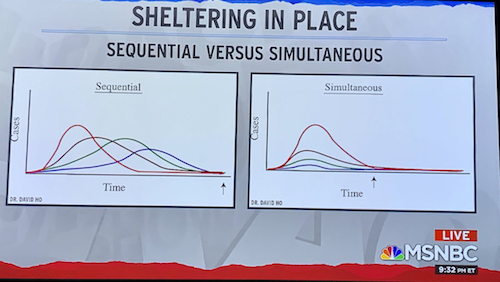
Last night Maddow shared two graphs from David Ho that illustrate why, unless everyone stays home at the same time, even those states that do will have a much longer and more costly pandemic. The best thing for everyone would be if we all lock down now, and wait out the virus.
Not Just 'The Death of IT'. Cringely Also Predicts Layoffs For Many IT Contractors Slashdotby EditorDavid on ibm at January 1, 1970, 1:00 am (cached at April 4, 2020, 6:05 pm)

Last week long-time tech pundit Robert Cringely predicted "the death of IT" in 2020 due to the widespread adoption of SD-WAN and SASE. Now he's predicting "an even bigger bloodbath as IT employees at all levels are let go forever," including IT consultants and contractors. My IT labor death scenario now extends to process experts (generally consultants) being replaced with automation. In a software-defined network, whether that's SD-WAN or SASE, so much of what used to be getting discreet boxes to talk with one another over the network becomes a simple database adjustment. The objective, in case anyone forgets (as IT, itself, often does) is the improvement of the end-user experience, in this case through an automated process. With SD-WAN, for example, there are over 3,000 available Quality of Service metrics. You can say that Office 365 is a critical metric as just one example. Write a script to that effect into the SD-WAN database, deploy it globally with a keyclick and you are done... It's slowly dawning on IBM [and its competitors] that they have to get rid of all those process experts and replace them with a few subject matter experts. Here's the big lesson: with SD-WAN and SASE the process no longer matters, so knowing the process (beyond a few silverbacks kept on just in case the world really does end) isn't good for business. Cringely predicts the downgrading of corporate bonds will also put pressure on IBM and its competitors, perhaps ultimately leading to a sale or spin-off at IBM. "Either they sell the parts that don't make money, which is to say everything except Red Hat and mainframes, or they sell the whole darned thing, which is what I expect to happen." With that he predicts thousands of layoffs or furloughs — and while the bond market puts IBM in a bigger bind, "this could apply in varying degrees to any IBM competitors."

Read more of this story at Slashdot.

Morning Coffee Notes Scripting News(cached at April 4, 2020, 6:03 pm)

A bunch of things to write about today. Rolling up my sleeve.

In the old days of blogging I had subscribed to Paolo Valdemarin's blog. Then Paolo must've gotten busy, being an entrepreneur in Italy, and now a VC in London. Then once they had the lockdown in the UK, he started blogging again. My RSS aggregator, which had been checking his feed every fifteen minutes during his decade-long hiatus, sprung to life. The lights came on. Paolo is a much better writer than I remembered. His blog flows, his stories are human, his observations are easy to relate to. Silver linings everywhere.

Same with John Naughton, though he never stopped writing. He's a columnist at the Guardian, also from the UK, a great thinker and observer. His blog is now published every morning (my timezone) via Substack. I looked at using Substack before writing my own software. I didn't like that I would have to manually transcribe my posts from my CMS to theirs to get them to publish it. It's 2020 for crying out loud. Support the standards. Or maybe they want their users locked in? I can't tell you how many times I've had to reimplement the entire functionality of a product to avoid having to manually transpose my writing or avoid lock-in. It's a VC way of thinking and not observant of the fundamental law of the web, people come back to places that send them away. Trust your users. If you have the best product, they'll continue to use it and sing your praises. If you don't, they'll bolt at the first opportunity.

Naughton also wrote about Private Kit, though I can't find the reference now. It's a brilliant idea. An app for iOS or Android that tracks your whereabouts, but doesn't share the data with anyone but you. The info never leaves your phone without your permission. It offers new opportunities for resarchers studying among other things the migration of pandemic viruses through the population. This is the future, and a very nice way to spin it, MIT. Keep up the good work.

[no title] Scripting News(cached at April 4, 2020, 6:03 pm)

Heard something disturbing on WNYC earlier. A Nobel laureate in psychology said he was optimistic for society and pessimistic for himself. At his age, he said, the virus is basically a life sentence of staying isolated. He's 86.
[no title] Scripting News(cached at April 4, 2020, 6:03 pm)

I asked a question on Twitter this morning that apparently was not understood. Let's try again. When Gov Cuomo says that NY got hit first, I want to know why other American cities didn't get hit at roughly the same time. They say a virus moves in waves. First northern Italy gets it, then the south. NY has its hospitals overloaded, but not Philadelphia. The theory is, according to Cuomo, that the virus will peak in NY, and then peak in other places. Since people move freely around the US, why wouldn't it all happen at roughly the same time. I'd like you to remember, before answering, I have a math degree, and have spent decades working with logic and numbers in computer software. Saying that Dallas has cases, as has St Louis and Cleveland, while true, is not an answer to this puzzling question. Thanks in advance for considering this.