IBM and Microsoft Sign Vatican Pledge For Ethical AI Slashdotby msmash on ai at January 1, 1970, 1:00 am (cached at February 28, 2020, 11:34 pm)

IBM and Microsoft have signed an "ethical resolution" with the Vatican to develop AI in a way that will protect the planet and the rights of all people [Editor's note: the link may be paywalled; alternative source]. From a report: The pledge, called the "Rome Call for AI Ethics," will be presented on Friday morning to Pope Francis by Brad Smith, the president of Microsoft, and John Kelly, IBM's executive vice-president, as well as Vatican officials and Qu Dongyu, the Chinese director-general of the UN Food and Agriculture Organization. The two US tech companies lead the world in AI development, measured by the number of patents they have amassed. The document calls for AI to safeguard the rights of all humankind, particularly the weak and underprivileged, and for new regulations in fields such as facial recognition. It said that there must be a "duty of explanation" that would show not only how AI algorithms come to their decisions but also what their purpose and objectives are.

Read more of this story at Slashdot.

[no title] Scripting News(cached at February 28, 2020, 11:33 pm)

Here's the full video of the Bloomberg town hall on Wednesday that impressed me so.
Apple Has Blocked Clearview AI's iPhone App for Violating Its Rules Slashdotby msmash on ai at January 1, 1970, 1:00 am (cached at February 28, 2020, 10:34 pm)

An iPhone app built by controversial facial recognition startup Clearview AI has been blocked by Apple, effectively banning the app from use. From a report: Apple confirmed to TechCrunch that the startup "violated" the terms of its enterprise program. The app allows its users -- which the company claims it serves only law enforcement officers -- to use their phone camera or upload a photo to search its database of three billion photos. But BuzzFeed News revealed that the company -- which claims to only cater to law enforcement users -- also includes many private sector users, including Macy's, Walmart, and Wells Fargo. Clearview AI has been at the middle of a media -- and legal -- storm since its public debut in The New York Times last month. The company scrapes public photos from social media sites, drawing ire from the big tech giants which claim Clearview AI misused their services. But it's also gained attention from hackers. On Wednesday, Clearview AI confirmed a data breach, in which its client list was stolen.

Read more of this story at Slashdot.

WHO Raises Coronavirus Threat Assessment To Its Highest Level Slashdotby msmash on medicine at January 1, 1970, 1:00 am (cached at February 28, 2020, 10:05 pm)

World Health Organization officials said Friday they are increasing the risk assessment of the coronavirus, which has spread to at least 49 countries in a matter of weeks, to "very high" at a global level. From a report: "We are on the highest level of alert or highest level of risk assessment in terms of spread and in terms of impact," said Dr. Mike Ryan, executive director of WHO's health emergencies program. The group isn't trying to alarm or scare people, he said. "This is a reality check for every government on the planet: Wake up. Get ready. This virus may be on its way and you need to be ready. You have a duty to your citizens, you have a duty to the world to be ready." The world can still avoid "the worst of it," but the increased risk assessment means the WHO's "level of concern is at its highest," he said at a press conference at WHO headquarters in Geneva. World leaders still have a chance to contain the virus within their borders, Ryan said. "To wait, to be complacent to be caught unawares at this point, it's really not much of an excuse."

Read more of this story at Slashdot.

Freeman Dyson, Visionary Technologist, Is Dead at 96 Slashdotby msmash on math at January 1, 1970, 1:00 am (cached at February 28, 2020, 9:05 pm)

darenw shares a report: Freeman J. Dyson, a mathematical prodigy who left his mark on subatomic physics before turning to messier subjects like Earth's environmental future and the morality of war, died on Friday at a hospital near Princeton, N.J. He was 96. His daughter Mia Dyson confirmed the death. As a young graduate student at Cornell in 1949, Dr. Dyson wrote a landmark paper -- worthy, some colleagues thought, of a Nobel Prize -- that deepened the understanding of how light interacts with matter to produce the palpable world. The theory the paper advanced, called quantum electrodynamics, or QED, ranks among the great achievements of modern science. But it was as a writer and technological visionary that he gained public renown. He imagined exploring the solar system with spaceships propelled by nuclear explosions and establishing distant colonies nourished by genetically engineered plants. "Life begins at 55, the age at which I published my first book," he wrote in "From Eros to Gaia," one of the collections of his writings that appeared while he was a professor of physics at the Institute for Advanced Study in Princeton -- an august position for someone who finished school without a Ph.D. The lack of a doctorate was a badge of honor, he said. With his slew of honorary degrees and a fellowship in the Royal Society, people called him Dr. Dyson anyway. Further reading: Slashdot's interview with Freeman Dyson (2013).

Read more of this story at Slashdot.

Senate Unanimously Approves Bill To Ban Purchase of Huawei Equipment With Federal Fu Slashdotby msmash on usa at January 1, 1970, 1:00 am (cached at February 28, 2020, 8:35 pm)

The Senate unanimously approved legislation on Thursday that would ban the use of federal funds to purchase telecommunications equipment from companies deemed a national security threat, such as Chinese group Huawei. From a report: The bipartisan Secure and Trusted Telecommunications Networks Act, which the House passed in December, bans the Federal Communications Commission (FCC) from giving funds to U.S. telecom groups to purchase equipment from companies deemed threats. The bill would require the FCC to establish a $1 billion fund to help smaller telecom providers to rip out and replace equipment from such companies, and to compile a list of firms seen as posing a threat to telecom networks.

Read more of this story at Slashdot.

Bernie Sanders Has an Audacious -- and Hugely Expensive -- Climate Plan Slashdotby msmash on earth at January 1, 1970, 1:00 am (cached at February 28, 2020, 7:35 pm)

Senator Bernie Sanders, the front-runner for the Democratic nomination in this year's presidential election, has put forth the most audacious climate plan among the contenders. But there are doubts about the political and economic feasibility of his sweeping vision, as well as the wisdom of some of his particular technical proposals. From a report: Notably, the plan restricts tools that could help rapidly cut greenhouse-gas emissions, including nuclear power and technologies that can capture carbon dioxide. Sanders wants to pump more than $16 trillion into a version of the Green New Deal that would eliminate emissions from the US power sector, as well as all ground transportation, within a decade. To pull it off, he wants the government to play a much larger role in the electricity sector. His plan would direct new or expanded federal agencies to build nearly $2.5 trillion worth of wind, solar, geothermal, and energy storage projects. The plan would also force major changes on the fossil-fuel sector, including ending federal subsidies, mountaintop-removal coal mining, and the import and export of fossil fuels. He'd also direct federal agencies to investigate whether companies broke the law in covering up their role in climate change, or owe damages for the destruction they cause. In addition, Sanders wants to invest more than $2 trillion to help families and small businesses improve the energy efficiency of their homes, buildings, and operations; and more than $1 trillion to retrofit or construct bridges, roads, water systems, and coastal protections in ways that will stand up to harsher climate conditions. He says the plan will create 20 million jobs, while offering wage guarantees, job training, and other assistance to displaced energy workers. His broader goals for the Green New Deal go beyond climate and clean energy as well, boosting funding for affordable housing and rural economic development, and enhancing protections for civil rights, environmental justice, and labor.

Read more of this story at Slashdot.

Printing's Not Dead: The $35 Billion Fight Over Ink Cartridges Slashdotby msmash on printer at January 1, 1970, 1:00 am (cached at February 28, 2020, 6:35 pm)

America's onetime innovation icons are wrestling over their biggest remaining piles of money. From a report: The HP 63 Tri-color ink cartridge retails for $28.99 at Staples. Stuffed with foam sponges drenched in a fraction of an ounce of cyan, magenta, and yellow dyes, this bestseller, model No. F6U61AN#140, can spray 36,000 drops per second in the Envy printers made by HP. The 63 Tri-color cartridge may not look like much, but that ink, which needs a refill every 165 pages, is ridiculously valuable. HP's printer supplies business garnered $12.9 billion in sales last year, and the printer division overall represented 63% of the company's profits. Here in the year 2020, proprietary ink cartridges remain important enough to spark a fight worth at least $35 billion. With backing from Carl Icahn, Xerox has been trying to buy the much larger HP for what the target says is a laughable bid. On Monday, HP Chief Executive Officer Enrique Lores moved to protect his hold on F6U61AN#140 and its toner brethren. During his report on the company's latest quarterly earnings, which met Wall Street's expectations, Lores announced that HP would triple its share buyback program to $15 billion over three years as part of an effort to fend off the hostile takeover. While Lores said he was open to exploring new merger frameworks, he dismissed the size and technology of Xerox Holdings Corp. and stressed that HP already had a winning strategy. "I am pumped up," the CEO tells Bloomberg Businessweek in an interview shortly after the earnings call. "We have a great plan." Lores, who's spent three decades at HP, has survived his share of existential threats. Before he took over as CEO in November, he'd led the printer business to a streak of revenue gains after even his bosses had left it for dead. But last year also saw HP's share price fall by a third from a February high. The company announced thousands of employee layoffs as it struggled to compete with cheaper ink cartridges from Asia. That public floundering has left HP freshly vulnerable to activist investors such as Icahn, who owns 11% of Xerox and 4% of HP. Icahn snarked in December that HP appears in danger of following "the road to the graveyard." For decades, HP and Xerox ranked among the most powerful forces of invention in Silicon Valley. Now they're arguing over who has the superior vision to acquire competitors, jettison workers, and jealously guard the tech specs of their aging intellectual property. It's unclear whether either company's leaders will be able to repeat the miracle Lores's team managed a few years back. Consumer and office printers still churn out an estimated 3.2 trillion pages a year, according to market researcher IDC, but Toni Sacconaghi, a tech analyst at Sanford C. Bernstein, warned in a client note that the "traditional printing and copying business is slowly collapsing." Recalling the image that critics deployed in 2002, when HP tried to acquire its way out of trouble in the PC business by buying Compaq, Sacconaghi wondered if the company is facing another deal that looks an awful lot like "two garbage trucks colliding."

Read more of this story at Slashdot.

Global Stocks Plummet Again in Worst Week Since 2008 Financial Crisis Slashdotby msmash on business at January 1, 1970, 1:00 am (cached at February 28, 2020, 6:05 pm)

Global stock markets plummeted for a seventh consecutive day on Friday as the coronavirus continued to spread, increasing fears that the epidemic will wipe out corporate profits and push some of the world's biggest economies into recession. From a report: China's Shanghai Composite closed down 3.7%, bringing losses for the week to 5.6%, the index's worst performance since April 2019. Japan's Nikkei ended down 3.7% and benchmark indexes in Australia and South Korea both shed 3.3%. European stocks suffered even greater losses, with Germany's DAX dropping as much as 5% in early trading and London's FTSE 100 shedding 4.4%. In Italy, where 17 people have now died as a result of the virus, the benchmark FTSE MIB index was down nearly 4%. US stock futures were also sharply lower Friday, suggesting that the country's three main indexes will resume their plunge after a sharp sell-off on Thursday during which the Dow suffered its worst ever points loss, dropping 1,191 points, or 4.4%. The S&P 500 suffered a similar fall and has slid more than 10% from its recent peak. Taken together, global stocks are on track for their worst week since the global financial crisis. The MSCI index, which tracks shares in many of the world's biggest companies, has fallen 8.9% -- its worst percentage decline since October 2008.

Read more of this story at Slashdot.

Report Identifies the Most Dangerous Mobile App Store on the Internet Slashdotby msmash on security at January 1, 1970, 1:00 am (cached at February 28, 2020, 5:05 pm)

9Game.com, a portal for downloading free Android games, was the mobile app store hosting the most malicious apps in 2019. From a report: 9Game ranked number one on the list of app stores with the most "new" malicious app uploads, but also number one on the list of app stores with the highest concentration of malicious apps overall. According to RiskIQ's 2019 Mobile App Threat Landscape report, 61,669 new malicious apps were uploaded on 9Game in 2019. In this ranking, 9Game was followed at a considerable distance by the official Android app store -- the Google Play Store -- with 25,647 new malicious apps. Completing the top 5 are Qihoo 360's Zhushou store, the Feral app store, and Huawei's Vmall app store. But while the Play Store ranked second on the list of new malware uploads, its sheer size diluted the impact these malicious apps had on Android users. The Play Store didn't rank at all in the top 5 app stores with the highest concentration of malicious apps, which included (1) 9Game, (2) the Feral app store, (3) the Vmall app store, (4) the Xiaomi app store, and (5) Qihoo 360's Zhushou store.

Read more of this story at Slashdot.
[no title] Scripting News(cached at February 28, 2020, 5:03 pm)

Reagan famously asked Gorbachev if they could set aside their differences if the world was invaded by aliens. Gorbachev said hell yes. I wonder if the Repubs could be so kind and temporarily pause their war on the American people.
[no title] Scripting News(cached at February 28, 2020, 5:03 pm)

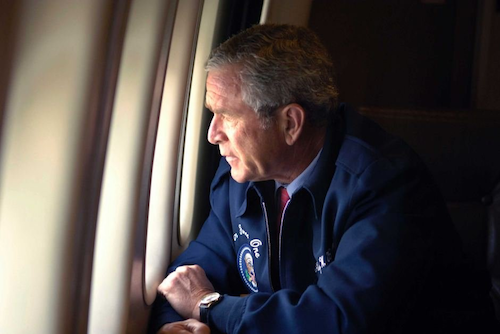
We are now having an extended heckuva job Brownie moment, only this time it isn't just New Orleans, it's the entire world.
[no title] Scripting News(cached at February 28, 2020, 5:03 pm)

President Bush learning that New Orleans had drowned.
The Most Popular YouTube Videos About The Coronavirus Are Being Made In India -- And Slashdotby msmash on social at January 1, 1970, 1:00 am (cached at February 28, 2020, 4:05 pm)

India is in the middle of a YouTube-powered coronavirus frenzy that could kill people. From a report: The most popular YouTube video in the world about the coronavirus was created by a channel called Wonderful Secrets of the World, which typically publishes Hindi-language videos about sports and cars, as well as roundups like "Top 5 Secret Places Hidden in Famous Locations" or "30 Amazing Facts About Human Body." The channel, the logo of which looks uncannily like that of Volkswagen, hides its subscriber count, but 16 of its videos have been viewed over a million times -- the most popular being the coronavirus explainer, which has been seen 13.6 million times as of Wednesday. Wonderful Secrets of the World isn't an outlier. It is the tip of a huge Indian YouTube iceberg of content about the outbreak. The disease has 75,280 confirmed cases, and 2,014 deaths, mostly in mainland China. Shared at high rates, these videos often combine basic facts about the novel coronavirus from Wuhan, China, with Indian nationalist propaganda and hearsay -- with serious real-life consequences. There are reports of a man in southeast India who had a urinary tract infection and killed himself on Feb. 10, mistakenly thinking he had the coronavirus. His son told local media he was watching a lot of videos about the virus online. "We told him that he did not have coronavirus, but he refused to let us near him. He told all the villagers to stay away. He would tell them that their kids would also end up contracting it if they came close to him," his son told reporters. Karen Rebelo, deputy editor for Boom, an Indian fact-checking organization that reported on the story, told BuzzFeed News it's extremely difficult to fact-check YouTube videos because often it's not a straightforward question of whether the content is true or false. "Most Indians coming online for the first time start by streaming YouTube videos because it's free," Rebelo said. She said that most fact-checking efforts in India are only being done in English and Hindi, so things are even more complicated for videos being created in regional languages. It's also hard to fact-check videos that mix truth and hoax freely together.

Read more of this story at Slashdot.
[no title] Scripting News(cached at February 28, 2020, 4:03 pm)

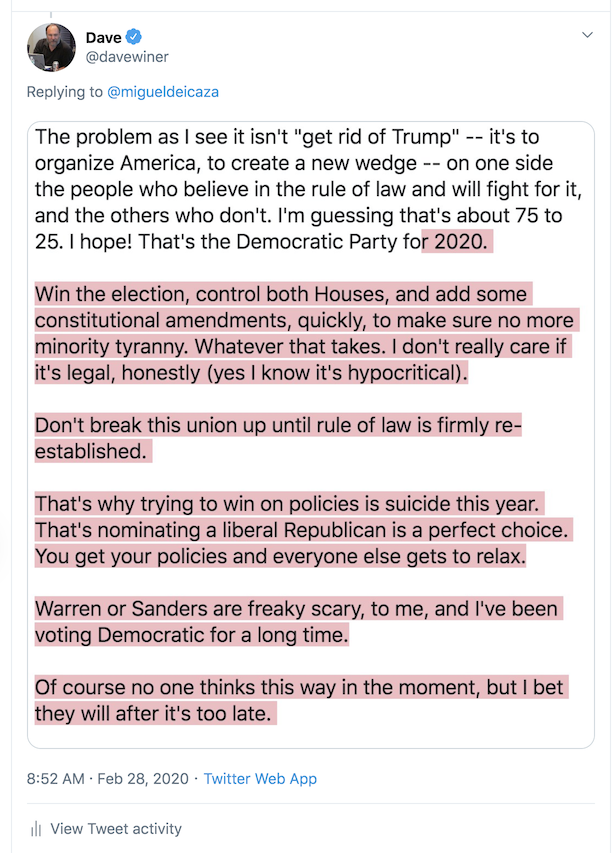
I was typing a reply to Miguel de Icaza on Twitter and went over the 280 char limit. Their thread editor doesn't work with replies don't do threads on replies, so I just kept typing, and at the end I posted a screen shot of what I wrote. Twitter please, the 280 char limit is bullshit. Let's go to infinite length tweets. Facebook manages to do this. It's time. Thanks.