Alternative Browser 'Waterfox' Acquired By System1 Slashdotby EditorDavid on internet at January 1, 1970, 1:00 am (cached at February 16, 2020, 11:05 pm)

Waterfox is an open-source web browser for x64, ARM64, and PPC64LE systems, "intended to be speedy and ethical, and maintain support for legacy extensions dropped by Firefox, from which it is forked," according to Wikipedia. (Its tabs also still have angled sides with rounded corners.) Friday Waterfox's original creator, 24-year-old Alexandros Kontos, announced that the browser "now has funding and a development team, so Waterfox can finally start to grow!" after its acquisition by a company called System1. I started Waterfox when I was 16. It was a way for me to understand how large software projects worked and the Mozilla documentation was a great introduction... I've touted Waterfox as an ethical and privacy friendly browser... I never wanted Waterfox to be a part of the hyper-privacy community. It would just feel like standards that would be impossible to uphold, especially for something such as a web browser on the internet. Throughout the years people have always asked about Waterfox and privacy, and if they've ever wanted more than it can afford, I've always pushed them to use Tor. Waterfox was here for customisations and speed, with a good level of privacy... I wasn't doing anything with Waterfox except developing it and making some money via search. Why I kept going throughout the years, I'll never know... System1 has been to Waterfox a search syndication partner. Essentially a way to have a search engine partnership (such as Bing) is through them, because companies such as Microsoft are too big and too busy to talk to small players such as Waterfox... It's probably the one easy way a browser can make money without doing anything dodgy, and it's a way I've been happy to do it without having to compromise Waterfox (and will be the same way System1 makes money from Waterfox -- nothing else). People also don't seem to understand what System1 does... "Now I can finally focus on making Waterfox into a viable alternative to the big browsers," Kontos concludes. Long-time Slashdot reader Freshly Exhumed contextualized the news with this brief history of the alternate browser ecosystem: As the usage share of web browsers continues to show a lopsideded dominance by Google Chrome, many previously-independent browsers have fallen by the wayside or have been reinvented as Chrome variants (i.e. Opera, Edge, Brave). Apple forges on with its Safari browser while other, smaller projects tend to be quite limited for multi-platform users, such as Dolphin and Bromite. Mozilla continues independently with Firefox for almost every platform, while variants such as Pale Moon and Sea Monkey have attempted to provide products that avoid drastic and/or controversial changes made by Mozilla but sometimes do not match the multi-platform support of Firefox. Let us not forget Tor, the Firefox-based anonymity-focused browser. Alex Kontos is a developer who attempted to provide continuity with dropped Firefox capabilities in his multi-platform Waterfox browser, proudly declaring that Firefox's user data sharing and telemetry collection was not included. For that privacy focus a certain popularity of Waterfox occurred. Now Kontos has revealed that his Waterfox project has been sold to System1, a company describing itself as "a consumer internet and applications company with the most powerful audience expansion platform in the industry."

Read more of this story at Slashdot.
Dark Mode vs. Light Mode: Which Is Better? Slashdotby EditorDavid on displays at January 1, 1970, 1:00 am (cached at February 16, 2020, 10:05 pm)

Recently a well-respected UI consulting firm (the Nielsen Norman Group) published their analysis of academic studies on the question of whether Dark Mode or Light Mode was better for reading? Cosima Piepenbrock and her colleagues at the Institut für Experimentelle Psychologie in Düsseldorf, Germany studied two groups of adults with normal (or corrected-to-normal) vision: young adults (18 to 33 years old) and older adults (60 to 85 years old). None of the participants suffered from any eye diseases (e.g., cataract)... Their results showed that light mode won across all dimensions: irrespective of age, the positive contrast polarity was better for both visual-acuity tasks and for proofreading tasks... Another study, published in the journal Human Factors by the same research group, looked at how text size interacts with contrast polarity in a proofreading task. It found that the positive-polarity advantage increased linearly as the font size was decreased: namely, the smaller the font, the better it is for users to see the text in light mode. Interestingly, even though their performance was better in the light mode, participants in the study did not report any difference in their perception of text readability (e.g., their ability to focus on text) in light versus dark mode — which only reinforces the first rule of usability: don't listen to users... While dark mode may present some advantages for some low-vision users — in particular, those with cloudy ocular media such as cataract, the research evidence points in the direction of an advantage of positive polarity for normal-vision users. In other words, in users with normal vision, light mode leads to better performance most of the time... These findings are best explained by the fact that, with positive contrast polarity, there is more overall light and so the pupil contracts more. As a result, there are fewer spherical aberrations, greater depth of field, and overall better ability to focus on details without tiring the eyes... That being said, we strongly recommend that designers allow users to switch to dark mode if they want to — for three reasons: (1) there may be long-term effects associated with light mode; (2) some people with visual impairments will do better with dark mode; and (3) some users simply like dark mode better. The long-term effects associated with light mode come from an "intriguing" 2018 study they found which argued that reading white text from a black screen or tablet "may be a way to inhibit myopia, while conventional black text on white background may stimulate myopia..." The researchers wrote that myopia "is tightly linked to the educational status and is on the rise worldwide."

Read more of this story at Slashdot.
Google Chrome Will Soon Start Blocking Insecure Downloads Slashdotby EditorDavid on chrome at January 1, 1970, 1:00 am (cached at February 16, 2020, 9:05 pm)

"Google has revealed plans to initially warn Chrome users about 'insecure' downloads and eventually block them outright," reports The Verge. The warnings will begin in April: "Today we're announcing that Chrome will gradually ensure that secure (HTTPS) pages only download secure files," Joe DeBlasio of the Chrome security team wrote in a blog post. "Insecurely-downloaded files are a risk to users' security and privacy. For instance, insecurely-downloaded programs can be swapped out for malware by attackers, and eavesdroppers can read users' insecurely-downloaded bank statements." Beginning with Chrome 82, due for release in April, Chrome will warn users if they're about to download mixed content executables from a secure website. Then, when version 83 is released, those executable downloads will be blocked and the warning will be applied to archive files. PDFs and .doc files will get the warning in Chrome 84, with audio, images, text, and video files displaying it by version 85. Finally, all mixed content downloads — a non-secure file coming from a secure site — will be blocked as of the release of Chrome 86. Right now, Google is estimating an October release for that build of the popular web browsing.

Read more of this story at Slashdot.

Do We Need To Talk About 'Cloud Neutrality'? Slashdotby EditorDavid on cloud at January 1, 1970, 1:00 am (cached at February 16, 2020, 8:05 pm)

"A multibillion-dollar, privately-owned infrastructure is now essential to the modern internet economy," writes Wired. And if you care about net neutrality, "That should freak you out." [T]here's an even bigger issue brewing, and it's time to start talking about it: cloud neutrality. "While its name sounds soft and fluffy," Microsoft president and general counsel Brad Smith and coauthor Carol Ann Browne write in their recent book, Tools and Weapons: The Promise and the Peril of the Digital Age, "in truth the cloud is a fortress...." Each data center costs hundreds of millions of dollars to build and many millions more to maintain; and you pretty much can't build a successful new company without them. So, thank goodness for Microsoft, right? The book means to portray this might and power as both a source of wonder and an enabling feature of the modern economy. To me, it reads like a threat. The cloud economy exists at the pleasure, and continued profit, of a handful of companies. The internet is no longer the essential enabler of the tech economy. That title now belongs to the cloud. But the infrastructure of the internet, at least, was publicly financed and subsidized. The government can set rules about how companies have to interact with their customers. Whether and how it sets and enforces those rules isn't the point, for now. It can. That's not the case with the cloud. This infrastructure is solely owned by a handful of companies with hardly any oversight. [Besides Microsoft, the article also notes Google and Amazon.] The potential for abuse is huge, whether it's through trade-secret snooping or the outright blocking, slowing, or hampering of transmission. No one seems to be thinking about what could happen if these behemoths decide it's against their interests to have all these barnacles on their flanks. They should be. Cloud companies "are essentially incubating and hosting their competition..." the article points out. "The problem is that few have the resources to replicate the cloud infrastructure, should the landlords suddenly turn on their tenants."

Read more of this story at Slashdot.

[no title] Scripting News(cached at February 16, 2020, 7:33 pm)

The term No Breakage Club has four hits on Google before this piece was posted.
[no title] Scripting News(cached at February 16, 2020, 7:33 pm)

I think the No Breakage Club might turn out to be like the Silicon Valley Asshole Society, something I had a role in starting in the 1990s. We had all kinds of Deadhead like rules and bylaws, all of which revolved around being unacceptable according to the rules of the valley.
[no title] Scripting News(cached at February 16, 2020, 7:33 pm)

I've been chatting about breakage with Dave Gandy, the founder of Font Awesome. I recorded a 15-minute voicemailcast to Dave, with a very small slice of my experience with breakage in tech. Dave is now a member of the No Breakage Club. Up until now I thought I was the only one. They learned the hard way by shipping a version of their product that basically broke everyone. It broke me. Squared the complexity of using FA, which ideally would require zero thought, it should "just work" as it did when I first adopted it in 2013. Now they're putting the pieces back together, and I'm guessing it will work. It doesn't always, sometimes you're stuck forever supporting both versions. At least if you care about your users. Not sure where this will go, but it's nice to have a friend on the frontier. In the cast I talk about Python's breakage, it came with v3.0.
[no title] Scripting News(cached at February 16, 2020, 7:33 pm)

BTW, as I mention in the cast, the new Concord, the one I just released, includes the latest version of Font Awesome. Since they're now a member of No Breakage Club, he's a friend, and it's worth helping him get the very latest stuff out there.
OpenPower Foundation Releases a Friendly EULA For IBM's Power ISA RISC Slashdotby EditorDavid on opensource at January 1, 1970, 1:00 am (cached at February 16, 2020, 7:05 pm)

Long-time Slashdot reader lkcl writes: Michael Larabel, of Phoronix, writes that the OpenPower Foundation has released a license agreement for Hardware Vendors to implement the Power ISA RISC instruction set in their processors. Hugh Blemings, the Director of OpenPower, was responsible for ensuring that the EULA is favourable and friendly towards Libre and Open Hardware projects and businesses. Of particular interest is that IBM's massive patent portfolio is automatically granted, royalty-free as long as two conditions apply: firstly, the hardware must be fully and properly Power ISA compliant, and secondly, the implementor must not "try it on" as a patent troll. Innovation in the RISC space just got a little more interesting. "Amidst the fully free and open RISC-V ISA making headway into the computing market, and ARM feeling pressured to loosen up its licensing, it seems they figured that it's best to join the party early," argues Hackaday.

Read more of this story at Slashdot.

[no title] Scripting News(cached at February 16, 2020, 7:03 pm)

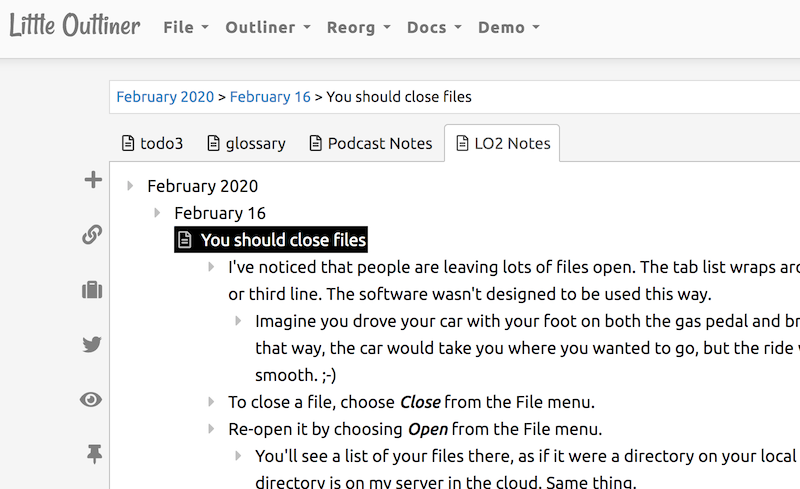
Here's a screen shot of what my tab list looks like. This gives you an idea of what you can do.
[no title] Scripting News(cached at February 16, 2020, 7:03 pm)

A couple of LO2 user tips. 1. Keep your tab list neat. Close files. They're easy to re-open and 2. Change the title of files to make the tab display more esthetic and usable.
The Gig Workers For Target's Delivery App Hate Their Algorithmically-Determined Pay Slashdotby EditorDavid on business at January 1, 1970, 1:00 am (cached at February 16, 2020, 5:35 pm)

In 2017 Target bought a same-day home-delivery company called Shipt for $550 million. Shipt now services half of Target's stores, reports Motherboard, and employs more than 100,000 gig workers. Unfortunately, they're working for a company that "has a track record of censoring and retaliating against workers for asking basic questions about their working conditions or expressing dissent," reports Motherboard. For example, an hour after tweeting about how there was now much more competition for assignments, one Seattle gig worker found their account suddenly "deactivated" — the equivalent of being fired — and also received an email saying they were no longer "eligible to reapply". "They stamp out resistance by flooding the market with new workers..." complained one Shipt worker, "and they're actively monitoring all the social media groups. " On its official national Facebook group, known as the Shipt Shopper Lounge, which has more than 100,000 members, Shipt moderators selected by the company frequently censor and remove posts, turn off comments sections, and ban workers who speak out about their working conditions, according to screenshots, interviews, and other documentation provided to Motherboard. The same is true on local Facebook groups, which Shipt also monitors closely, according to workers. Motherboard spoke to seven current Shipt workers, each of whom described a culture of retaliation, fear, and censorship online... Because Shipt classifies its workers as contractors, not employees, workers pay for all of their expenses — including gas, wear and tear on their cars, and accidents — out of pocket. They say the tips on large orders from Target, sometimes with hundreds of items, can be meager. Workers say Shipt customers often live in gated and upscale communities and that the app encourages workers to tack on gifts like thank you cards, hot cocoa, flowers, and balloons onto orders (paid for out of their own pocket) and to offer to walk customer's dogs and take out their trash, as a courtesy. Shipt calls this kind of service "Bringing the Magic," which can improve workers' ratings from customers that factor into the algorithm that determines who gets offered the most lucrative orders... Unfortunately, that new algorithm (which began rolling out last year) is opaque to the workers affected by it — though Gizmodo reported pay appears to be at least 28% lower. And Motherboard heard even higher estimates: "Our best estimate is that payouts are now 30 percent less, and up to 50 percent on orders," one Shipt worker in Kalamazoo with two years under her belt, who wished to remain anonymous for fear of retaliation, told Motherboard. "I fluctuate between extreme anger and despair. It's been three weeks since this has been implemented, and one of my good friends told me that she's down the equivalent of a car payment." Another Shipt worker in Palm Springs, California provided Motherboard with receipts for a 181-item order that included six Snapple cases, five La Croix cases, and 12 packs of soda. They had to wheel three shopping carts out of a Ralph's grocery store and deliver them -- and earned $12.68 for the job. The customer did not tip. (Under the older, more transparent pay model, they would have earned $44.19.) "That's a real slap in the face," they told Motherboard.

Read more of this story at Slashdot.

Firefox, Wordpress Move to Support Lazy Loading of Images and iFrames Slashdotby EditorDavid on chrome at January 1, 1970, 1:00 am (cached at February 16, 2020, 5:05 pm)

"Lazy Loading" would augment HTML's <img> tag (and <iframe> tag) with two new attributes -- "eager" (to load immediately) and "lazy" (to load only when it becomes relevant in the viewport). Felix Arntz, a developer programs engineer at Google (and a WordPress core committer) notes the updates in the HTML specification for the lazy loading attributes, adding that it's "already supported by several browsers, including Chrome and Edge" and also the Android browser and Opera. And lazy loading can now also be toggled on for Firefox 75 Nightly users, reports Neowin, though it's disabled by default: It's not clear if it will be enabled by the time Firefox 75 reaches the stable branch but according to comments on the Bugzilla thread, it's in high demand. Previously, websites could employ lazy loading by using JavaScript but now lazy loading syntax is supported directly in the web browser. The implementation in Firefox comes after Google added the feature to its browser. Google's Arntz has also written a post describing a proposal to begin lazy-loading images by default in Wordpress. The proposed solution is available as a feature plugin WP Lazy Loading in the plugin repository. The plugin is being developed on GitHub. Your testing and feedback will be much appreciated.

Read more of this story at Slashdot.

Watch Out: This Verizon Smishing Scam Is Crazy Realistic Slashdotby EditorDavid on crime at January 1, 1970, 1:00 am (cached at February 16, 2020, 4:05 pm)

Slashdot reader Iwastheone shared a warning from the editor-in-chief at How-To Geek about a "shockingly convincing" scam: The scam text message says, "Your Verizon account security needs validation" and invites you to tap a link to "validate your account." Once you do, you end up at a phishing website that looks almost exactly like Verizon's real website. The fake website asks for your My Verizon mobile number or user ID and password. After you provide those, it'll ask for your account PIN. Finally, it requests all your personal details to "identify yourself." For smishing scams, this is convincing work. The website looks real and authentic — if you don't look too hard at the address, which isn't actually Verizon's actual website... At the end of the process, the phishing website thanks you for providing your information and "redirects you to the home page." For maximum deception, the phishing website actually redirects you to Verizon's real website at the end of the process. If you don't look too close, you might be deceived into thinking you were on Verizon's website the whole time. What's the game? We didn't provide real Verizon account details, so we can't say for sure. The scammer will probably try to take over your Verizon account, order smartphones on credit, and stick you with the bill.

Read more of this story at Slashdot.

[no title] Scripting News(cached at February 16, 2020, 4:03 pm)

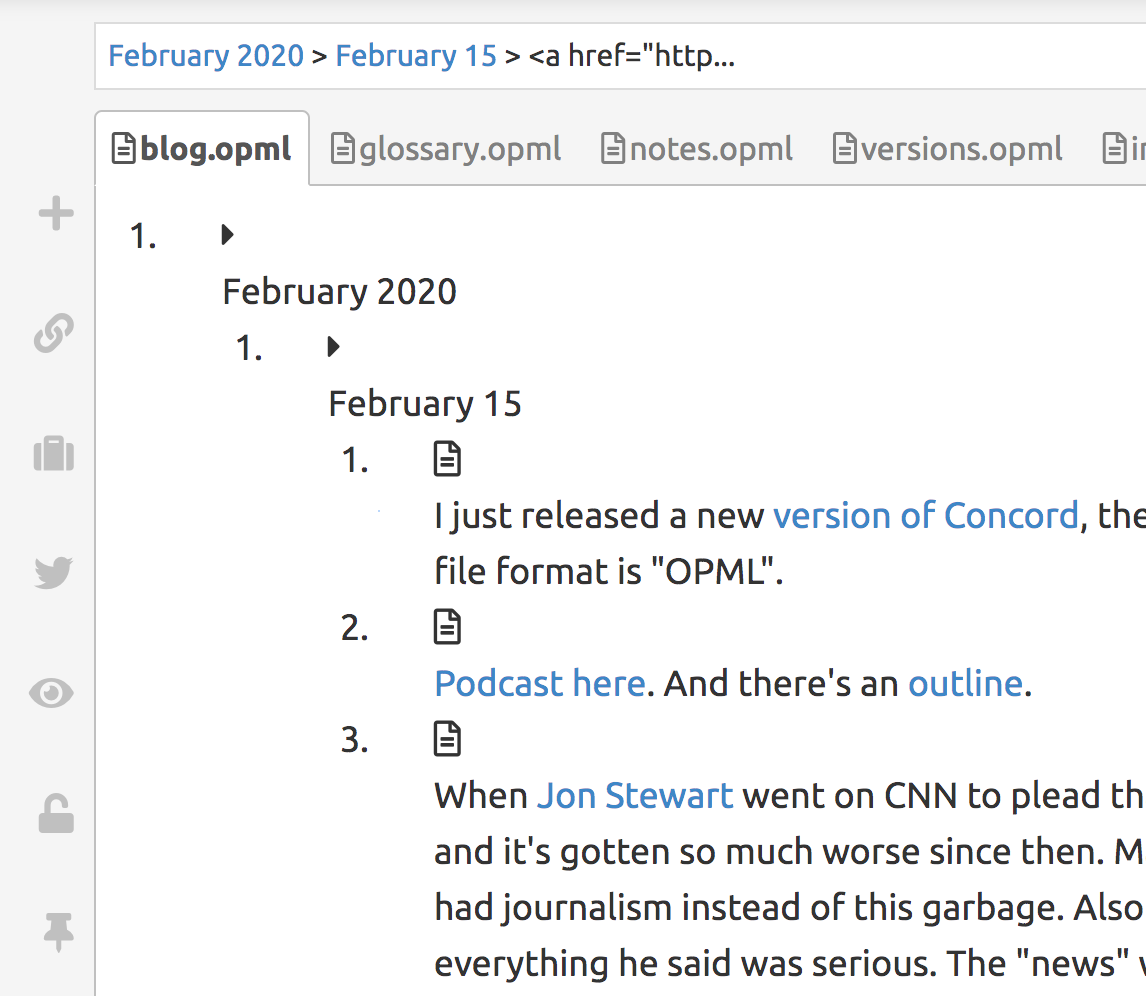
Yesterday I released a new version of Concord, the outliner core of LO2. This broke the then-current release, v1.8.6. After a report by Andy Sylvester, I quickly released v1.8.7, which works with the new Concord. The problem was that the name of the CSS file changed. The result is that the outlines looked pretty horrible. To get the latest version reload the page. If that doesn't get you 1.8.7, here are tips for getting the browser to do a full reload.