At Least 13 Managed Service Providers Were Used To Push Ransomware This Year Slashdotby msmash on security at January 1, 1970, 1:00 am (cached at October 31, 2019, 11:32 pm)

A new report published this week by threat intelligence firm Armor puts the number of managed service providers (MSPs) that got hit with ransomware this year at 13, possibly more. From a report: For those unfamiliar with the term, a managed service provider is a company that manages a customer's IT infrastructure using remote administration tools. MSPs have been around since the 90s, with the dawn of large computer fleets; however, they've been catching on with more and more companies in recent years. [...] Starting this year, ransomware gangs have realized that they could compromise the network of an MSP, and then use their remote access tools to deploy ransomware on the MSP's customer networks, infecting hundreds of companies and thousands of computers, all at once, with the push of a few buttons. In a report published this week, Armor took a deeper look at the entire MSP ecosystem and unearthed several other incidents. In total, the company found 13, but many more could be unreported.

Read more of this story at Slashdot.
US: Chicago teachers strike ends after 11 days without school AL JAZEERA ENGLISH (AJE)(cached at October 31, 2019, 11:32 pm)

Students to go back to school Friday after Chicago Teachers Union, third-largest US school district reach contract deal.
Netflix Expands Into a World Full of Censors Slashdotby msmash on censorship at January 1, 1970, 1:00 am (cached at October 31, 2019, 10:49 pm)

The streaming giant is having to navigate different political and moral landscapes, and calls for government oversight, as it seeks subscribers worldwide. From a report: In September, Netflix released a trailer for the "Breaking Bad" sequel "El Camino." In it, a character sits in a car, lights a cigarette and holds it out the window, its orange tip glowing. The next day, Netflix Turkey released its own version. In it, the character sparks a lighter and puts his hand out of the window. But there's a difference: The cigarette has been edited out. It wasn't the first time Netflix had censored one of its trailers here. In January, the streaming giant edited one for "Sex Education," a series about a teenage sex therapist, to blur a character's hands so you couldn't see the raised middle fingers. These changes may seem small, but they are a sign of Netflix trying to get ahead of regulation it could soon face in Turkey. [...] In Turkey, and in other countries, Netflix must navigate different political and moral landscapes, and calls for censorship, as it expands worldwide. Its 2018 annual report lists both "censorship" and "the need to adapt our content and users interfaces for specific cultural and language differences" as business risks. India is another country where Netflix has been embroiled in debates around regulation and censorship. In 2017, the company offered viewers "Angry Indian Goddesses," a movie that had been released in Indian theaters in a censored form to avoid offending religious sensibilities.ï Netflix, which is not subject to India's movie theater code, initially showed the censored version anyway, to avoid a backlash from religious viewers. But complaints came instead from viewers who wanted to see the movie uncut. Netflix made that version available and released a statement: "Our members reached out to us and we listened."

Read more of this story at Slashdot.

Netflix Expands Into a World Full of Censors Slashdotby msmash on censorship at January 1, 1970, 1:00 am (cached at October 31, 2019, 10:49 pm)

The streaming giant is having to navigate different political and moral landscapes, and calls for government oversight, as it seeks subscribers worldwide. From a report: In September, Netflix released a trailer for the "Breaking Bad" sequel "El Camino." In it, a character sits in a car, lights a cigarette and holds it out the window, its orange tip glowing. The next day, Netflix Turkey released its own version. In it, the character sparks a lighter and puts his hand out of the window. But there's a difference: The cigarette has been edited out. It wasn't the first time Netflix had censored one of its trailers here. In January, the streaming giant edited one for "Sex Education," a series about a teenage sex therapist, to blur a character's hands so you couldn't see the raised middle fingers. These changes may seem small, but they are a sign of Netflix trying to get ahead of regulation it could soon face in Turkey. [...] In Turkey, and in other countries, Netflix must navigate different political and moral landscapes, and calls for censorship, as it expands worldwide. Its 2018 annual report lists both "censorship" and "the need to adapt our content and users interfaces for specific cultural and language differences" as business risks. India is another country where Netflix has been embroiled in debates around regulation and censorship. In 2017, the company offered viewers "Angry Indian Goddesses," a movie that had been released in Indian theaters in a censored form to avoid offending religious sensibilities.ï Netflix, which is not subject to India's movie theater code, initially showed the censored version anyway, to avoid a backlash from religious viewers. But complaints came instead from viewers who wanted to see the movie uncut. Netflix made that version available and released a statement: "Our members reached out to us and we listened."

Read more of this story at Slashdot.

Cricketers hit nets under smoggy skies in New Delhi AL JAZEERA ENGLISH (AJE)(cached at October 31, 2019, 10:03 pm)

Filthy air polluted by rural crop fires and urban traffic and factories reached dangerous new levels in India's capital.
The Drone Wars Are Already Here Slashdotby msmash on military at January 1, 1970, 1:00 am (cached at October 31, 2019, 10:01 pm)

The skies of Syria, Yemen, and Libya swarm with armed and dangerous unmanned aerial vehicles. And the technology is spreading farther and farther afield. From a report: Three decades ago, drones were available to only the most technologically developed state military organizations. Today they're everywhere, being used by weaker states and small military forces, as well as many non-state actors, including Islamic State and al-Qaeda. "We're seeing a cycle of technological innovation regarding the use of drones and associated systems, and that cycle of techno-tactical adaptation and counter-adaptation will only hasten going forward," says Raphael Marcus, a research fellow in the department of war studies at King's College London. The diffusion of such technology is leveling the playing field, says Marcus, author of Israel's Long War With Hezbollah: Military Innovation and Adaptation Under Fire. He says that because armies no longer have the monopoly on the use of drones, surveillance technology, precision capabilities, and long-range missiles, other actors in the region are able to impose their will on the international stage. "The parameters have changed," he says. That's already leading to greater instability. For example, Hezbollah's thwarted drone strike in August and increasingly sophisticated and more frequent drone attacks by Hamas raise the risk of another war with Israel; meanwhile, Yemen's Houthi rebels made an impact on the global price of oil with a strike on Saudi Arabia, using 25 drones and missiles.

Read more of this story at Slashdot.

The Drone Wars Are Already Here Slashdotby msmash on military at January 1, 1970, 1:00 am (cached at October 31, 2019, 10:01 pm)

The skies of Syria, Yemen, and Libya swarm with armed and dangerous unmanned aerial vehicles. And the technology is spreading farther and farther afield. From a report: Three decades ago, drones were available to only the most technologically developed state military organizations. Today they're everywhere, being used by weaker states and small military forces, as well as many non-state actors, including Islamic State and al-Qaeda. "We're seeing a cycle of technological innovation regarding the use of drones and associated systems, and that cycle of techno-tactical adaptation and counter-adaptation will only hasten going forward," says Raphael Marcus, a research fellow in the department of war studies at King's College London. The diffusion of such technology is leveling the playing field, says Marcus, author of Israel's Long War With Hezbollah: Military Innovation and Adaptation Under Fire. He says that because armies no longer have the monopoly on the use of drones, surveillance technology, precision capabilities, and long-range missiles, other actors in the region are able to impose their will on the international stage. "The parameters have changed," he says. That's already leading to greater instability. For example, Hezbollah's thwarted drone strike in August and increasingly sophisticated and more frequent drone attacks by Hamas raise the risk of another war with Israel; meanwhile, Yemen's Houthi rebels made an impact on the global price of oil with a strike on Saudi Arabia, using 25 drones and missiles.

Read more of this story at Slashdot.

New fires spark in California as crews hope for weather change AL JAZEERA ENGLISH (AJE)(cached at October 31, 2019, 9:59 pm)

Forecasters say high winds are expected to subside on Thursday night, as fires continue across region of horse ranches.
Google's Network Congestion Algorithm Isn't Fair, Researchers Say Slashdotby msmash on network at January 1, 1970, 1:00 am (cached at October 31, 2019, 9:31 pm)

Researchers at Carnegie Mellon University say a Google algorithm designed help reduce internet congestion is mathematically unfair, resulting in network management systems that may disadvantage some traffic over others. From a report: Several years back, Google began work on a new open source congestion control algorithm (CCA) designed to improve the way the internet functions. The result was BBR, short for Bottleneck Bandwidth and RTT (Round-Trip Time). The goal of the project: to improve how network packets travel between servers to mitigate congestion on the internet. CCAs have long been used to help manage congestion -- ideally while treating all traffic equally. But in a study unveiled last week at the Internet Measurement Conference in Amsterdam, researchers revealed that BBR doesn't actually do a very good job of that last part. In fact, they found that during periods of congestion, BBR connections would take up 40 percent of the available bandwidth, leaving the remaining 60 percent to be fought over by the remaining users on the network.

Read more of this story at Slashdot.

Ethiopia says 78 killed in protests against treatment of activist AL JAZEERA ENGLISH (AJE)(cached at October 31, 2019, 9:30 pm)

Government says investigations into 'senseless act' of last week's violence continue, warns death toll could rise.
Ethiopia says 78 killed in protests against treatment of activist AL JAZEERA ENGLISH (AJE)(cached at October 31, 2019, 9:30 pm)

Government says investigations into 'senseless act' of last week's violence continue, warns death toll could rise.
[no title] Scripting News(cached at October 31, 2019, 9:27 pm)

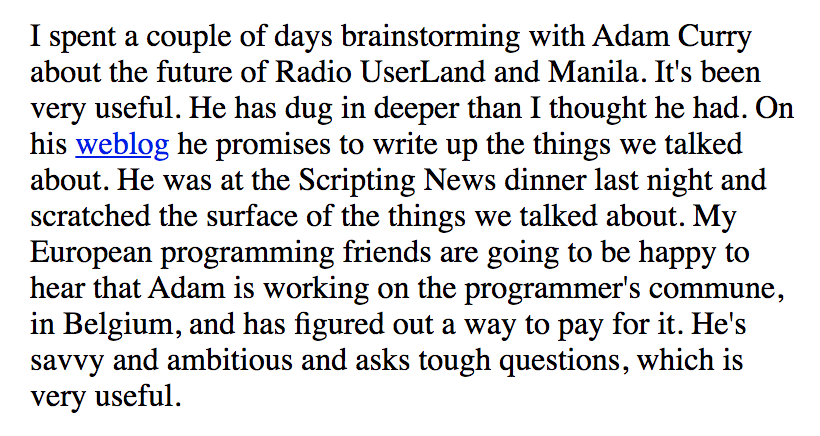
In today's podcast I talk about the 20th anniversary of the idea of podcasting. Not as soon as I thought: October 26, 2020. Having a blog archive is useful. Here's a screen shot of the relevant bit.
Should political ads be banned on social media? AL JAZEERA ENGLISH (AJE)(cached at October 31, 2019, 9:27 pm)

Twitter is banning all political advertising around the world from next month.
Should political ads be banned on social media? AL JAZEERA ENGLISH (AJE)(cached at October 31, 2019, 9:27 pm)

Twitter is banning all political advertising around the world from next month.
Should political ads be banned on social media? AL JAZEERA ENGLISH (AJE)(cached at October 31, 2019, 9:27 pm)

Twitter is banning all political advertising around the world from next month.