Privacy-Respecting Smart Home System Can Work Offline and Sends Fake Data Slashdotby EditorDavid on privacy at January 1, 1970, 1:00 am (cached at October 20, 2019, 11:54 pm)

A publicly-funded group of designers, artists and privacy experts from Amsterdam have designed a smart home system prototype to "prove it's technically possible to build a privacy respecting smart home while maintaining convenience." Its controller uses an Arduino Nano to disconnect the system from the internet during times when it's not in use. They're building everything on Mozilla's open smart home gateway software. The system's microphone is a separate USB device that can be easily unplugged. For extra security, the devices don't even use wifi to communicate. "The Candle devices offer the advantages of a smart home system -- such as voice control, handy automations and useful insights -- without the downsides of sending your data to the cloud and feeling watched in your own home," explains their blurb for Dutch Design Week, where they're launching their prototypes of trust-worthy smart locks, thermostats, and other Internet of Things devices: Most smart devices promises us an easier life, but they increasingly disappoint; they eavesdrop, share our data with countless third parties, and offer attractive targets to hackers. Candle is different. Your data never leaves your home, all devices work fine without an internet connection, and everything is open source and transparent. One of the group's members is long-time Slashdot reader mrwireless, who shares an interesting observation: Smart homes track everything that happens inside them. For developing teenagers, this makes it more difficult to sneak in a date or break the rules in other subtle ways, which is a normal, healthy part of growing up. Candle is a prototype smart home that tries to mitigate these issue. It has given its sensors the ability to generate fake data for a while. In the future, children could get a monthly fake data allowance. Some of the devices have "skirts", simple fabric covers that can be draped over the devices to hide their screen. If you own a dust sensor, this can be useful if your mother in law comes over and you haven't vacuumed in a while.

Read more of this story at Slashdot.

Pro-separatists stage new Barcelona rallies AL JAZEERA ENGLISH (AJE)(cached at October 20, 2019, 11:09 pm)

No sign of the violence that has shaken Barcelona in recent days as crowds block roads on Sunday.
What's next for the Catalan people in Spain? AL JAZEERA ENGLISH (AJE)(cached at October 20, 2019, 11:05 pm)

Following mass march and violent protests, government leaders in Madrid are dismissing Catalan calls for talks.
What's next for the Catalan people in Spain? AL JAZEERA ENGLISH (AJE)(cached at October 20, 2019, 11:05 pm)

Following mass march and violent protests, government leaders in Madrid are dismissing Catalan calls for talks.
What's next for the Catalan people in Spain? AL JAZEERA ENGLISH (AJE)(cached at October 20, 2019, 11:05 pm)

Following mass march and violent protests, government leaders in Madrid are dismissing Catalan calls for talks.
WAV Audio Files Are Now Being Used To Hide Malicious Code Slashdotby EditorDavid on security at January 1, 1970, 1:00 am (cached at October 20, 2019, 10:56 pm)

JustAnotherOldGuy quotes ZDNet: Two reports published in the last few months show that malware operators are experimenting with using WAV audio files to hide malicious code. The first of these new malware campaigns abusing WAV files was reported back in June by Symantec security researchers who said they spotted a Russian cyber-espionage group known as Waterbug (or Turla) using WAV files to hide and transfer malicious code from their server to already-infected victims. The second malware campaign was spotted this month by BlackBerry Cylance. In a report published today and shared with ZDNet last week, Cylance said it saw something similar to what Symantec saw a few months before. But while the Symantec report described a nation-state cyber-espionage operation, Cylance said they saw the WAV steganography technique being abused in a run-of-the-mill crypto-mining malware operation.

Read more of this story at Slashdot.
Domestic workers search for rights amid pro-democracy protests AL JAZEERA ENGLISH (AJE)(cached at October 20, 2019, 10:35 pm)

How the current movement in Hong Kong affects migrant domestic workers and their continued battle for equality.
Domestic workers search for rights amid pro-democracy protests AL JAZEERA ENGLISH (AJE)(cached at October 20, 2019, 10:35 pm)

How the current movement in Hong Kong affects migrant domestic workers and their continued battle for equality.
Hamas decries Israel's participation in Bahrain summit AL JAZEERA ENGLISH (AJE)(cached at October 20, 2019, 10:18 pm)

Palestinian group Hamas condemned Israel's participation in a US-led maritime security meeting in Bahrain.
Mozilla is Sharing YouTube Horror Stories To Prod Google For More Transparency Slashdotby EditorDavid on google at January 1, 1970, 1:00 am (cached at October 20, 2019, 9:51 pm)

CNET reports on a new crowdsourced public awareness campaign: Mozilla is publishing anecdotes of YouTube viewing gone awry -- anonymous stories from people who say they innocently searched for one thing but eventually ended up in a dark rabbit hole of videos. It's a campaign aimed at pressuring Google's massive video site to make itself more accessible to independent researchers trying to study its algorithms. "The big problem is we have no idea what is happening on YouTube," said Guillaume Chaslot, who is a fellow at Mozilla, a nonprofit best known for its unit that makes and operates the Firefox web browser. Chaslot is an ex-Google engineer who has investigated YouTube's recommendations from the outside after he left the company in 2013. (YouTube says he was fired for performance issues.) "We can see that there are problems, but we have no idea if the problem is from people being people or from algorithms," he said.... Mozilla is publishing 28 stories it's terming #YouTubeRegrets; they include, for example, an anecdote from someone who who said a search for German folk songs ended up returning neo-Nazi clips, and a testimonial from a mother who said her 10-year-old daughter searched for tap-dancing videos and ended up watching extreme contortionist clips that affected her body image.

Read more of this story at Slashdot.

'The people are one': Lebanese unite against political elite AL JAZEERA ENGLISH (AJE)(cached at October 20, 2019, 9:48 pm)

Hundreds of thousands take to streets in the biggest protests in four days threatening the coalition government.
Parliament poised for feverish Brexit week: Five things to know AL JAZEERA ENGLISH (AJE)(cached at October 20, 2019, 9:21 pm)

Despite being snubbed by MPs, Johnson believes he has enough support to push new deal through. What might happen next?
Superyacht linked to Malaysia's 1MDB for sale, again AL JAZEERA ENGLISH (AJE)(cached at October 20, 2019, 9:04 pm)

Three hundred-foot vessel linked to 1MDB corruption scandal listed by broker Camper and Nicholsons.
Too many remotes, still Scripting News(cached at October 20, 2019, 8:42 pm)

This started out being a review of the new Apple TV but the real story is same as it ever was, the living room networking situation is still a mess.

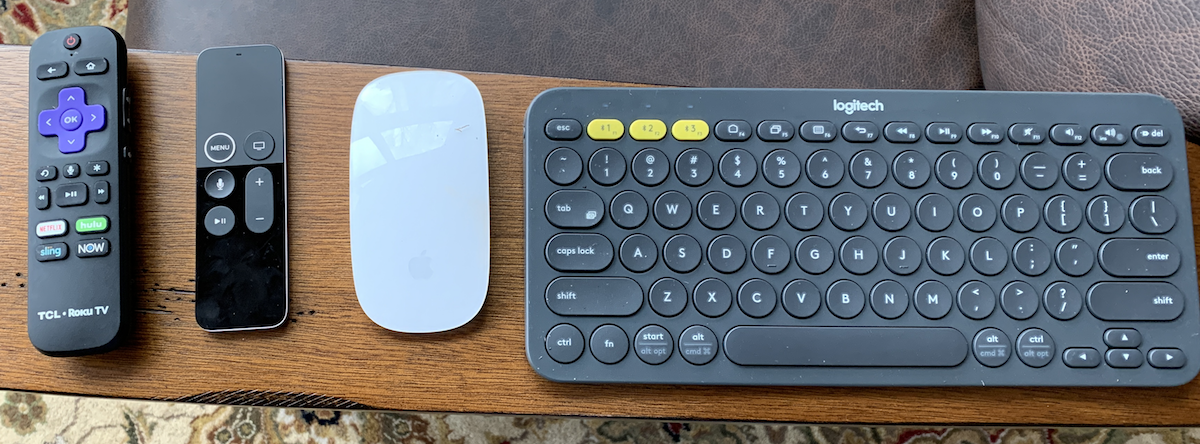
The reason -- too many remotes.

This tale started when the Spectrum app for Roku broke, I could no longer access my favorites. That meant every time I wanted to find a program, I had to fish through all the channels. I've learned over the years which channels I need, basically MSNBC, CNN, HBO, Showtime, the stations that have Law & Order, channels that carry the sports teams I follow. I imagine it's pretty similar for other people. After all these years you develop paths, and program the system accordingly. At this point, I'm not willing to use Spectrum without favorites. But I have been, and it's unacceptable.

Their support is also ridiculous. They want you to jump through the same set of hoops every time no matter what the problem is. I do what they ask, even though I have a theory about what happened. I'm pretty sure they broke something in an upgrade. I can tell I'm using a new version, they made little UI changes, at the same time Favorites stopped working. That's an Occam's Razor type thing. More evidence -- my Favorites are still there on my iPhone, iPad and in the new Apple TV.

Which brings me to why I was interested in Apple TV in the first place. I thought perhaps I could just use Apple TV to access Spectrum, working around the breakage. $199 is a lot of money to spend to do that, but I had an extra HDMI port open on my TV, and I wanted to see what's new there, so why not. I had an old Apple TV, btw -- but the Spectrum app wasn't available for it.

So I've spent a few days with Apple TV, trying to fit it into my routine. But it's not a good fit for mostly UI reasons.

The net-net is that the Apple TV will not get a lot of use. It doesn't have anything over Roku, and they make me put down the Roku remote and pick up theirs. The Apple remote is weird, it doesn't work the way I feel it should. I'm sure they think I'm wrong, but I remember that I'm the customer, and there's an adage that goes with that too.

I'm trying to think but nothing happens!

'How I Compiled My Own SPARC CPU In a Cheap FPGA Board' Slashdotby EditorDavid on hardhack at January 1, 1970, 1:00 am (cached at October 20, 2019, 8:41 pm)

Long-time Slashdot reader ttsiod works for the European Space Agency as an embedded software engineer. He writes: After reading an interesting article from an NVIDIA engineer about how he used a dirt-cheap field-programmable gate array board to code a real-time ray-tracer, I got my hands on the same board -- and "compiled" a dual-core SPARC-compatible CPU inside it... Basically, the same kind of design we fly in the European Space Agency's satellites. I decided to document the process, since there's not much material of that kind available. I hope it will be an interesting read for my fellow Slashdotters -- showcasing the trials and tribulations faced by those who prefer the Open-Source ways of doing things... Just read it and you'll see what I mean. This is the same Slashdot reader who in 2016 reverse engineered his Android tablet so he could run a Debian chroot inside it. "Please remember that I am a software developer, not a HW one," his new essay warns. "I simply enjoy fooling around with technology like this."

Read more of this story at Slashdot.