Seaweed Could Make Cows Burp Less Methane and Cut Their Carbon Hoofprint Slashdotby msmash on science at January 1, 1970, 1:00 am (cached at November 24, 2018, 11:05 pm)

A diet supplemented with red algae could lessen the huge amounts of greenhouse gases emitted by cows and sheep, if we can just figure out how to grow enough. From a report: In a wooden barn on the edge of campus at the University of California, Davis, cattle line up at their assigned feed slots to snatch mouthfuls of alfalfa hay. This past spring, several of these Holstein dairy cows participated in a study to test a promising path to reducing methane emissions from livestock, a huge source of the greenhouse gases driving climate change. By adding a small amount of seaweed to the animals' feed, researchers found, they could cut the cows' methane production by nearly 60%. Each year, livestock production pumps out greenhouse gases with the equivalent warming effect of more than 7 gigatons of carbon dioxide, roughly the same global impact as the transportation industry. Nearly 40% of that is produced during digestion: cattle, goats, and sheep belch and pass methane, a highly potent, albeit relatively short-lived, greenhouse gas. If the reductions achieved in the UC Davis study could be applied across the worldwide livestock industry, it would eliminate nearly 2 gigatons of those emissions annually -- about a quarter of United States' total climate pollution each year. Ermias Kebreab, an animal science professor at UC Davis who leads the work, is preparing to undertake a more ambitious study in the months ahead, evaluating whether smaller amounts of a more potent form of seaweed can cut methane emissions even further. Meanwhile, some businesses have begun to explore what could be the harder challenge: Growing it on a massive scale.

Read more of this story at Slashdot.
Lewisham, London 1977: Notes on fighting fascism AL JAZEERA ENGLISH (AJE)(cached at November 24, 2018, 11:00 pm)

Balwinder Singh Rana, a 71-year-old anti-fascist, recalls the day he and thousands of others took on the National Front.
Science Journals Are Laughing All the Way To the Bank, Locking the Results of Public Slashdotby msmash on money at January 1, 1970, 1:00 am (cached at November 24, 2018, 10:05 pm)

Here is a trivia question for you: what is the most profitable business in the world? You might think oil, or maybe banking. You would be wrong. The answer is academic publishing. Its profit margins are vast, reportedly in the region of 40 per cent. New Scientist: The reason it is so lucrative is because most of the costs of its content is picked up by taxpayers. Publicly funded researchers do the work, write it up and judge its merits. And yet the resulting intellectual property ends up in the hands of the publishers. To rub salt into the wound they then sell it via exorbitant subscriptions and paywalls, often paid for by taxpayers too. The academic publishing business model is indefensible. Practically everybody -- even the companies that profit from it -- acknowledges that it has to change. And yet the status quo has proven extremely resilient. The latest attempt to break the mould is called Plan S, created by umbrella group cOAlition S. It demands that all publicly funded research be made freely available. When Plan S was unveiled in September, its backers expected support to snowball. But only a minority of Europe's 43 research funding bodies have signed up, and hoped-for participation from the US has failed to materialise. Meanwhile, a grass-roots campaign against it is gathering momentum. Plan S deserves a chance.

Read more of this story at Slashdot.

Will Taiwan vote's outcome bring China-friendly party? AL JAZEERA ENGLISH (AJE)(cached at November 24, 2018, 10:00 pm)

Taiwan's midterm vote is seen a test of popularity for the pro-independence ruling party.
[no title] Scripting News(cached at November 24, 2018, 9:33 pm)

People who say they know what Facebook should do. How could they. Nothing like it has ever existed. It’s a miracle that it works at all. This is what I think when critics profess to know what’s wrong and how to fix it.
What's the Next Big Thing in Tech? It's Up To Us Slashdotby msmash on china at January 1, 1970, 1:00 am (cached at November 24, 2018, 9:05 pm)

If it feels like new technologies go from flights of fancy to billion-dollar businesses faster than ever, that's because they do. From a column (which may be paywalled): Consider that Uber, founded in 2009, started allowing drivers to sign up with their own cars in 2013. Five short years later, the company operates in more than 70 countries and competes with dozens of copycats. It's considering going public in 2019 at a potential valuation of $120 billion, which would make it the biggest IPO in U.S. history by far. When novel software can go from hackathon to app store overnight, and even complex hardware can hit manufacturing lines in months, the determining factor of success is us -- as consumers, workers, even regulators. If the pitch works and we bite, a technology can quickly transform our social norms. At the WSJ Tech D. Live conference in Laguna Beach, Calif., this week, what became apparent across dozens of talks, classes and informal chats is that, when almost anything we can dream up is possible, the most important factors in the spread of technology are now cultural. Not every new development in technology leads to an Uber-scale industry, of course, but here are five trends that highlight this shift. China's success in addressing tech needs at home has made it a global leader. As Google struggles with walkouts and morale at Facebook craters, many workers at Chinese startups are so committed to their work that they've adopted a grueling schedule called 996 -- 9 a.m. to 9 p.m., six days a week. In 2018, China will eclipse the U.S. in spending on R&D, projects the National Science Board. Patrick Collison, chief executive of Stripe, talked about how much of Asia is leapfrogging the West because there isn't tons of old infrastructure -- like gas-guzzling car fleets -- to update, so the latest technology catches on right away. In China, this is especially true in payments, which are now overwhelmingly made through mobile phones. The world's leading face-recognition and drone companies are in China, and its electric-vehicle, autonomous-driving and AI companies are already on par with their U.S. counterparts, said Kai-Fu Lee, former president of Google China and current head of technology-investment firm Sinovation Ventures. China's mission rests on techies dedicated to building the future for its billion-plus population -- achieving global technological dominance en route.

Read more of this story at Slashdot.

Same-sex marriage advocates lose Taiwan referendums AL JAZEERA ENGLISH (AJE)(cached at November 24, 2018, 9:00 pm)

Gay rights activists suffer setback, with conservative groups coming out on top in key referendums they initiated.
What you need to know about the crucial EU Brexit summit AL JAZEERA ENGLISH (AJE)(cached at November 24, 2018, 9:00 pm)

European leaders will meet in Brussels on Sunday where they could rubber stamp two Brexit texts.
How A Mysterious Tech Billionaire Created Two Fortunes -- And a Global Software Swea Slashdotby msmash on business at January 1, 1970, 1:00 am (cached at November 24, 2018, 8:05 pm)

An anonymous reader writes: Forbes magazine has an in-depth piece on Joe Liemandt. As you may be aware, Liemandt was the founder of Trilogy, a startup which has been credited to help put Austin on the tech map. He is also founder of ESW Capital, a private equity firm that is scooping up software startups left and right. Forbes called him "one of the most mysterious and innovative figures in technology." But the story explores the approach Liemandt and his team took to acquire enterprise software companies, install new leadership, lay off staff and hire significantly cheaper tech labor abroad. And the numbers are compelling -- $15 an hour C++ programmers. Those are Amazon warehouse wages -- and those $15 programming gigs don't come with much for benefits. Plus, they require you to install software to your computer that tracks surfing, keystrokes and even takes screen grabs and photos via your computer's camera -- and this is typically on a gig worker's personal computer, not an employers' machine. The story opens with this: From an office suite on the 26th floor of the iconic Frost Bank Tower in Austin, Texas, a little-known recruiting firm called Crossover is searching the globe for software engineers. Crossover is looking for anyone who can commit to a 40- or 50-hour workweek, but it has no interest in full-time employees. It wants contract workers who are willing to toil from their homes or even in local cafes. "The best people in the world aren't in your Zip code," says Andy Tryba, chief executive of Crossover, in a promotional YouTube video. Which, Tryba emphasizes, also means you don't have to pay them like they are your neighbors. "The world is going to a cloud wage." Tryba's video has 61,717 views, but he is no random YouTube proselytizer. He worked in sales at Intel for 14 years before serving in the White House as an advisor to President Obamaâ(TM)s Council on Jobs and Competitiveness. Since 2014, Tryba has been the right-hand man of Joe Liemandt, one of the most mysterious and innovative figures in technology. In the 1990s Liemandt was the golden boy of enterprise software, a 30 Under 30 wunderkind before there was a Forbes 30 Under 30 list. Like Bill Gates before him, he dropped out of college, in his case Stanford, to start a company, Trilogy, and build his fortune. In 1996, at the age of 27, he made the cover of Forbes, and a few months later he appeared as the youngest self-made member of The Forbes 400, with a $500 million net worth.

Read more of this story at Slashdot.

Zimbabwe's Robert Mugabe no longer able to walk AL JAZEERA ENGLISH (AJE)(cached at November 24, 2018, 7:00 pm)

The 94-year-old ex-president of Zimbabwe is in Singapore for treatment and is expected to return home later this month.
Taiwan president quits party leadership after polls setback AL JAZEERA ENGLISH (AJE)(cached at November 24, 2018, 7:00 pm)

President Tsai Ing-wen resigns as DPP leader after it suffers major defeats in key local polls.
Microsoft Briefly Overtakes Apple as Most Valuable US Company Slashdotby msmash on microsoft at January 1, 1970, 1:00 am (cached at November 24, 2018, 6:35 pm)

Microsoft briefly overtook Apple as the world's most valuable listed company, fulfilling what it almost did eight years ago and adding a feather on the cap on CEO Satya Nadella. From a report: Redmond, Washington-headquartered Microsoft had a market cap of $753.34 billion, beating out the iPhone maker's $746.82 billion in intra-day trade on Friday at the Nasdaq in New York. Apple, however, regained control at the close. According to the Nasdaq website, Apple's market cap rose back up to $817.58 billion. Right behind it is Microsoft, which also increased to $791.19 billion. Tech companies have undergone some rough times recently. In particular, the so-called FAANG group -- Facebook, Amazon, Apple, Netflix and Google (Alphabet) -- had, as at November 20, combined market cap losses of over $1.02 trillion from their recent highs.

Read more of this story at Slashdot.

[no title] Scripting News(cached at November 24, 2018, 6:33 pm)

When I use my own apps and Chrome shows NOT SECURE in red, I realize they are warning me, not about my security but their intentions toward the web.
[no title] Scripting News(cached at November 24, 2018, 6:33 pm)

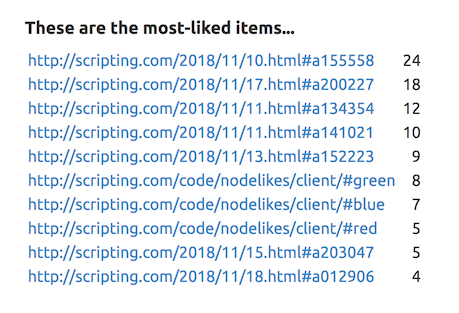
New feature. The home page of my Likes server now includes a list of the 10 most-liked posts. Yes, I know titles would be nice to have. Most of my posts don't have titles. Also released a new version of the Likes server with this feature included.
Amazon Rainforest Deforestation 'Worst in 10 Years', Says Brazil Slashdotby msmash on earth at January 1, 1970, 1:00 am (cached at November 24, 2018, 6:06 pm)

Deforestation of the Amazon rainforest in Brazil has hit its highest rate in a decade, according to official data. BBC reports: About 7,900 sq km (3,050 sq miles) of the world's largest rainforest was destroyed between August 2017 and July 2018 -- an area roughly five times the size of London. Environment Minister Edson Duarte said illegal logging was to blame. The figures come amid concerns about the policies of Brazil's newly elected president, Jair Bolsonaro. During the 2018 election campaign, Mr Bolsonaro pledged to limit fines for damaging forestry and to weaken the influence of the environmental agency. An aide for the president-elect has also announced the administration will merge the agriculture and environment ministries, which critics say could endanger the rainforest. The latest government data says most of the deforestation occurred in the states of Mato Grosso and Para, and marked a 13.7% rise over last year's figures. Mato Grosso is the top producer of grains in Brazil, and critics say expanding agriculture is also encroaching on the rainforest.

Read more of this story at Slashdot.