Read more of this story at Slashdot.
Union Square Ventures has a new home, and it's a dandy! :-)
Down the left edge is a news flow that works more or less like Hacker News. Anyone can submit a link, upvote or comment. Comments are managed by Disqus, a USV company, btw (we also use Disqus here for comments).
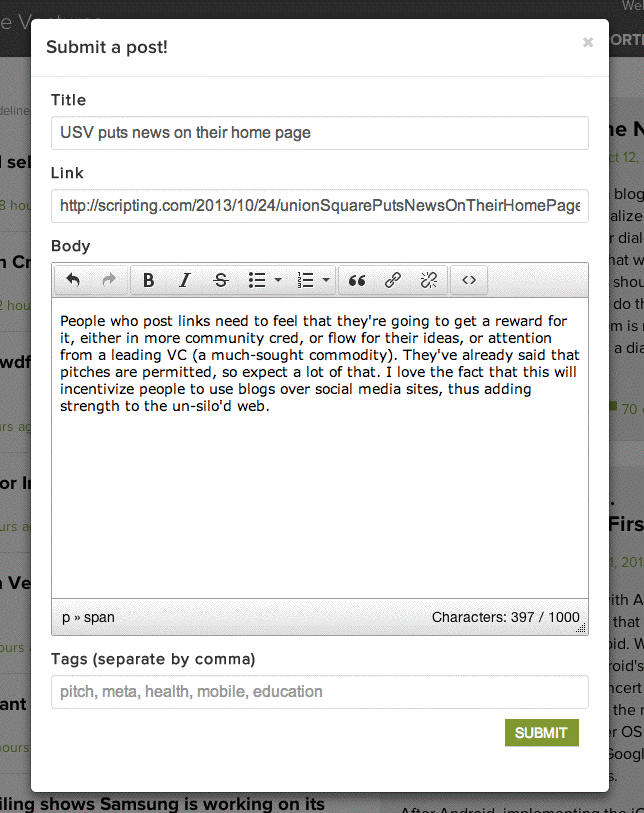
There are the usual three components to a post: title-link-description. You can add tags. You can view the news flow in either reverse-chronologic order or ranked by number of votes.
The community is small, so the ranked page is not so interesting at least not yet. And there aren't many people submitting links. They've had ten submissions so far today, as I write this as 10:15AM on a Thursday. But it's only been around for 12 days, and Fred Wilson's blog has a sizeable audience to tap. I'm guessing the word really hasn't spread yet. (A side-effect of there being no culture of software reviews in tech.)
They have an RSS feed for the newest stuff and another that has just the hot ones. I added the full feed to my personal river, so if you watch that for your news, you'll automatically get all the links in the USV flow. Oddly the white-on-orange RSS icon in the upper-right corner of their home page does not lead to a feed. This is a bad idea. What little consistency there is in the RSS world should be preserved.
I asked a series of questions yesterday to find out how their editorial flow works, and in the process learned a bunch about how it was implemented. Nick Grossman, who developed the software says "The app is python + tornado + redis + mongodb + bootstrap + jquery." They say it will be released with an open source license. There is a bookmarklet and an Android app, Chrome extension and they're working on a Firefox extension. I imagine that Fred Wilson's dislike of iPhones is responsible for the lack of an iOS app? :-)
Why this is significant
News organizations take note
Lots of responses and unprecedented traffic for Tuesday's Apple/NSA piece.
In a comment on that post, Tom Nemec expressed a fairly common idea about journalism.
My response, which I wanted to get into a separate post:
I’ve always written my if statements like this:
if (something)
doAThing();
That is — no braces when the code under the if is just one line.
That’s never, not even once, been a problem for me. Never caused a bug.
And, as a relentless cutter, a simplifier by temperament, I like it because it means I can do without a couple braces. Though it doesn’t make a difference to the generated code, it does means less actual characters in the source file, and it saves a line for the closing brace.
But I recently changed my mind. Now I write it like this:
if (something) {
doAThing();
}
And for the same reason: for the reason of simplification.
It’s simpler because it removes a special case, which means I no longer have to notice that it’s one line or multiple lines and add or delete braces as needed. I’ve simplified what my brain has to do at the cost of some more braces in the source code. I can live with that trade-off.
(Second reason: it’s likely that I was the last Cocoa coder to omit the braces on these statements, and I’ve learned the hard way that other people are going to work on my code some day. Even with Vesper we’ve had Doug Russell work on the code, on accessibility.)
PS But you know what I’m never going to do? Write methods like this:
- (void)doSomething
{
doAThing();
}
I absolutely cannot bear that extra line for the opening brace. It gives me gas. I’ll often — usually, even — put a blank line there, but a blank line is nice and clean. A line with just an opening brace is like a fingernail on the page. (And it ruins the clean left edge of - to open and } to close.) Instead I’d write it like this:
- (void)doSomething {
doAThing();
}
PPS Reasonable people may disagree. It’s a cinch that unreasonable people will also disagree.
Read more of this story at Slashdot.